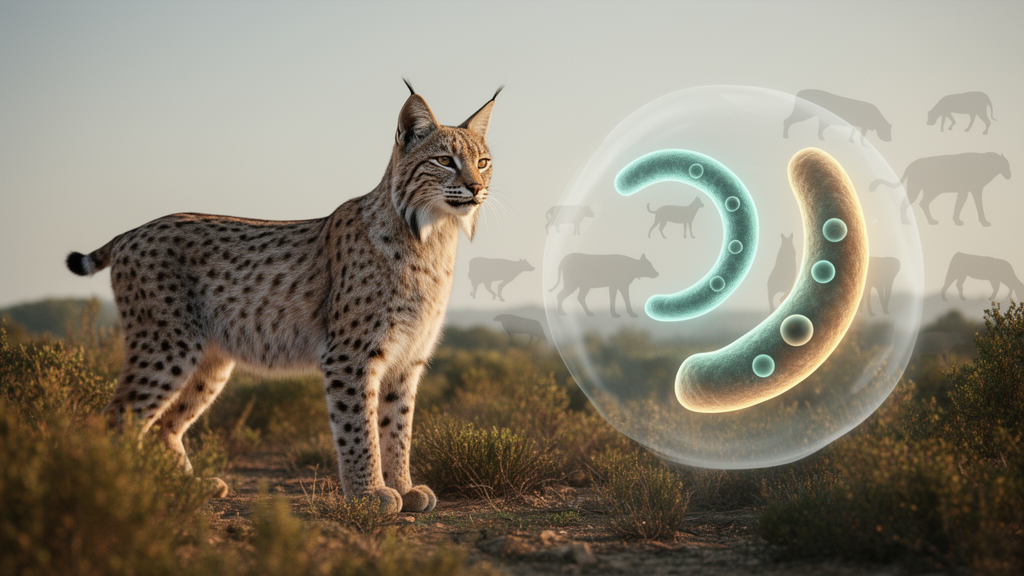
Nearly half of the Iberian lynxes tested in a new study carried antibodies against Toxoplasma gondii, and genetic analysis of the parasites recovered from these endangered cats points to a close connection between the strains circulating in wild animals and those found in domestic hosts across the Iberian Peninsula.
The Iberian lynx (Lynx pardinus) is one of the world’s most endangered felid species. Until now, researchers had made no attempt to isolate viable T. gondii from the species or to identify which genotypes circulate in it. The new study set out to estimate the extent of T. gondii infection in Iberian lynxes, to genotype strains from wild and captive lynxes in the Iberian Peninsula, and to determine how much genetic overlap exists with strains previously characterized from other wild and domestic animals in the same region.
The team screened lynx sera for anti-Toxoplasma antibodies using a modified agglutination test together with a western-blot assay, two methods that showed high agreement with each other. The presence of T. gondii in muscle tissue was determined by quantitative PCR, and a mouse bioassay was used to isolate live strains from positive animals.
The results showed a substantial infection burden in the species. Anti-T. gondii antibodies were detected in 44.2 percent of lynxes tested, or 238 of 538 animals. T. gondii DNA was present in tissue samples from 17 percent of 176 animals examined. Viable parasites were successfully isolated from the tissues of six out of 44 individuals whose serological status was unknown.
Genetic characterization of the isolates revealed a limited set of lineages. By PCR-RFLP, the researchers identified genotype ToxoDB #3 in five of the six isolates and genotype #2 in the remaining one. Subsequent microsatellite subtyping refined this picture, identifying five Type II variants and one Type III variant among the isolates. An additional attempt at direct microsatellite typing of three T. gondii DNA-positive tissue samples allowed the identification of one further Type II variant.
The researchers also genotyped virulence-related markers, including GRA7, CS3, and ROP5/ROP18. This complementary analysis showed the presence of alleles previously associated with intermediate-to-non-virulent strain phenotypes, indicating that the parasites carried by lynxes belong to lineages not characterized by the highly virulent profiles described for some other T. gondii strains.
Phylogenetic analyses demonstrated genetic proximity between the lynx-derived strains and strains previously identified in other wild and domestic animals in the Iberian Peninsula. This overlap in genotypes is the basis for the study’s central conclusion about interconnection: the same or closely related parasite lineages appear to move between wild felids, other wildlife, and domestic animals sharing the same landscape.
The authors conclude that Iberian lynxes contribute to the genetic diversity of T. gondii observed in the study area, and that a notable degree of interconnection between wild and domestic cycles of the parasite is evident when strains from different compartments of the One Health approach are compared.
Subject of Research: Toxoplasma gondii infection frequency and strain genotyping in Iberian lynxes
Article Title: High frequency of Toxoplasma gondii infections in vulnerable Iberian lynxes shows high degree of interconnection between the strains circulating in wild and domestic hosts in the Iberian Peninsula
Article References: Calero-Bernal, R., Salas-Fajardo, M. Y., Fernández-Escobar, M., Huertas-López, A., Castro-Scholten, S., Caballero-Gómez, J., Nájera, F., Crespo, E., García-Talens, A., Grande-Gómez, R., Zorrilla, I., Fernández-Verón, I., Peña, J., Palacios, M. J., González-Barrio, D., Habela, M. Á., López, G., Salcedo, J., Serra, R., … Ortega-Mora, L. M. (2026). High frequency of Toxoplasma gondii infections in vulnerable Iberian lynxes shows high degree of interconnection between the strains circulating in wild and domestic hosts in the Iberian Peninsula. Parasites & Vectors. https://doi.org/10.1186/s13071-026-07749-8
Image Credits: AI Generated
DOI: 10.1186/s13071-026-07749-8
Keywords: Toxoplasma gondii, Iberian lynx, Lynx pardinus, parasite genotyping, PCR-RFLP, microsatellite typing, One Health, Iberian Peninsula, endangered felids, wildlife disease, High, frequency
News Source: Kristina Jarvis. (October 27, 2026). Toxoplasma gondii found in nearly half of Iberian lynxes tested, with strains linked to wild and domestic hosts. Scienmag.