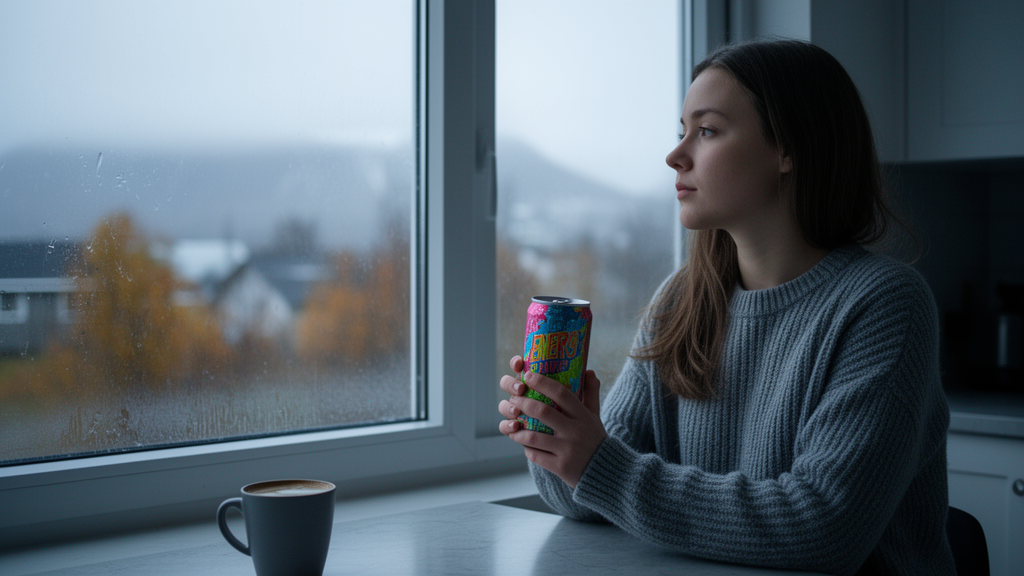
Energy drink consumption, but not coffee, was associated with more depressive symptoms in autumn than in summer, according to a study published in BMC Public Health that tracked Icelandic adults across all four seasons. Participants reported how often they consumed energy drinks and coffee using a food frequency questionnaire, described their circadian preference with the Morningness–Eveningness Questionnaire, rated insomnia symptoms on the Bergen Insomnia Scale, and completed the depression subscale of the Depression Anxiety Stress Scales. The design addressed a gap that previous work had left open.
Evening chronotypes are known to report more insomnia and depressive symptoms and to drink energy drinks more often, while shrinking autumn and winter daylight is independently linked to poorer sleep and mood. But no earlier study had examined how energy drink intake, circadian preference and seasonal daylight change jointly relate to insomnia and depressive symptoms, or whether any such association is specific to energy drinks rather than to caffeine more broadly. Iceland’s extreme seasonal swing in daylight made it a natural laboratory for the question.
The results were deliberately cautious. In cross-sectional analyses using multiple linear regression, energy drink intake frequency was associated with insomnia, but this association did not survive correction for multiple comparisons. Coffee showed no association with insomnia at either analytical stage, a contrast that hints the energy drink signal is not simply a caffeine story.
The longitudinal picture, modelled with linear mixed-effects models that follow the same people across seasons, proved more informative. Both energy drink and coffee intake showed interactions with autumn and with circadian preference in predicting depressive symptoms before statistical correction. After correction for multiple comparisons, however, only one result held: the interaction between energy drink intake and autumn.
In plain terms, the link between energy drink frequency and depressive symptoms was stronger in autumn, when daylight is falling rapidly, than in summer, and coffee did not show the same pattern. The chronotype angle is where the story becomes most tantalising and most tentative. Before correction, the seasonal energy drink effect appeared more pronounced among evening types, the people whose body clocks run late and who are already more vulnerable to insomnia and low mood.
That chronotype-specific pattern did not remain statistically significant after correction in the primary analyses. A supplementary categorical analysis, however, provided additional support for the possibility that evening types who frequently consume energy drinks form a group worth watching, particularly during periods of rapid seasonal decline in daylight. The authors are careful about what these findings do and do not establish.
The study is observational and relies on self-report, so it cannot show that energy drinks cause depressive symptoms, nor can it rule out reverse pathways, such as people with low mood or disturbed sleep reaching for energy drinks. The published version is also an accepted-manuscript release that remains subject to final editorial edits. If the autumn association were merely a marker of caffeine intake, coffee should have shown it too; it did not.
The practical implication the authors draw is methodological as much as clinical: studies of energy drinks and mental health should account for circadian preference and seasonal context, because a summer-only snapshot could miss or misestimate the association. Their conclusions support continued public health attention to energy drink consumption, with evening types during the autumn light decline flagged as a priority for further investigation rather than as a settled risk group. Whether the autumn energy drink signal reflects disrupted sleep, light-driven mood changes, the pharmacology of the drinks themselves, or some combination of the three remains an open question, and the authors are explicit that their evidence points toward further study rather than a verdict.
Subject of Research: Seasonal and chronotype-specific associations between energy drink consumption and depressive symptoms in Icelandic adults
Article Title: Energy drink consumption and depressive symptoms in Iceland: associations with season and circadian preference
Article References: Zelinski, L., Ólafsson, R. P., & Höller, Y. (2026). Energy drink consumption and depressive symptoms in Iceland: associations with season and circadian preference. BMC Public Health. https://doi.org/10.1186/s12889-026-29704-z
Image Credits: AI Generated
DOI: 10.1186/s12889-026-29704-z
Keywords: energy drinks, depressive symptoms, insomnia, circadian preference, chronotype, seasonal daylight, Iceland, coffee, BMC Public Health, public health, longitudinal study, mental health
News Source: Glenn Wilkins. (October 27, 2026). Energy drinks, not coffee, linked to autumn blues in Icelandic study. Scienmag.