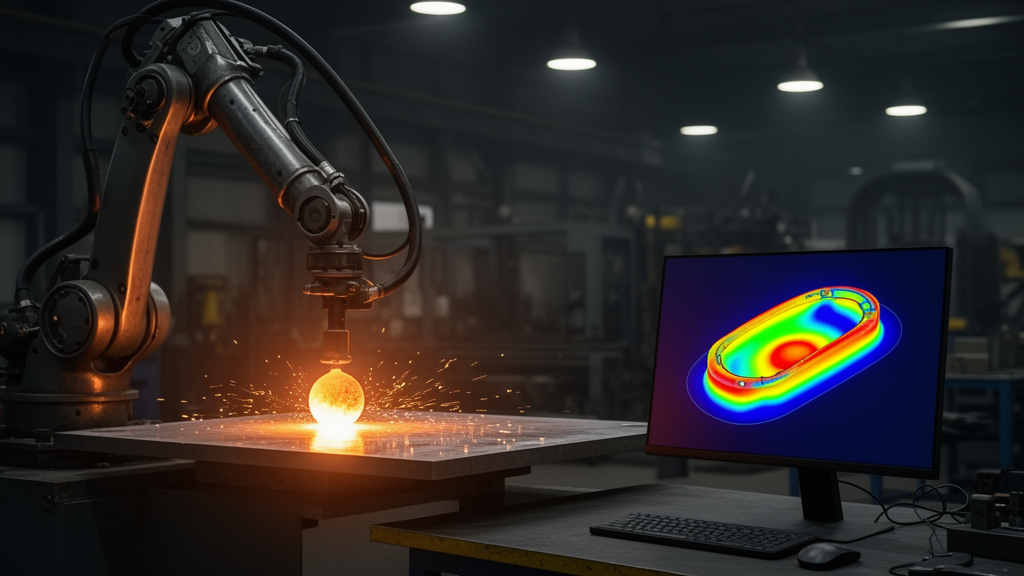
Engineers building metal parts with wire arc additive manufacturing, or WAAM, often spend hours waiting for a single thermal simulation to finish. A new study reports a way to compress that burden dramatically: a machine learning surrogate model, trained on just 120 high-fidelity simulation snapshots, that reproduces thermocouple temperature curves in milliseconds and helps identify the uncertain parameters that make simulations match real experiments. The work, published in Advanced Modeling and Simulation in Engineering Sciences, was carried out by an international team within the European PIONEER project, combining experimental campaigns at the AIMEN Technology Center with detailed thermal simulations of steel walls built layer by layer.
WAAM uses an electric arc to melt and deposit metallic wire, building large components with high deposition rates. Temperature evolution during the process governs microstructure formation, residual stresses and defect generation, so predicting it accurately is central to process control. Full three-dimensional finite-element models can capture these thermal histories, but each run takes several hours, which limits how many parameter combinations engineers can realistically explore when tuning a model to reproduce measured temperatures.
The researchers focused on three parameters that strongly shape the thermal response but are difficult to measure directly: the surface heat transfer coefficient, the process efficiency or absorptivity that describes how much of the electrical arc power actually enters the material, and the dwell time between layers. Their simulations used a three-dimensional transient heat-transfer model in OpenFOAM, with a volumetric heat source representing the arc energy input and a layer-activation scheme that switches on each deposited layer after the previous one has completed its activation and dwell periods. The computational domain contained 14,994 cells, with refined meshes in the first and final layers of the wall.
Before building the surrogate, the team calibrated the OpenFOAM model itself against pyrometer measurements taken at the end of each deposited layer. Through an iterative tuning procedure with discrete parameter steps of 20, they found a heat source efficiency of 60 percent and a lumped heat-transfer coefficient of 60 watts per square meter per kelvin, achieving a maximum mean absolute percentage error of 15 percent between simulation and experiment. That coarse step size, however, was dictated by cost: a finer resolution of one unit would have required far more multi-hour simulations than was feasible, and this limitation directly motivated the reduced-order model.
The design of experiments behind the surrogate was deliberately economical. The three parameters spanned heat transfer coefficients from 10 to 100 watts per square meter per kelvin, efficiencies from 50 to 95 percent, and dwell times from 30 to 240 seconds. For each of the five dwell times used in the physical experiments, the team sampled the four boundary combinations of efficiency and heat transfer coefficient, then added eight interior points by Latin Hypercube Sampling. Another 60 sampling points covered the full three-dimensional parameter space, including dwell times outside the experimental set. In total, 120 simulations were generated, with 17 randomly selected interior cases reserved for testing.
Handling the raw simulation output posed its own challenge. Each simulation produced 24,000 time steps at half-second intervals over a standardized 12,000-second window, with shorter runs extended using Newton’s law of cooling. Fully connected neural networks overfitted on the small dataset, and tree-based regressors applied directly to the full time series could not cope with the output dimension. The solution was Proper Orthogonal Decomposition, which compressed each temperature curve into 35 modal coefficients, with reconstruction errors typically below 0.5 percent. An XGBoost regressor then learned to predict those 35 coefficients from the parameter triple, using a shallow tree depth of three, a learning rate of 0.05, and explicit L1 and L2 regularization to control overfitting.
The accuracy figures are striking. Across all training and testing cases, every predicted temperature fell within a tolerance band of plus or minus 20 degrees Celsius of the OpenFOAM reference. The average root-mean-square error was about 2 degrees Celsius on training data and about 5 degrees Celsius on withheld testing data from the same experimental setup, with average relative errors near 1 percent and maxima not exceeding 3 percent. The model even predicted thermal responses for dwell times not present in the experiments, such as a case at 36 seconds, despite having less training data in those intermediate regions.
Generalization was tested on a second, independent experimental setup. The two setups differed in wire material, wall geometry, build height and thermocouple position, though all other process parameters were identical. On 12 testing cases from the second setup at a fixed dwell time of 60 seconds, all predictions again stayed within the 20-degree corridor, with an average root-mean-square error of about 9 degrees Celsius and relative errors below 2 percent on average. The authors note this is a preliminary assessment of robustness, since the two materials are similar low-alloy steels and the simulation does not resolve alloy-dependent melting or flow behavior.
The computational payoff is considerable. Generating the 120 training snapshots required more than 300 hours of simulation on a computing cluster with 48-core nodes, whereas a trained surrogate infers all 120 cases in milliseconds. A companion experiment showed why the full dataset matters: when the model was retrained on only 64 snapshots, training accuracy stayed high, but testing errors grew, with an average root-mean-square error of about 7.5 degrees Celsius and individual cases reaching 30 degrees Celsius. The richer 120-snapshot dataset was therefore critical for the bounded, engineering-level accuracy the method targets.
Finally, the team used the surrogate to calibrate the simulation parameters against experimental thermocouple curves, sweeping efficiency and heat transfer coefficient at unit resolution for each dwell time. For the first setup, the globally calibrated pair was an efficiency of 57 percent and a heat transfer coefficient of 25 watts per square meter per kelvin; for the second setup it was 51 percent and 30. The two sets are close, and the first setup’s global calibration remained competitive when applied to the second, though the authors stress that these are effective, lumped values rather than uniquely identifiable physical quantities, and that the approach applies to similar parts and conditions rather than serving as a universally transferable calibration.
Subject of Research: A machine learning reduced-order model for calibrating thermal simulations in wire arc additive manufacturing
Article Title: Machine learning-based reduced order modeling for thermal simulation calibration in wire arc additive manufacturing
Article References: Tannous, M., Elsayed, M., Elmansy, A., López, A., Rosero-Montalvo, P. D., Fouad, D., Attallah, M., Megahed, M., Ghnatios, C., & Chinesta, F. (2026). Machine learning-based reduced order modeling for thermal simulation calibration in wire arc additive manufacturing. Advanced Modeling and Simulation in Engineering Sciences, 13(1), Article 23. https://doi.org/10.1186/s40323-026-00341-w
Image Credits: AI Generated
DOI: 10.1186/s40323-026-00341-w
Keywords: wire arc additive manufacturing, reduced order modeling, machine learning, Proper Orthogonal Decomposition, XGBoost, thermal simulation, model calibration, OpenFOAM, heat transfer coefficient, process efficiency, surrogate modeling, WAAM
News Source: Denise Maddox. (October 27, 2026). Machine learning surrogate slashes cost of calibrating WAAM thermal simulations. Scienmag.