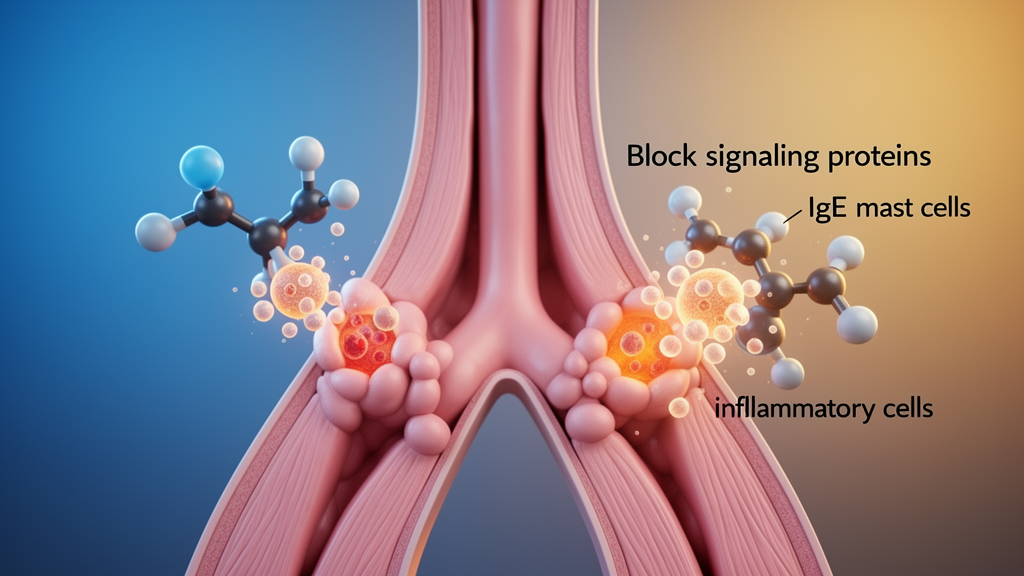
Two of the most widely prescribed biologic drugs for moderate-to-severe asthma appear to deliver similar short-term clinical benefits, yet leave opposite fingerprints on a key immune marker, according to a retrospective real-world study from China. Adults treated with omalizumab, an anti-IgE therapy, and those treated with dupilumab, an interleukin-4 receptor alpha blocker, both showed meaningful gains in asthma control and lung function over their first four months of treatment. But serum total IgE rose in the omalizumab group while falling in the dupilumab group, a divergence the researchers attribute to the drugs’ fundamentally different pharmacodynamic mechanisms rather than to any difference in therapeutic performance.
The study, conducted at the Department of Allergy of the Second Affiliated Hospital of Zhejiang University School of Medicine in Hangzhou, included 72 adults with moderate-to-severe asthma who began either omalizumab (48 patients) or dupilumab (24 patients) between January 2024 and December 2025 and remained on their index biologic through an assessment at approximately four months, defined as 16 plus or minus 4 weeks. Outcomes were collected from electronic medical records at baseline, at the four-month visit, and, where available, at approximately 12 months. Because treatment assignment was made by treating physicians as part of routine care rather than by randomization, the comparison is exploratory by design, and the authors emphasize that all reported P values are nominal, with no adjustment for multiple comparisons.
Eligible patients were adults diagnosed with moderate-to-severe asthma under Global Initiative for Asthma guidelines who required medium- to high-dose inhaled corticosteroids combined with a long-acting beta2-agonist, with or without a leukotriene receptor antagonist, to achieve or maintain control, or who had persistent symptoms despite such therapy. Patients with clinically important coexisting respiratory diseases such as chronic obstructive pulmonary disease, bronchiectasis, or interstitial lung disease were excluded, as were those with previous biologic therapy, allergen immunotherapy, or other systemic immunomodulatory treatment. Pregnancy, lactation, and active malignancy were also exclusion criteria. Notably, the cohort consisted of four-month completers, a restriction the authors acknowledge may bias effectiveness and safety estimates.
The two treatment groups differed in ways that reflect phenotype-guided prescribing in routine practice. Patients receiving omalizumab were younger on average, at 37 plus or minus 12 years versus 45 plus or minus 12 years for dupilumab (P = 0.011). Aeroallergen sensitization, assessed by serum allergen-specific IgE testing, was present in 44 of 47 omalizumab-treated patients with available results (93.62 percent) but only 10 of 21 dupilumab-treated patients (47.62 percent), a highly significant difference. Dust mite and animal dander sensitization were each more common in the omalizumab group. Conversely, atopic dermatitis was far more frequent among dupilumab recipients, affecting 62.5 percent versus 14.6 percent of the omalizumab group (P < 0.001). No significant baseline differences were seen in sex, body mass index, asthma duration, baseline Asthma Control Test score, blood eosinophil count, serum total IgE, fractional exhaled nitric oxide, or pulmonary function indices.
On treatment, both groups improved. Asthma Control Test scores rose from a median of 21 to 24 in the omalizumab group and from 21.5 to 24.5 in the dupilumab group, with within-group changes significant at P < 0.001 in both cases. Percent-predicted forced expiratory volume in one second increased significantly in each group, and improvements were also observed in FEV1, the FEV1/FVC ratio, forced expiratory flow at 25 to 75 percent of forced vital capacity, and its percent-predicted value. In the omalizumab group, blood eosinophil count, fractional exhaled nitric oxide measured at 50 mL/s, and nitric oxide measured at 200 mL/s all decreased significantly, while total IgE increased. In the dupilumab group, total IgE and FeNO50 decreased, but no statistically significant changes in eosinophil count or the other nitric oxide parameters were detected.
The most striking divergence was in serum total IgE. Among patients with paired measurements, median total IgE climbed from 176 IU/mL at baseline to 328 IU/mL at four months in the omalizumab group, while it fell from 133 IU/mL to 48.8 IU/mL in the dupilumab group. Adjusted linear mixed-effects models, which accounted for age, sex, atopic dermatitis, and binary aeroallergen sensitization, confirmed a significant treatment-by-time interaction for log-transformed total IgE (P < 0.001), whereas neither the treatment-group effect nor the time effect alone was significant for this biomarker. The authors explain the biology: omalizumab forms IgE-anti-IgE complexes that can raise measured total IgE even as free IgE activity declines, whereas dupilumab’s blockade of IL-4/IL-13 signaling can suppress IgE class switching and production.
In the adjusted models covering the baseline-to-four-month window, ACT score and percent-predicted FEV1 both improved over time (P < 0.001 and P = 0.002, respectively), without significant treatment-group effects or treatment-by-time interactions. Exploratory models incorporating available 12-month measurements showed a similar overall pattern, though follow-up at that time point was sparse: only 23 omalizumab-treated and 6 dupilumab-treated patients had ACT data at 12 months, and just one dupilumab-treated patient contributed a total IgE measurement at that visit, which the authors say was insufficient to characterize a reliable 12-month IgE trajectory in that group. Among the 43 patients without on-treatment 12-month data, 19 omalizumab-treated and 15 dupilumab-treated patients had discontinued the index biologic, while 6 and 3 patients, respectively, had switched, mainly citing insufficient perceived benefit or persistent comorbid symptoms.
Recognizing that baseline differences could confound any comparison, the researchers also attempted a post hoc feasibility assessment of a clinical overlap population: patients who, based on pretreatment information, could reasonably have been candidates for either drug. This required clinically relevant aeroallergen sensitization and a total IgE-body weight combination within the approved omalizumab dosing table, plus at least one feature supporting dupilumab, such as a blood eosinophil count of at least 0.15 x 10^9/L, FeNO50 of at least 25 ppb, or maintenance systemic corticosteroid use. Only 41 of the 72 patients met these concurrent criteria, 33 treated with omalizumab and 8 with dupilumab. Because the groups were small and markedly unbalanced and paired follow-up measurements were sparse, particularly in the dupilumab group, no formal restricted outcome comparison was performed.
Safety signals in the cohort were limited. Adverse events were documented in three omalizumab-treated patients (6.3 percent), consisting of injection-site swelling and transient urticaria-like reactions. No adverse events were documented in the dupilumab group, and no severe hypersensitivity reactions or treatment-related deaths occurred in either group. However, the authors caution that the sample size and follow-up duration were insufficient for a reliable comparative safety assessment or for detecting uncommon adverse events. Maintenance systemic corticosteroid use, recorded in three patients in each group at baseline, was not recorded at the four-month visit or among patients assessed at 12 months.
The study’s limitations are substantial and clearly stated. The retrospective, single-center design and modest, unequal group sizes limit precision and generalizability, and the findings describe patients who continued treatment through four months under routine clinical selection rather than a randomized comparison. Non-random allocation, residual confounding by specific sensitization profiles despite adjustment, incomplete measurements with possible informative missingness, and incompletely documented changes in background asthma therapy and topical atopic dermatitis treatment all constrain interpretation. The authors also note they did not assess whether IgE changes predicted clinical improvement or could guide treatment monitoring or biologic selection. Within those boundaries, the message is straightforward: in this cohort, both biologics were associated with better asthma control and lung function at four months, with no clear between-group differences, and their opposing effects on measured total IgE are consistent with known pharmacology rather than with differential efficacy. Larger prospective multicenter studies with more complete follow-up and standardized outcome collection, the authors conclude, are needed to validate these exploratory findings.
Subject of Research: Real-world comparison of omalizumab and dupilumab treatment outcomes and total IgE changes in adults with moderate-to-severe asthma
Article Title: Clinical outcomes and total IgE changes with omalizumab and dupilumab in moderate-to-severe asthma: a retrospective real-world cohort study
Article References: Chen, Y., Yang, B., Yao, W., Diao, R., Wang, Y., Li, B., Li, T., Ge, L., Hu, Y., & Wang, H. (2026). Clinical outcomes and total IgE changes with omalizumab and dupilumab in moderate-to-severe asthma: a retrospective real-world cohort study. Frontiers in Medicine, 13, Article 1964856. https://doi.org/10.3389/fmed.2026.1964856
Image Credits: AI Generated
DOI: 10.3389/fmed.2026.1964856
Keywords: asthma, omalizumab, dupilumab, biologic therapy, immunoglobulin E, asthma control test, lung function, blood eosinophils, fractional exhaled nitric oxide, real-world cohort, type 2 inflammation, atopic dermatitis
News Source: Ophelia Keating. (October 27, 2026). Asthma biologics omalizumab and dupilumab both ease symptoms but move IgE in opposite directions. Scienmag.