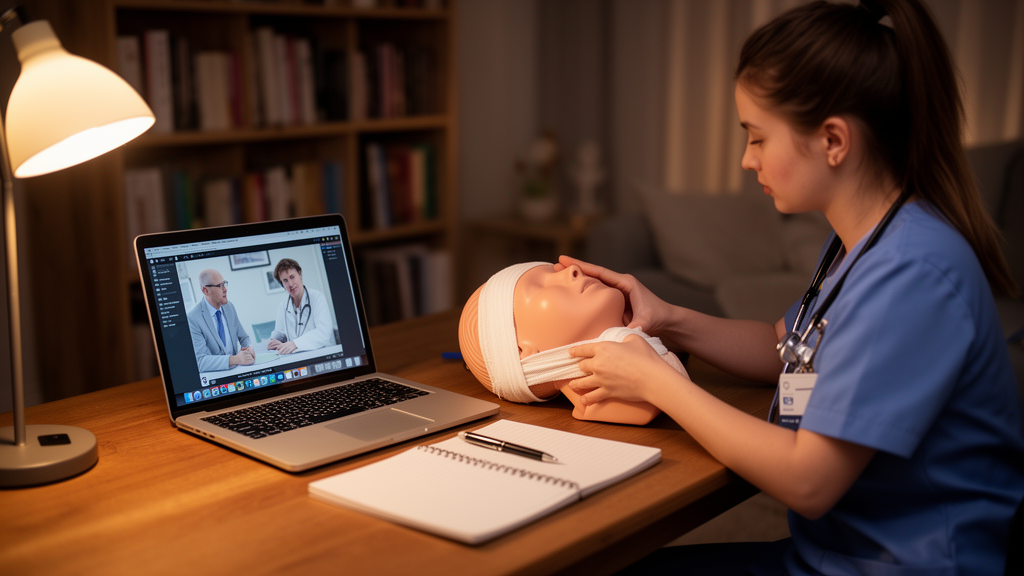
Nursing students trained through an online flipped classroom combined with case-based learning performed as well as, and in some reasoning tasks slightly better than, students taught through traditional on-site simulation, according to a quasi-experimental study published in BMC Medical Education. The research focused on the primary survey for neurotrauma care, the rapid ABCDE assessment sequence covering airway, breathing, circulation, disability and exposure that nurses must master when patients arrive with traumatic brain or spinal cord injuries. The study, conducted by Natthacha Chiannilkulchai and Pichaya Thongpo, compared two cohorts of third-year nursing students.
The intervention group consisted of 114 students enrolled in the 2022 academic year who learned through an online flipped classroom paired with case-based learning. The comparison group was a historical control: records from 110 learners from the previous cohort who had completed the same curriculum framework but received simulation-based learning, the long-standing standard for experiential clinical practice.
The question the study addressed was whether the online approach could deliver comparable gains in clinical reasoning without the hands-on setting. Outcomes were measured with knowledge test scores and self-reported confidence. Because only post-test records existed for the simulation group, the primary analysis compared the two groups at post-test alone.
A secondary analysis examined pre- and post-test changes within the online flipped classroom group. Statistical methods included the chi-square test and Mann–Whitney U test for between-group differences, and the Wilcoxon signed-rank test or McNemar’s test for within-group changes. At post-test, students in the online flipped classroom and case-based learning group achieved a median knowledge score of 7.0 with an interquartile range of 6.0 to 9.0, while the simulation group scored a median of 7.0 with an interquartile range of 5.0 to 8.0.
The difference was statistically significant, with Z equal to -2.62, p equal to 0.009 and a small effect size of r equal to 0.18. The advantage appeared on selected reasoning tasks, including breathing assessment, circulation management and disability assessment, which map directly onto the B, C and D steps of the ABCDE algorithm. In other domains of the primary survey, post-test outcomes did not differ significantly between the two groups.
Within the online cohort, knowledge gains ranged from 15 to 57 percent across learners, and self-reported confidence increased after the intervention. The authors note, however, that confidence was measured by self-report rather than by any assessment of actual competence, a distinction that matters when the ultimate goal is safe performance at a patient’s bedside. The researchers are careful about the practical meaning of these numbers.
The effect size was small, and they describe the practical impact of the teaching change as minimal. Their conclusion is not that the online approach outperforms simulation, but that it can deliver experiential learning in clinical reasoning comparable to traditional on-site simulation. Several limitations temper the interpretation.
Only post-test outcomes were measured for the simulation group, so no before-and-after comparison exists for those learners. The simulation cohort also served as a historical control, meaning the two groups were taught and assessed at different times under potentially different conditions that a quasi-experimental design cannot fully eliminate. The authors also flag a gap that knowledge tests cannot close: psychomotor skill.
They recommend that further development of the online flipped classroom and case-based learning model integrate skill-based training and validated skill assessments, so that gains in clinical reasoning are matched by demonstrable competence in hands-on procedures. Until such assessments exist, the study supports the online model as a comparable route to clinical reasoning, not as a full substitute for simulation-based practice.
Subject of Research: Comparing online flipped classroom with case-based learning against simulation-based learning for training nursing students in the primary survey of neurotrauma care
Article Title: Effect of online flipped classroom and case-based learning approaches on nursing students' training in primary survey for neurotrauma care: a quasi-experimental study
Article References: Chiannilkulchai, N., & Thongpo, P. (2026). Effect of online flipped classroom and case-based learning approaches on nursing students' training in primary survey for neurotrauma care: a quasi-experimental study. BMC Medical Education. https://doi.org/10.1186/s12909-026-10226-6
Image Credits: AI Generated
DOI: 10.1186/s12909-026-10226-6
Keywords: nursing education, flipped classroom, case-based learning, simulation-based learning, neurotrauma, primary survey, ABCDE algorithm, clinical reasoning, quasi-experimental study, online learning, traumatic brain injury, spinal cord injury
News Source: Cassandra Pierce. (October 27, 2026). Online Flipped Classroom Matches Simulation for Teaching Neurotrauma Nursing Skills. Scienmag.