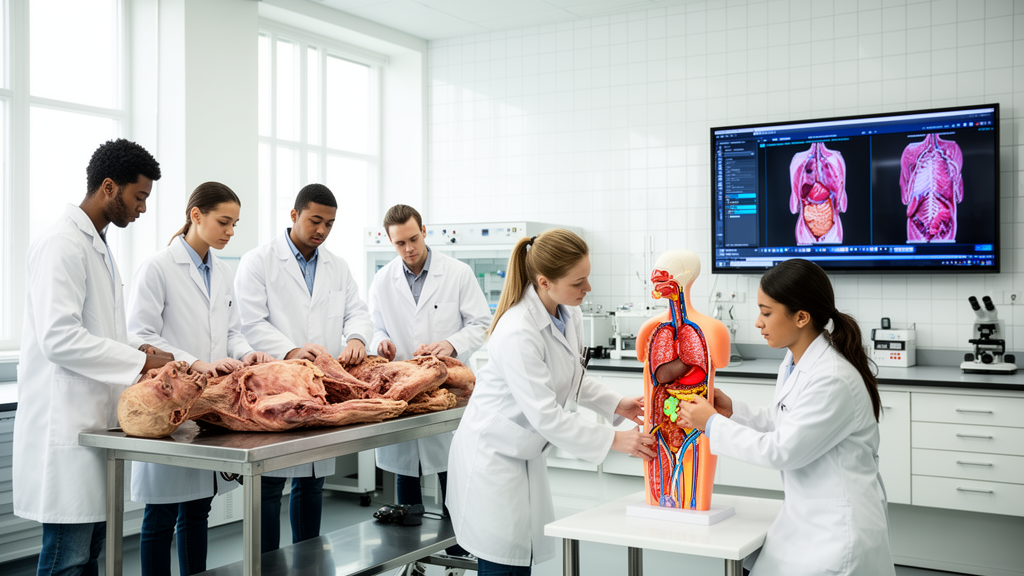
First-year medical students showed comparable knowledge gains whether they practiced anatomy with cadaveric prosections, plastic models, or Acland’s Video Atlas of Human Anatomy, according to a prospective crossover study published open access in BMC Medical Education. The study, led by Buse Naz Çandır Gürses and colleagues, enrolled 45 first-year medical students in a within-subjects design, meaning each participant sequentially experienced all three instructional modalities across two anatomy topics. The authors report that learning effectiveness appeared to depend more on how the modalities were integrated pedagogically than on the instructional medium itself.
The procedure was straightforward. After attending theoretical lectures on two anatomy topics, students took part in practical sessions using each of the three modalities in turn. Pre- and post-tests assessed both theoretical and practical knowledge, and a feedback questionnaire combining Likert-scale items with open-ended questions captured students’ emotional responses, learning experiences, and instructional preferences. The qualitative responses were then analyzed using thematic analysis.
All groups demonstrated statistically significant improvement between pre- and post-test scores, with p values below 0.05. However, there were no significant between-group differences in theoretical, practical, or total post-test scores. The researchers did observe tool-specific performance gains on assessment items tied to cadaver-based and video-based content, an association suggesting that each format may confer advantages on questions closely matched to the way the material was studied, rather than a general superiority of any single method.
The qualitative analysis identified three main themes: self-development, learning strategies and method preferences, and evaluation of the instructional modalities. Within these themes, students described a gradual transition from anxiety and uncertainty toward familiarity, confidence, and engagement with anatomical material. They also emphasized the complementary roles of videos, plastic models, and cadaver-based learning, indicating that the formats were experienced as reinforcing one another rather than competing.
The authors conclude that multimodal anatomy learning appears to support knowledge acquisition while fostering positive learning experiences and authentic engagement with the subject. The findings arrive as anatomy education increasingly incorporates digital and simulation-based resources alongside cadaveric instruction, and they suggest that combining formats can serve both cognitive learning and emotional adaptation. The study’s scope should be kept in view, however: it involved first-year medical students, covered two anatomy topics, and used a crossover design in which every student ultimately received all three methods, so broader generalization would require further research.
Subject of Research: Comparing prosection, plastic model, and video atlas instruction in medical students' anatomy learning outcomes and experiences
Article Title: Learning anatomy through multiple modalities: medical students’ learning experiences and outcomes
Article References: Çandır Gürses, B. N., Karaca Bozdağ, Z., Gürses, İ. A., & Arı, Z. (2026). Learning anatomy through multiple modalities: medical students’ learning experiences and outcomes. BMC Medical Education, 26(1), Article 1666. https://doi.org/10.1186/s12909-026-10050-y
Image Credits: AI Generated
DOI: 10.1186/s12909-026-10050-y
Keywords: anatomy education, medical students, prosection, plastic models, video atlas, crossover study, learning outcomes, cadaver-based learning, multimodal learning, BMC Medical Education, Learning, anatomy
News Source: Courtney Benton. (October 27, 2026). Cadavers, Models and Videos Teach Anatomy Equally Well, Study Finds. Scienmag.