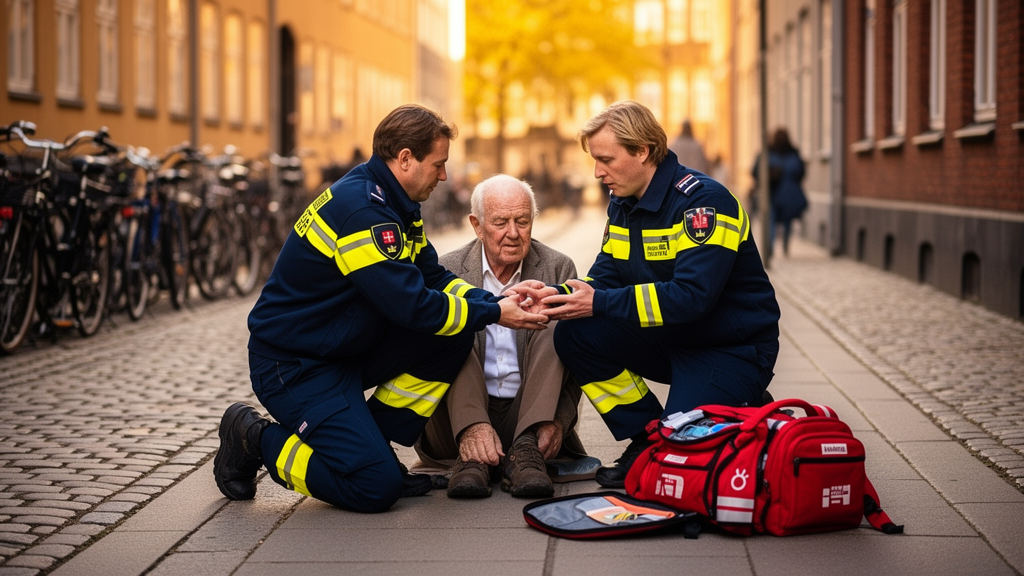
Most of the volunteers dispatched to start cardiopulmonary resuscitation before an ambulance arrives in Denmark have no professional healthcare training, and a new qualitative study has now examined what drives them and what the experience feels like from the inside. Denmark’s national community first responder system sends nearby volunteers to begin CPR and, when available, fetch and use an automated external defibrillator before emergency medical services reach the scene. The system includes more than 60,000 volunteers, and roughly 70% of them do not have a professional healthcare background. Despite their central role in the chain of survival after out-of-hospital cardiac arrest, little has been known about the experiences and motivations of these lay responders.
The study, published in BMC Emergency Medicine as an open access research article, was designed as an interpretive phenomenological investigation. The researchers generated data through semi-structured interviews with ten community first responders without a professional healthcare background, recruited nationwide through social media. The interviews were analysed using Interpretative Phenomenological Analysis, an approach that draws on phenomenology and hermeneutics to explore lived experience and meaning making. Because the study rests on ten interviews with volunteers recruited via social media, its findings describe the lived experiences of this particular group rather than statistical patterns across the whole responder corps.
The analysis identified four superordinate themes. The first, a sense of duty, examines why these responders choose to act. The second, from civilian to responder, examines how they act under uncertainty in emergency situations. The third, navigating relational roles in emergency response, addresses how they collaborate with professionals and with peers. The fourth, carrying the self into crisis, explores how personal identity is carried into the responder role. Together, the themes suggest that people with no clinical training step into emergency situations not as detached technicians but as whole persons, bringing their ordinary working lives and private experiences with them when they respond.
On motivation, the authors conclude that community first responders without a professional healthcare background are driven by moral duty, meaningfulness and community belonging. Interpreted through the distinction between strong and weak altruism, the accounts of several participants point towards weak altruism, in which the wish to help others coexists with personal gains such as meaning and belonging, although elements of strong altruism were also present. In other words, for many of these volunteers, helping strangers and finding purpose in their own lives are not competing motives but intertwined ones. The study’s title phrase, that you could be in the target group yourself, reflects this blurring of the line between helper and potential patient.
Because the responders lack clinical expertise, the study found that they drew on experiences from their work and private lives when acting in emergencies. The authors conclude that structured preparation, clear role definitions, and systematic feedback and debriefing may enhance cooperation with the ambulance service and address needs expressed by the volunteers. These are framed as measures that may help, based on what the participants themselves expressed, rather than as tested interventions. The findings offer emergency medical services and responder organisations a grounded account of how lay volunteers experience being dispatched, how they navigate their position relative to professionals, and what support they say they need to keep serving in a system where early CPR and defibrillation are known to increase survival after out-of-hospital cardiac arrest.
Subject of Research: Lived experiences and motivations of Danish community first responders without a professional healthcare background
Article Title: “You could be in the target group yourself”: Lived experiences of community first responders without a professional healthcare background in Denmark – an interpretive phenomenological study
Article References: Sørensen, O. B., Laerkner, E., Jørck, C., Folke, F., Mikkelsen, S., & Bruun, H. (2026). “You could be in the target group yourself”: Lived experiences of community first responders without a professional healthcare background in Denmark – an interpretive phenomenological study. BMC Emergency Medicine. https://doi.org/10.1186/s12873-026-01826-y
Image Credits: AI Generated
DOI: 10.1186/s12873-026-01826-y
Keywords: community first responders, out-of-hospital cardiac arrest, cardiopulmonary resuscitation, automated external defibrillator, Denmark, volunteers, qualitative research, Interpretative Phenomenological Analysis, altruism, emergency medical services, BMC Emergency Medicine, target
News Source: Ophelia Keating. (October 27, 2026). Volunteer first responders in Denmark act from duty, meaning and belonging. Scienmag.