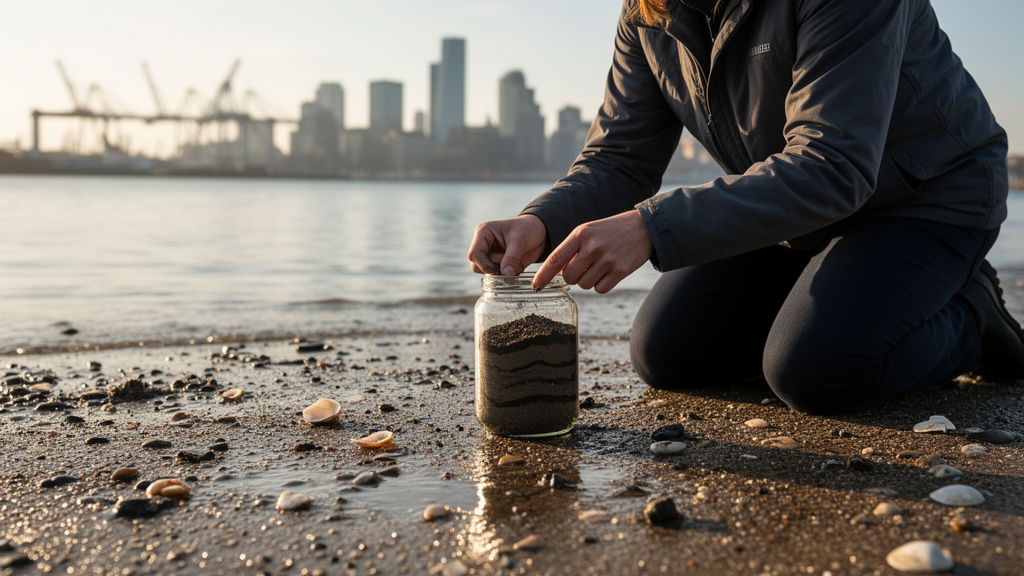
Coastal sediments near cities and harbors act as archives of environmental change, accumulating both natural grains and particles of human origin. A new study in Environmental Geochemistry and Health examines nearshore surface sediments from two contrasting settings: the Kifissos River discharge into the Saronikos Gulf near Athens, Greece, and the harbor area of Fujairah in the United Arab Emirates. Using an integrated mineralogical, geochemical, isotopic and particle-scale analytical approach, the researchers document marked differences between the two environments.
The Athens sediments, delivered by the Kifissos River, are enriched in a broad suite of trace metals and metalloids, including chromium, zinc, nickel, vanadium, copper, lead, arsenic, cobalt and tin. Because no known metal-bearing deposits occur within the river’s catchment, the authors interpret this enrichment as consistent with substantial anthropogenic inputs rather than local geology.
Stable lead isotopes in the Kifissos sediments point to the sources of that metal: the isotope signatures indicate that lead was derived primarily from historical coal combustion, lead-containing paints and industrial activities. Isotopic analysis of this kind allows researchers to distinguish between lead released by human processes and lead inherited from natural mineral sources.
The study also identifies distinctive particles the authors describe as "Anthropocene" particles, supporting the anthropogenic influence in the sediments. Among these are possible incidental micro- and nanoparticles, formed as byproducts of human activity, exemplified by iron microspheres. The sediments also contain probable engineered micro- and nanoparticles, represented by cobalt-rich iron nanoparticles and aggregates of tungsten, gold, mercury and calcium-iron microcrystals.
The Fujairah sediments tell a very different story. The Fujairah sediments contain abundant natural nanoparticles, alongside possible incidental anthropogenic particles and gold-bearing microparticles of likely anthropogenic origin.
This contrast highlights why a single contamination metric can mislead. In Athens, metal enrichment reflects human activity superimposed on a catchment lacking metal deposits. In Fujairah, high chromium, nickel and cobalt levels largely reflect the region’s distinctive geology, so distinguishing natural background from added contamination requires particle-level and isotopic evidence rather than concentration data alone.
The authors argue that combining mineralogy, bulk geochemistry, isotope systematics and individual particle characterization provides a robust framework for separating natural and anthropogenic contributions to coastal sediments.
Beyond diagnosing current conditions, the work establishes baseline datasets intended to support future environmental monitoring in these two contrasting coastal environments.
Subject of Research: Mineralogy and geochemistry of urban-influenced nearshore coastal sediments in Athens and Fujairah
Article Title: Anthropocene mineralogy and geochemistry of nearshore surface sediments from urban-influenced coastal zones of Athens (Greece) and Fujairah (UAE)
Article References: Santos, A., Tsabaris, C., Zavašnik, J., Panagiotopoulos, I., Gondikas, A., Argyraki, A., Mavromatis, V., & Godelitsas, A. (2026). Anthropocene mineralogy and geochemistry of nearshore surface sediments from urban-influenced coastal zones of Athens (Greece) and Fujairah (UAE). Environmental Geochemistry and Health, 48(16), Article 669. https://doi.org/10.1007/s10653-026-03571-4
Image Credits: AI Generated
DOI: 10.1007/s10653-026-03571-4
Keywords: coastal sediments, Anthropocene, trace metals, lead isotopes, nanoparticles, Athens, Fujairah, Saronikos Gulf, ophiolites, geochemistry, environmental monitoring, mineralogy
News Source: Violet Maxwell. (October 27, 2026). Urban Coastal Sediments Reveal Contrasting Fingerprints of Human and Natural Particle Inputs. Scienmag.