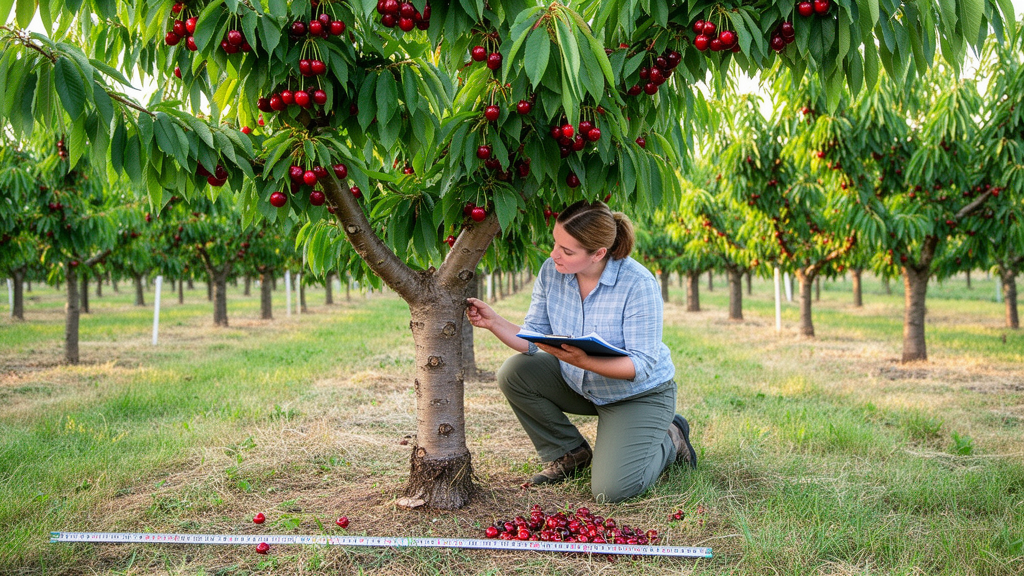
A six-year field trial in central North Macedonia has mapped how seven different rootstocks shape the performance of two widely grown sweet cherry cultivars, ‘Kordia’ and ‘Regina’. The study, conducted by researchers at Saints Cyril and Methodius University in Skopje, evaluated vegetative growth, productivity and fruit quality under the growing conditions of the region, offering orchard planners a long-term comparison rather than a single-season snapshot.
The researchers assessed vegetative growth through annual shoot growth and trunk cross-sectional area, a standard measure of tree size and vigour. Reproductive performance was judged by yield per tree, cumulative yield, yield per unit area and yield efficiency, while fruit quality was determined by fruit weight, diameter, soluble solids content and titratable acidity. This combination of measures allowed the team to weigh the trade-off between how much fruit a tree produces and how large and sweet that fruit is.
The clearest pattern to emerge concerned the dwarfing rootstocks Gisela 5 and Gisela 6. Both induced the lowest vegetative growth in both cultivars, yet they also delivered the highest yield efficiency and the highest yield per unit area. In other words, the smaller trees converted their size into production more effectively than more vigorous options, producing more crop per unit of trunk size and per hectare of orchard.
That productivity advantage came with a cost. The study found that rootstocks inducing greater vigour generally produced larger fruits, while highly productive dwarfing rootstocks tended to reduce fruit size, a consistent inverse relationship across the trial.
Mahaleb, a traditional vigourous rootstock, promoted the strongest vegetative growth of all the options tested. At the same time, Gisela 5 stood out for productivity: it produced the highest cumulative yield per unit area in ‘Kordia’ and also delivered the highest cumulative yield in ‘Regina’. This dual performance across two cultivars suggests the effect is rooted in the rootstock itself rather than in one particular scion combination.
The authors draw practical conclusions from these patterns. Although Gisela 5 and Gisela 6 achieved high yield efficiency and productivity per unit area, their lower fruit weight and diameter may limit their suitability where larger fruit size is required. Under conditions similar to those of the study, Mahaleb appears suitable for semi-intensive systems, while MaxMa 14 appears better suited to more intensified orchard systems.
The findings underline a central dilemma in modern sweet cherry production: the rootstocks that make orchards most productive per hectare are not necessarily the ones that produce the largest fruit.
Because the trial was conducted under the specific conditions of central North Macedonia, the authors frame their recommendations as applying to environments similar to the study site. Within its scope, however, the study offers a clear message: rootstock choice is a balancing act between productivity and fruit quality, and the best choice depends on which of those goals a given orchard system prioritises.
Subject of Research: The effects of seven rootstocks on vegetative growth, productivity and fruit quality of two sweet cherry cultivars over six years in North Macedonia
Article Title: Vegetative growth, productivity and fruit quality of ‘Kordia’ and ‘Regina’ sweet cherry on different rootstocks: a six-year field evaluation
Article References: Saraginovski, N., Kiprijanovski, M., & Gjamovski, V. (2026). Vegetative growth, productivity and fruit quality of ‘Kordia’ and ‘Regina’ sweet cherry on different rootstocks: a six-year field evaluation. Frontiers in Horticulture, 5, Article 1970596. https://doi.org/10.3389/fhort.2026.1970596
Image Credits: AI Generated
DOI: 10.3389/fhort.2026.1970596
Keywords: sweet cherry, rootstocks, Gisela 5, Gisela 6, Mahaleb, MaxMa 14, yield efficiency, fruit quality, fruit size, orchard systems, North Macedonia, Prunus avium
News Source: Alan Morgan. (October 27, 2026). Six-year trial reveals how rootstocks shape sweet cherry growth and fruit quality. Scienmag.