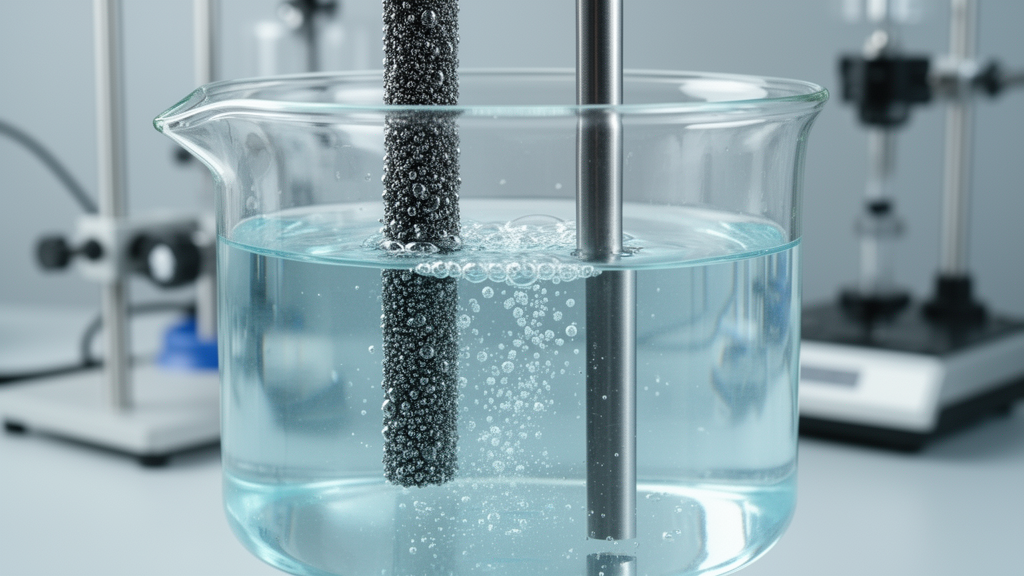
A laboratory catalyst study reports that a nickel-cobalt layered double hydroxide combined with titanium dioxide, or NiCo LDH/TiO2, reached an overpotential of 86.8 mV at 10 mA·cm−2 for hydrogen evolution in 1 M potassium hydroxide. The researchers identified a 2:1 nickel-to-cobalt ratio as the best-performing composition among those tested, with a Tafel slope of 61 mV·dec−1. The composite was deposited directly on nickel foam and evaluated under alkaline conditions.
The experimental work, reported in Catalysis Letters, focused on optimizing the bimetallic composition of NiCo LDH/TiO2 electrocatalysts. The catalysts were constructed on nickel foam through a hydrothermal method, after which the nickel-to-cobalt ratio was systematically varied. Layered double hydroxides were described as offering tunable structures and abundant active sites, but also as suffering from poor conductivity. The investigators therefore examined how the composition affected the composite catalyst’s structure, electrochemical behavior and hydrogen-evolution performance.
Structural characterization confirmed the presence of TiO2 and the characteristic chemical states of NiCo LDH in the composites. At the selected 2:1 Ni/Co ratio, the material formed nanosheets that were distributed uniformly and had an open porous architecture. The nanosheets also made close contact with the TiO2 component. These observations identify the morphology and interfacial structure associated with the best-performing composition, rather than establishing a separate causal mechanism for its measured electrochemical performance.
Electrochemical measurements showed that the optimized catalyst had the lowest charge-transfer resistance and the highest double-layer capacitance of the samples examined. Its double-layer capacitance reached 3.87 mF·cm−2. The researchers interpreted these findings as consistent with facilitated charge transfer and increased exposure of active sites. At a current density of 10 mA·cm−2 in 1 M KOH, the 2:1 Ni/Co catalyst required an overpotential of 86.8 mV, while its Tafel slope was 61 mV·dec−1. These values were reported for the optimized composite; the supplied evidence does not provide the complete numerical results for every comparison formulation.
The researchers also assessed operational stability through chronoamperometry at a constant potential for 10 hours. The available study abstract reports the duration and method of this stability assessment but does not state a separate numerical current-retention value. Taken together, the results connect systematic Ni/Co composition optimization with the observed nanosheet morphology, lower charge-transfer resistance, higher double-layer capacitance and enhanced hydrogen-evolution activity in alkaline electrolyte. The work provides a compositional design basis for layered-double-hydroxide composite catalysts, although the reported evidence is limited to laboratory electrochemical testing rather than operation at an industrial scale.
Subject of Research: Experimental optimization of NiCo LDH/TiO2 electrocatalysts for alkaline hydrogen evolution
Article Title: Composition Optimization of NiCo LDH/TiO2 for Boosted Electrocatalytic Hydrogen Evolution
Article References: Qiao, F., Ren, Z., & Liu, J. (2026). Composition Optimization of NiCo LDH/TiO2 for Boosted Electrocatalytic Hydrogen Evolution. Catalysis Letters, 156(11), Article 308. https://doi.org/10.1007/s10562-026-05552-9
Image Credits: AI Generated
DOI: 10.1007/s10562-026-05552-9
Keywords: hydrogen evolution, electrocatalysis, NiCo LDH, titanium dioxide, alkaline electrolyte, layered double hydroxides, nanosheets, chronoamperometry, charge-transfer resistance, potassium hydroxide, Composition, Optimization
News Source: Bethany Barker. (October 20, 2026). NiCo–TiO2 catalyst lowers hydrogen-evolution overpotential in alkaline testing. Scienmag.