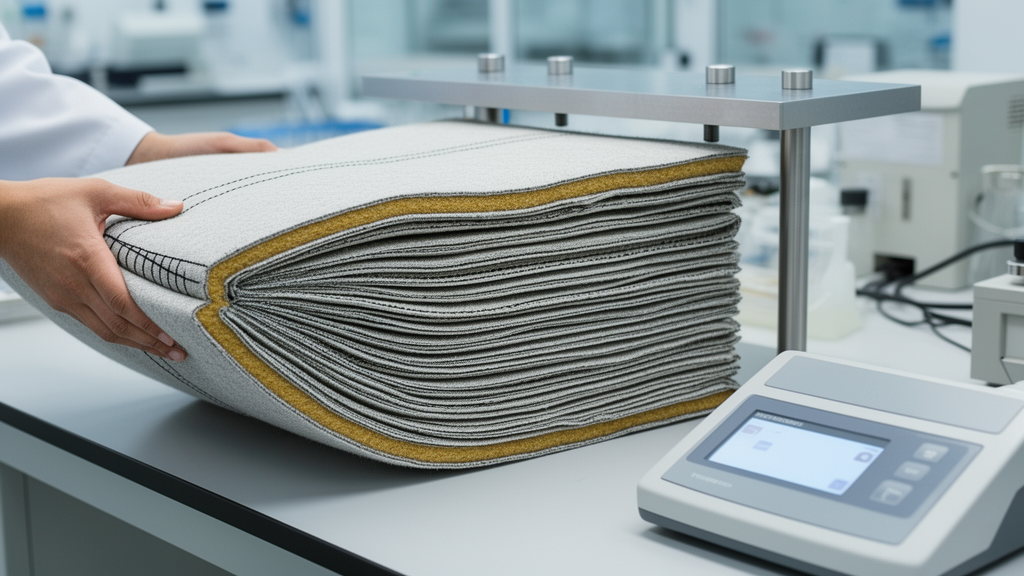
Laboratory testing found that the number of layers was the dominant factor governing the flexural response of sewn multilayer insulation blankets for aerospace applications. Researchers characterized aluminized BoPET radiation shields separated by polyester net spacers in assemblies containing 2, 6, 12, and 24 layers. Thicker configurations exhibited greater bending resistance, while the tested sewing parameters affected different aspects of the mechanical response.
The study used a full factorial experimental design to assess how layer count, stitch density, needle thread tension, and needle foot force influenced the room-temperature, quasi-static flexural behavior of the multilayer assemblies. Statistical analysis identified layer count as the dominant factor. Needle thread tension was associated with modifications in bending length, whereas needle foot force primarily affected local compaction. The experiments measured effective cantilever flexural response in laboratory specimens at a fixed width, rather than evaluating the material as a complete aerospace installation.
The observed scaling indicated a provisional transition in bending resistance within the 6–12-layer range under the tested conditions. Below this range, the assemblies followed a lower scaling exponent consistent with weaker interlayer constraint. Above the range, stiffness increased more steeply, indicating enhanced constraint within the thicker structures. The authors describe this interval as a tendency observed for the tested materials and configurations, not as a universal threshold. The results apply to room-temperature, quasi-static bending at the specified specimen width.
Bending length rose uniformly as the number of layers increased because the measure depends simultaneously on stiffness and mass. Its behavior therefore differed from that of stiffness alone. To characterize the scaling relationship, the researchers applied a continuous piecewise power-law regression and compared it with a conventional single-slope model. The piecewise model provided the better statistical description, reducing the residual sum of squares from 2.43 to 1.764 and producing a lower corrected Akaike information criterion value.
Together, the experiments show that layer count provided the strongest statistical association with flexural response, but the sewing conditions also influenced measurable properties of the assemblies. The distinction between stiffness and bending length is particularly important when comparing configurations with different masses. The study establishes a quantitative description of effective cantilever flexural behavior for the selected materials, layer structures, sewing parameters, fixed specimen width, and laboratory conditions. The authors position these findings as a possible basis for manufacturing quality control during handling and assembly, without extending the conclusions beyond the tested scope.
Subject of Research: Experimental flexural scaling of sewn multilayer insulation assemblies
Article Title: Experimental characterization and scaling of flexural rigidity in sewn multilayer structures
Article References: Jamshidi, Z., Ajeli, S., & Salmani-Tehrani, M. (2026). Experimental characterization and scaling of flexural rigidity in sewn multilayer structures. Scientific Reports. https://doi.org/10.1038/s41598-026-76003-z
Image Credits: AI Generated
DOI: 10.1038/s41598-026-76003-z
Keywords: multilayer insulation, flexural rigidity, sewn structures, layer count, stitch density, thread tension, needle-foot force, BoPET, polyester spacers, power-law scaling, Experimental, characterization
News Source: Denise Maddox. (October 20, 2026). Lab tests show layer count dominates flexural rigidity in sewn insulation. Scienmag.