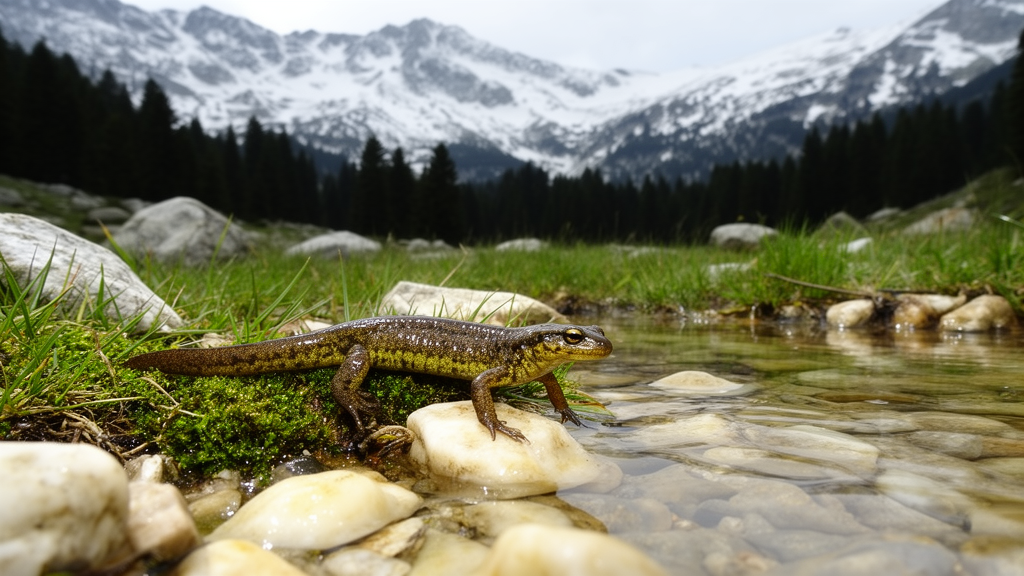
The Balkan endemic Macedonian newt, Triturus macedonicus, has been documented at 2,360 meters above sea level in Lake Gistova on Mount Grammos, Greece, extending the species’ known altitudinal maximum beyond earlier records of 1,900, 2,000 and 2,140 meters. Researchers also confirmed its presence at sea level in the estuaries of the River Pineios in Larissa Prefecture, near the southern limit of the genus’ European distribution. These observations establish a documented vertical range of at least 2,360 meters between an alpine lake and low-elevation estuarine wetlands, while their ecological and evolutionary significance remains a subject for further investigation.
Lake Gistova, the highest alpine lake in Greece, lies at 40°21.905′ N, 20°47.419′ E in Kastoria Prefecture. The reported observation was a male Macedonian newt, providing the first published record of the species from the lake and the highest documented point for both T. macedonicus and the genus Triturus. Earlier bibliographical information placed the species on Mount Grammos at 1,950 meters, while previous records elsewhere reached 1,900, 2,000 and 2,140 meters. The Lake Gistova record therefore raises the highest published occurrence by 220 meters relative to the prior 2,140-meter record, although the observation does not establish the absolute upper limit of the species’ distribution.
The authors consider two possible explanations for the absence of Macedonian newts from an earlier account. The lake may have held an undocumented population that was overlooked, or a lower-elevation population may have shifted its dispersal upward and only recently begun occupying the site. The available observations do not resolve which explanation is correct, and the record does not reveal the population’s demographic history. This uncertainty is important because previous work has shown that increased temperature directly affects Triturus species, while studies of other amphibian taxa have documented movement toward higher elevations as climate warms. The new record establishes a present occurrence at Lake Gistova but does not by itself demonstrate an upward population shift.
At the opposite end of the documented range, the researchers confirmed T. macedonicus in the Pineios estuaries at 39°52.947′ N, 22°43.096′ E. A female was recorded in the Pineios Delta, where the habitat experiences hot summer conditions in contrast with the cold, often nearly frozen alpine environment of Lake Gistova. The records show that the species occupies markedly different thermal, hydrological and microclimatic conditions across its vertical range. Research on another newt, Ommatotriton vittatus, found extensive gene-expression shifts and transcriptomic remodelling between terrestrial and aquatic stages in a population inhabiting an extreme environment, supporting the broader role of phenotypic plasticity in amphibian responses to environmental change. The authors identify T. macedonicus as a candidate for comparable transcriptomic investigation across the contrasting habitats at the limits of its range; the current observations do not demonstrate a particular molecular mechanism in the species.
Improved knowledge of where the Macedonian newt occurs may assist conservation planning. The species is listed as Vulnerable by the International Union for Conservation of Nature, with aquatic habitat loss among the factors affecting it, and it is included in Annex II of Directive 92/43/EEC, which provides for the establishment of special conservation areas. The authors also point to climate change, overgrazing and the bioaccumulation of agricultural chemicals as direct pressures associated with changing habitats. Available datasets could be used in species-distribution modelling to identify unsurveyed locations, including possible additional high-altitude populations of T. macedonicus or related Triturus species. Better delineation of the species’ range would support more precise site preservation and conservation actions, but the two new records alone cannot establish the presence of other populations or quantify changes in their distribution.
Subject of Research: Documented altitudinal range and environmental tolerance of the Macedonian newt in Greece
Article Title: Extending the known vertical distribution for the highly adaptive Triturus macedonicus (Karaman, 1922)
Article References: Daftsios, T., Sagonas, K., & Strachinis, I. (2024). Extending the known vertical distribution for the highly adaptive Triturus macedonicus (Karaman, 1922). Herpetozoa, 37, 107-110. https://doi.org/10.3897/herpetozoa.37.e123770
Image Credits: AI Generated
DOI: 10.3897/herpetozoa.37.e123770
Keywords: Macedonian newt, Triturus macedonicus, Lake Gistova, Mount Grammos, Pineios Delta, altitudinal range, amphibian adaptation, Greece, species distribution, conservation, Extending, known
News Source: Gavin Prescott. (October 20, 2026). Macedonian newt documented across 2,360-meter elevational range in Greece. Scienmag.