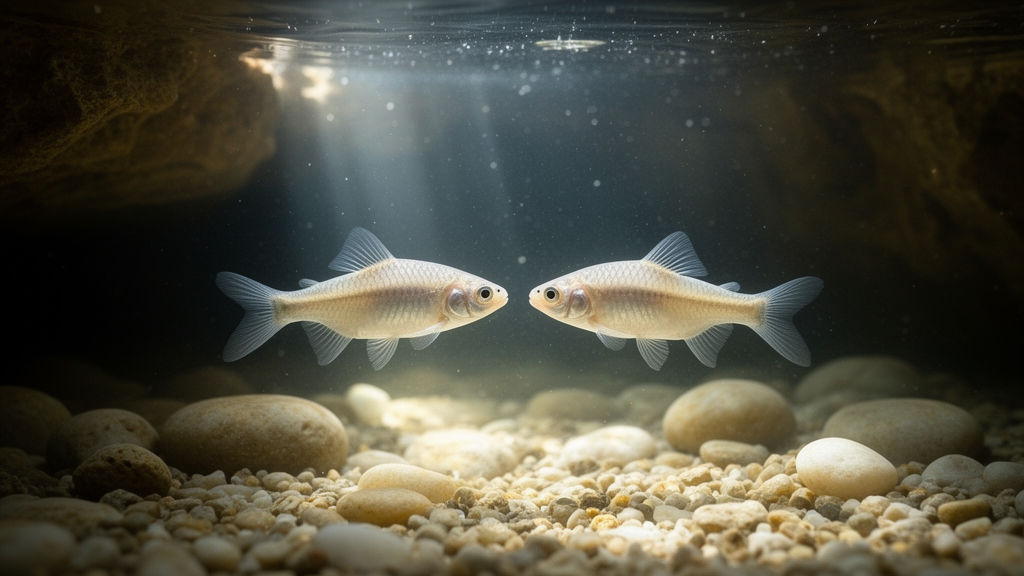
A stygobiotic form of the surface fish Garra rufa has been documented for the first time in Iran, living sympatrically with the cave-restricted Garra tashanensis in Tang-e-Ban Spring in the Zagros Mountains. Researchers combined external morphology, skeletal counts and mitochondrial DNA analysis of specimens collected from the seasonal spring. The underground G. rufa clustered genetically with surface populations of the species, including fish from a nearby stream, while the second species at the spring grouped with G. tashanensis from nearby Tashan Cave.
The findings establish the first known stygobiotic form of G. rufa, which had previously been recorded only from surface waters. The study classified the Tang-e-Ban population of G. rufa as a stygobiont, an aquatic species restricted to underground habitats and unable to complete any part of its life cycle outside them. It did not identify the population as a separate species.
Tang-e-Ban is a seasonal karst spring near Ablash Village in Khuzestan Province, approximately five kilometres east of Tashan Cave, the type locality of G. tashanensis. Depending on precipitation, water flows from the spring from February to May or June. It dries completely during summer and may remain dry for much of the year in years with low precipitation.
The investigators collected fish with a small hand net on 20 April 2022, photographed living animals, anaesthetized them with diluted clove oil and preserved specimens in 96% ethanol. Voucher material was deposited in the Natural History Museum of Khuzestan Province and the Natural History Museum in Vienna. The molecular analysis targeted a 649-base-pair fragment of the mitochondrial cytochrome c oxidase subunit I gene, abbreviated COI.
Seventeen original sequences were combined with 17 additional sequences representing 15 taxa from GenBank. Bayesian and maximum-likelihood analyses used the HKY+G nucleotide substitution model, with Cyprinus carpio as the outgroup. The Bayesian analysis ran for 20 million generations across four Markov chain Monte Carlo chains, while the maximum-likelihood analysis used 1,000 ultrafast bootstrap replicates.
The Bayesian phylogeny placed the troglomorphic specimens from Tang-e-Ban Spring in a well-supported clade with surface G. rufa from a stream near Sarjowshar village and with other available G. rufa sequences. Kimura two-parameter distances between the underground fish and surface G. rufa were no greater than 1.09% and were as low as 0.31% in sampled comparisons. The other Tang-e-Ban species grouped with G. tashanensis exemplars.
Maximum K2P distance among the Tang-e-Ban G. tashanensis samples was 0.31%, while their distance from published sequences of Tashan Cave individuals was 0.78%. The researchers considered the genetic differences insufficient to warrant describing either Tang-e-Ban population as a new species and treated the cave-associated populations as morphotypes of G. rufa and G. tashanensis. The cave-associated G. rufa nevertheless displayed pronounced differences from the surface population examined in the nearby Maroon River.
Its eyes ranged from nearly normal, pigmented eyes to complete absence of externally visible eye structures; reduction was asymmetrical in four of the five specimens examined in detail. Most body scales were absent, although a complete or nearly complete lateral line retained 33–35 scales. Live fish appeared pink because blood vessels could be seen through translucent skin, while preserved specimens became yellowish white.
The gular disc was well developed, with free lateral and posterior margins, and measured approximately as long as it was wide. These features are consistent with the morphology of fish occupying an underground environment, in which reductions in eyes and pigmentation are common. Several meristic characters also distinguished the Tang-e-Ban G. rufa from the surface fish.
The underground form had seven and a half branched dorsal-fin rays rather than the usual eight and a half. It had two pre-anal caudal vertebrae, or three in one specimen, compared with three to five and most commonly four in the surface sample. It also had 13–14 post-anal caudal vertebrae rather than 11–12, and 10–11 vertebrae between the first pterygiophores of the dorsal and anal fins, compared with 12–14 in surface fish.
The shorter dorsal-fin base, longer caudal peduncle, more anterior anal fin and altered arrangement of the caudal vertebrae expressed these anatomical differences externally. Relative measurements of caudal-peduncle depth and length, predorsal and postdorsal distances, pre-anal distance, pelvic-to-anal-fin distance, dorsal-fin base, gill-slit separation and gular-disc proportions also differed between the samples. Principal component analysis and cluster analysis produced separate groups for hypogean and epigean G. rufa when morphometric and meristic characters were combined, and also separated them when only counts were analysed.
In the combined cluster analysis, however, the cave G. rufa grouped with the sympatric G. tashanensis rather than with surface G. rufa. Analyses based only on meristic characters placed the groups closer together, with one surface G. rufa and one Tang-e-Ban G. tashanensis clustering with the cave fish. The researchers noted that the hypogean G. rufa specimens were smaller than the surface comparison fish: 40.7–52.9 mm standard length versus 49.3–74.8 mm.
They also cautioned that morphometric characters can depend on age, size and habitat, and that the Maroon River sample was not specifically compared with G. rufa populations from other Iranian localities. The available comparative material was therefore adequate for identifying the cave-associated form but limited for establishing the full extent of geographic variation in the species. The Tang-e-Ban population of G. tashanensis also differed from the specimen examined at its type locality, although the comparison was constrained by the small Tashan Cave sample.
The Tang-e-Ban fish were generally slimmer and had a narrower gular disc, an arched mouth cleft, commonly two rather than three unbranched dorsal-fin rays, and 11–13 rather than 10 predorsal abdominal vertebrae. Their most conspicuous distinction was a more extensive lateral line: Tang-e-Ban fish had 10–34 pored scales embedded in the skin or externally visible, whereas the 42.2-mm-standard-length Tashan Cave specimen had seven pores and no visible scales. Because the original description was based on smaller specimens, including a holotype and paratypes of 22–27 mm standard length, the study concluded that absence of a lateral line could not be treated as a diagnostic feature of the species.
The Tashan population was also highly variable, including specimens with different head and body forms, and a disc-less phenotype occurring alongside the disc-bearing form. The results expand the documented subterranean fish diversity of Iran to five cave-fish species in two genera and two families. Four species belong to Garra, while the nemacheilid Eidinemacheilus smithi occurs with G. lorestanensis and G. typhlops in Loven Cave and Tuveh Spring.
The Tang-e-Ban finding also raises unresolved questions about regional hydrology. The occurrence of G. tashanensis in both Tashan Cave and Tang-e-Ban Spring may indicate a connected aquifer, although the study did not directly trace the underground connection. Tang-e-Ban has several outflows, and nearby springs may join through agricultural land used for irrigation.
Fish can die within the spring or enter streams and rivers, but the researchers could not determine from which outlets the specimens originated. Comprehensive fieldwork across the Tashan area is needed to clarify the movement of fish among springs, surface waters and subterranean channels. The study identifies several questions for further genetic research, including whether the two Garra species hybridize at Tang-e-Ban, whether gene flow occurs between epigean and hypogean forms of G. rufa, and whether an epigean form of G. tashanensis exists in the area.
Cave populations may remain interfertile with ancestral surface forms or become reproductively isolated species following prolonged isolation, but the present data do not resolve which outcome applies here. Additional genetic markers and broader sampling are also required to clarify relationships within the Garra lineage. The authors identify human waste, water extraction, fish collection and uncontrolled visits as threats to the Tashan habitat.
These findings establish Tang-e-Ban as a site containing a newly documented stygobiotic form of G. rufa alongside G. tashanensis, while leaving the boundaries, connectivity and evolutionary status of the underground populations open for further study.
Subject of Research: Morphological and genetic identification of sympatric stygobiotic Garra fish in an Iranian karst spring
Article Title: The first record of a stygobiotic form of Garra rufa (Heckel, 1843), sympatric with Garra tashanensis Mousavi-Sabet, Vatandoust, Fatemi & Eagderi, 2016 ( Teleostei , Cyprinidae ), in Iranian subterranean waters
Article References: Malek-Hosseini, M. J., Flot, J.-F., Fatemi, Y., Babolimoakher, H., Kuntner, M., Diripasko, O. A., Jelić, D., & Bogutskaya, N. G. (2023). The first record of a stygobiotic form of Garra rufa (Heckel, 1843), sympatric with Garra tashanensis Mousavi-Sabet, Vatandoust, Fatemi & Eagderi, 2016 (Teleostei, Cyprinidae), in Iranian subterranean waters. Subterranean Biology, 46, 97-127. https://doi.org/10.3897/subtbiol.46.108396
Image Credits: AI Generated
DOI: 10.3897/subtbiol.46.108396
Keywords: Garra rufa, Garra tashanensis, stygobionts, cave fish, Tang-e-Ban Spring, Iran, Zagros Mountains, mitochondrial COI, karst groundwater, troglomorphy, first, record
News Source: Margaret Porter. (October 20, 2026). First stygobiotic Garra rufa found beside Iranian cave fish. Scienmag.