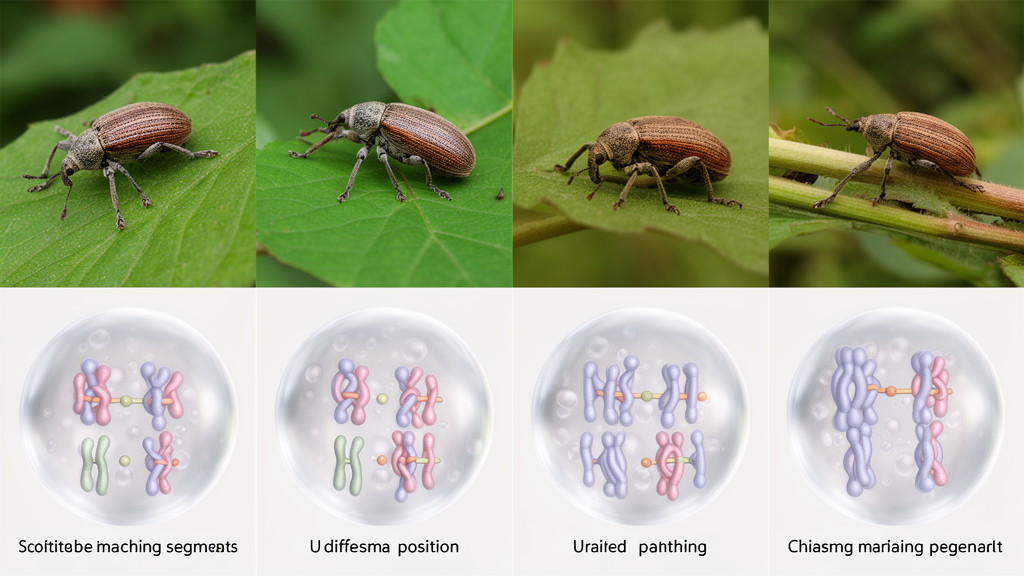
A cytogenetic study of four male Chrysolina latecincta intermedia beetles from three Scottish locations found broadly similar total numbers of meiotic chiasmata but significant differences in where those chromosome exchanges occurred along the chromosomes. The sampled beetles came from the Orkney Islands, the Shetland Islands and Loch Etive in Argyllshire. Across the individuals, 68.2% of scored bivalents contained one chiasma and 31.8% contained two, while distal chiasmata accounted for between 87.7% and 96.3% of all scored exchanges.
Despite this overall consistency, the two Loch Etive beetles had fewer proximal and interstitial chiasmata than the Orkney and Shetland specimens. The findings concern chromosome-level variation within a small sample of the rare Scottish subspecies; they do not establish a population-wide geographic or environmental effect. The research focused on Chrysolina latecincta subspecies intermedia , one of ten described subspecies of a leaf beetle distributed across western and central Europe from southern Norway to Spain and from Scotland to the Alps and Apennines.
The rare Scottish subspecies has been recorded in a few cliff localities. Investigators chromosomally surveyed one male from Orkney, one from Shetland and two from Loch Etive. Their testes had been preserved in ethanol and glacial acetic acid at a ratio of 3:1, and the samples were sent to the University of the Balearic Islands in Palma de Mallorca for chromosome analysis.
The study design therefore combined one specimen from each island group with two specimens from the mainland locality. To produce chromosome preparations, the researchers used a slide-making technique reported by Petitpierre and colleagues in 1998. The resulting slides were stained with 4% diluted Giemsa in tap water and examined under a ZEISS AXIOSKOP microscope.
Observations and scoring of chiasmata were performed on cells at meiotic diakinesis. At this stage, researchers classified each bivalent as unichiasmate or bichiasmate and assigned each chiasma to a proximal, interstitial or distal position, following drawings published by John and Lewis in 1975. This classification allowed the analysis to address both the number of exchanges in each cell and their chromosomal location, rather than comparing only total chiasma counts.
The study was a cytogenetic analysis of preserved reproductive tissue, not an experiment manipulating environmental conditions. Most scored bivalents were unichiasmate and were usually rod-shaped, whereas bichiasmate bivalents were more often ring-shaped. The results text reports 1,264 scored bivalents, while the tabulated cell and bivalent counts sum to 1,265, an internal difference of one in the supplied article.
The reported proportions were 68.2% unichiasmate and 31.8% bichiasmate. The table recorded 825 bivalents in the two Loch Etive individuals, 121 in the Orkney individual and 319 in the Shetland individual. Of these, 254 Loch Etive bivalents, 42 Orkney bivalents and 106 Shetland bivalents were bichiasmate, corresponding respectively to 30.8%, 34.7% and 33.2% within each location’s sample.
Unichiasmate bivalents made up the remaining 69.2% at Loch Etive, 65.3% in Orkney and 66.8% in Shetland. Mean total chiasma counts were close for all four sampled beetles. The table gives 14.373 ± 0.117 chiasmata per cell for Loch Etive, 14.818 ± 0.157 for Orkney and 14.60 ± 0.162 for Shetland.
Pairwise t-tests found no statistically significant differences among the specimens in total chiasma number, nor in their mean numbers of bichiasmate or unichiasmate bivalents. The similarity in total counts reflected a consistent pattern across the chromosome complement. Prior cytogenetic analysis of three male Ch. latecincta latecincta from southern France had reported a chromosome complement of 2n = 24: four large autosome pairs, seven small autosome pairs, a medium-sized X chromosome and a very small Y chromosome.
Its meiotic metaphase I formula was 11 + Xyp, with four large and seven small autosome bivalents and an achiasmate, parachute-like Xyp sex-chromosome association. The Scottish observations were described as consistent with this size-asymmetric organization. In the French material, the four larger autosomes represented 57.44% of the total complement length and were responsible for all scored bichiasmate bivalents.
Although the totals and the proportions of one- and two-chiasma bivalents did not differ significantly, chiasma positions did. The mean number of proximal plus interstitial chiasmata varied significantly between the Loch Etive individuals and those from Shetland and Orkney, with P < 0.01 for both comparisons in the reported Student’s t-test. The mean number of distal chiasmata also differed significantly between Loch Etive and Orkney at P < 0.05.
At Loch Etive, 1,038 of 1,078 chiasmata were distal, or 96.3%, while 40 were proximal or interstitial, or 3.7%. The corresponding mean values were 13.84 ± 0.122 distal chiasmata and 0.533 ± 0.089 proximal-plus-interstitial chiasmata per cell. In Orkney, 143 of 163 chiasmata were distal, or 87.7%, and 20 were proximal or interstitial, or 12.3%; the respective means were 13.00 ± 0.374 and 1.818 ± 0.395.
Shetland had 392 distal chiasmata, or 92.2%, and 33 proximal or interstitial chiasmata, or 7.76%, with means of 13.517 ± 0.297 and 1.138 ± 0.207 per cell. The high prevalence of distal chiasmata in the Scottish beetles agrees with earlier observations for Ch. latecincta in southern France and for related species in the subgenus Stichoptera . A closely related southwestern French species, Ch. oceanoripensis , has a 2n = 24 (Xyp) complement and approximately 14 chiasmata per cell.
Its reported average of 27.3% bichiasmate bivalents was slightly below the 30.8% to 34.7% recorded for the sampled Scottish individuals. Distal localization has also been reported in Ch. oceanoripensis and Ch. gypsophilae . The article also cites comparable patterns in the scarab genus Pleocoma , the weevil genus Pissodes and almost all New World members of the chrysomelid subtribe Oedionychina.
Among two Hispini chrysomelids, more than 85% of chiasmata were distal in Dicladispa testacea and 75% were distal in Polyconia caroli . These comparisons place the Scottish pattern within a wider pattern observed across several beetle lineages, but they do not demonstrate that all members of those groups share identical crossover systems. The authors suggest that the difference in chiasma location may be related to environmental differences among the Scottish sites, while explicitly presenting this as a hypothesis that requires further analysis.
They note that proximal and interstitial chiasmata may correspond to a higher level of recombination than distal chiasmata because the exchanged chromatid segments are larger. However, they also state that the effects of extreme conditions such as low temperature on chiasma frequency are ambiguous. The reported mean annual temperatures were 7.1 °C in Shetland, 7.8 °C in Orkney and 8.1 °C at Loch Etive.
These small differences provide an environmental context for comparison, but the study did not manipulate temperature, measure the mechanisms directly or test causation. The significant geographic contrasts therefore cannot be assigned to climate on the basis of these data alone. Several limitations constrain the conclusions.
Only four male beetles were examined: one from Orkney, one from Shetland and two from Loch Etive, with 75, 11 and 29 cells scored across the three locations, respectively. The analysis used a single meiotic stage and classified chiasmata into three positional categories, so the results describe the sampled chromosome preparations rather than every aspect of recombination in the subspecies. The most statistically significant contrasts involved a small number of individuals, and the Scottish subspecies is known from only a few localities.
The study demonstrates that chiasma placement differed measurably among these sampled beetles and sites while total chiasma counts remained similar; it does not show that the differences are consistent throughout Scottish populations. The authors conclude that a larger sample from more localities and a more informative experimental design would be needed to determine whether temperature or other environmental factors influence the observed pattern.
Subject of Research: Cytogenetic variation in chiasma number and placement in four Scottish Chrysolina latecincta intermedia beetles
Article Title: The chiasmata systems of Scottish Chysolina latecincta (Demaison, 1896) ( Coleoptera , Chrysomelidae )
Article References: Petitpierre, E. (2021). The chiasmata systems of Scottish Chysolina latecincta (Demaison, 1896) (Coleoptera, Chrysomelidae). Comparative Cytogenetics, 15(4), 339-343. https://doi.org/10.3897/compcytogen.v15.i4.68309
Image Credits: AI Generated
DOI: 10.3897/CompCytogen.v15.i4.68309
Keywords: Chrysolina latecincta, leaf beetle cytogenetics, meiotic chiasmata, chromosome recombination, Scottish beetles, distal chiasmata, Orkney Islands, Shetland Islands, Loch Etive, Coleoptera, chiasmata, systems
News Source: Drew Townsend. (October 20, 2026). Four Scottish leaf beetles show site differences in chiasma placement. Scienmag.