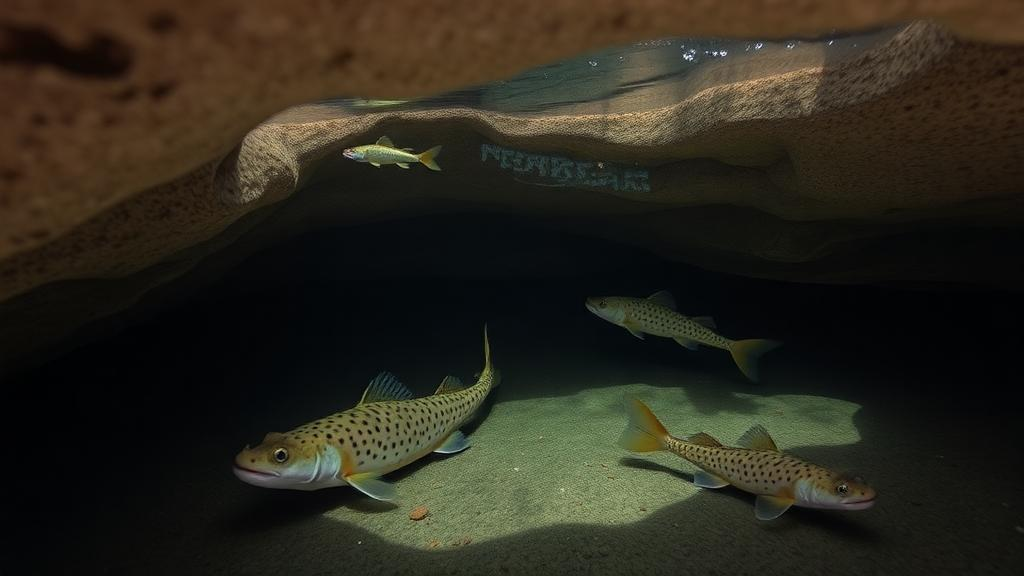
Researchers have documented four previously unverified populations of cave-dwelling Rhamdia catfishes in Chiapas, Mexico, following ichthyological surveys of four karst caves in the Grijalva River drainage basin. Morphological measurements, fin-ray counts and mitochondrial DNA analyses identified the animals not as undescribed species, but as populations of two widespread surface species: R. laticauda in Paso Burro and El Chorro Grande caves, and R. guatemalensis in Los Bordos and El Encanto. The findings bring the number of taxonomically verified cave-catfish populations in Chiapas from one to five, while documenting a wide range of eye reduction and depigmentation among animals living underground.
The expedition took place from March 17 to 25, 2022, and targeted caves mentioned in earlier speleological reports or local accounts that had not previously been investigated from a taxonomic perspective. Paso Burro and El Chorro Grande are resurgences connected to the Río Sabinal and Río Suchiapa, respectively, whereas Los Bordos and El Encanto belong to the Río La Venta basin. The four systems differ substantially in scale and accessibility.
Los Bordos extends for 5,211 metres and contains pools about two metres deep. El Chorro Grande reaches 9,650 metres and has a vertical gradient of 175 metres. El Encanto is only 364 metres long and readily accessible by vehicle, while Paso Burro requires a short hike from the nearest point accessible to vehicles.
Baited minnow traps were deployed along the main longitudinal axis of each cave, extending to the researchers’ maximum penetration, generally a few hundred metres into the surveyed passages. For comparison, the team also collected surface-dwelling Rhamdia by electrofishing at river locations near three of the four caves. A nearby surface population could not be sampled at El Chorro Grande.
Captured fish were euthanized with tricaine mesylate, and fin clips were taken for genetic analysis. Tissues were preserved in 96% ethanol and cryopreserved at −80 °C. Voucher specimens were fixed in 10% formalin, washed and transferred to 70% ethanol for long-term storage in the National Fish Collection at the Institute of Biology of the National Autonomous University of Mexico.
For the genetic comparison, the researchers sequenced an approximately 650-base-pair fragment of the mitochondrial cytochrome c oxidase subunit I gene, or COI, from 18 fish: eight representing all four newly documented cave populations and 10 from nearby surface waters. These sequences were combined with 63 previously available or unpublished records to produce a matrix of 81 terminals and 640 aligned positions, representing about 90% of the recognized species in the trans-Andean and Middle American Rhamdia clade. Maximum-likelihood phylogenetic analysis placed the cave samples within species-level clades containing R. laticauda and R. guatemalensis .
Bootstrap support was estimated from 1,000 pseudoreplicates, and R. quelen was used as the outgroup. The placements were clear and geographically coherent. Fish from Paso Burro were nearly genetically identical to R. laticauda collected in the Río Sabinal flowing from the cave and formed a strongly supported group with them, together with the El Chorro Grande samples.
The Los Bordos and El Encanto fishes grouped closely with surface R. guatemalensis collected at La Conchuda and El Aguacero waterfalls. Those four sites all belong to the Río La Venta basin and lie within roughly 10 kilometres of one another. Pairwise differences between the cave fish and their corresponding surface species did not exceed the approximately 3% sequence-divergence heuristic commonly used to identify conspecific organisms in animal DNA barcoding, providing additional support for the species assignments.
Most cave specimens displayed external features associated with subterranean life, including partial loss of body pigmentation and reduction or disappearance of the eyes. No newly sampled population consistently showed complete troglomorphy, the full suite of external modifications traditionally associated with permanent cave residence. Variation was especially pronounced in Los Bordos, where some R. guatemalensis had lost their eyes and pigmentation while others retained intermediate or nearly normal features.
El Encanto yielded only one specimen, which appeared externally normal; the small sample does not establish that troglomorphic individuals are absent from that population. A fish from Paso Burro also showed asymmetric eye reduction, lacking its right eye while retaining what appeared to be a normal left eye. The observations add nuance to the traditional image of cave fish as uniformly transformed by prolonged isolation in darkness.
Mexican cave Rhamdia originally described as fully troglobitic have since been found to retain variation in eye reduction and depigmentation, and the Brazilian species R. enfurnada was likewise reported with variable regressive traits. In light of these findings, the authors suggest that incomplete and variable troglomorphy may be the norm among subterranean Rhamdia . They discuss two possible explanations: cave populations may still be at relatively early stages of divergence, or exchanges between subterranean and surface individuals may continue and limit the fixation of complete cave-associated traits.
Neither mechanism was directly tested in this study, so the observations do not establish which process governs the pattern. The populations also expand the known range of a distinctive evolutionary pattern. Nearly all recognized Mexican cave Rhamdia lineages belong to the R. laticauda radiation, including the named species R. zongolicensis , R. reddelli , R. laluchensis and R. macuspanensis .
Before this study, the only known fully subterranean population of R. guatemalensis came from Grutas de Coconá in Tabasco, where three sampled fish had normal external features. The researchers did not assign subspecies names to the four populations despite their ecological distinctiveness, stating that formal taxonomic recognition should require evidence of geographical discontinuities in phenotypic traits and clear phylogenetic or phylogeographic substructure. They argue that the populations and their habitats warrant conservation attention because they represent biologically distinctive components of subterranean communities.
The study also identified a notably long genetic branch separating the El Chorro Grande, Paso Burro and nearby Río Sabinal group from other members of the R. laticauda radiation, a pattern the authors say requires further scrutiny. More extensive cave exploration, denser geographic sampling and genome-wide markers may clarify the taxonomy and evolutionary history of subterranean Rhamdia , whose diversity is likely underestimated by the limited scope of past field surveys.
Subject of Research: Morphological and mitochondrial DNA documentation of four cave-dwelling Rhamdia catfish populations in Chiapas, Mexico
Article Title: New records of cave-dwelling populations of Rhamdia catfishes ( Siluriformes , Heptapteridae ) from Chiapas, Mexico
Article References: Buenavad-González, M. A., López-Vila, J. M., Torres-Vázquez, D., Hernández-Ávila, S. G., Zárate-Gálvez, K., & Arroyave, J. (2023). New records of cave-dwelling populations of Rhamdia catfishes (Siluriformes, Heptapteridae) from Chiapas, Mexico. Subterranean Biology, 46, 61-76. https://doi.org/10.3897/subtbiol.46.110269
Image Credits: AI Generated
DOI: 10.3897/subtbiol.46.110269
Keywords: Rhamdia catfishes, cave fish, Chiapas, Mexico, karst caves, troglomorphy, mitochondrial DNA, phylogenetics, groundwater biodiversity, ichthyology, records, cave-dwelling
News Source: Drew Townsend. (October 20, 2026). Four cave-catfish populations documented in Chiapas, Mexico. Scienmag.