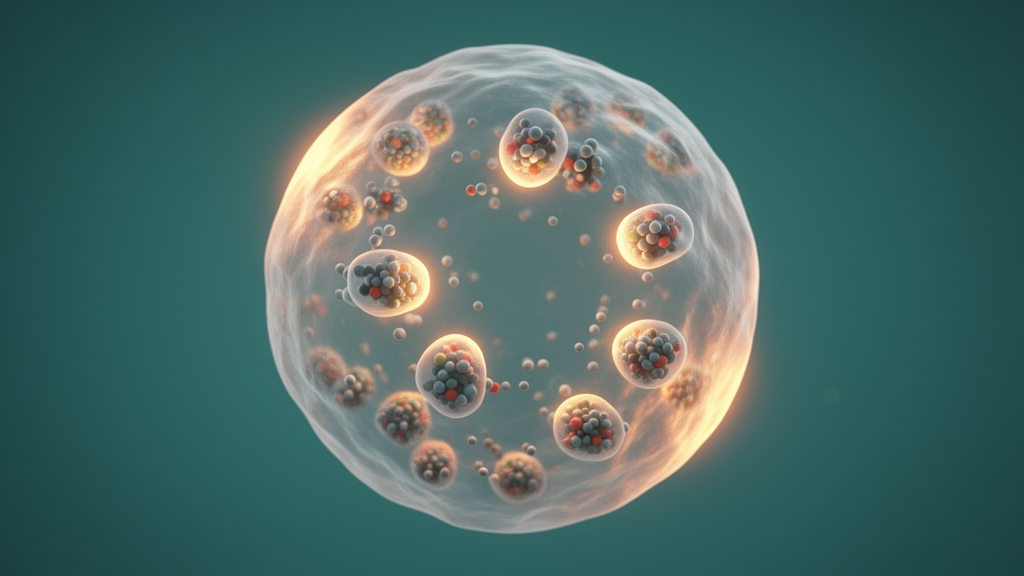
Inside every cell, a vast logistics network works around the clock. Proteins and receptors that have been taken up from the cell surface are delivered to endosomes, the cell’s internal sorting stations, where a decision is made: some cargo is condemned to degradation, while the rest is recycled and sent back to the membrane for another round of duty. How the cell ensures that the right molecules end up in the right recycling vehicle has long been one of the stubborn questions in cell biology. Now a team at the Biozentrum of the University of Basel, led by Professor Anne Spang, has identified a molecular switch that governs this sorting step, and the answer turns out to hinge on a small protein that must flicker on and off with remarkable precision.
The switch in question is ARF-1, a small regulatory protein belonging to a family of molecular timers known as small GTPases. These proteins act like toggle switches, alternating between an active state and an inactive state, and in doing so they control when and where other cellular machines can engage with their targets. According to the new study, published in the Journal of Cell Biology, ARF-1 performs exactly this role during the loading of recyclable cargo into transport vesicles, the small membrane bubbles that ferry molecules between cellular compartments. When ARF-1 is active, the adaptor complex AP-1 can bind the cargo destined for recycling. When ARF-1 switches off, AP-1 releases its grip, and the cargo is free to enter the recycling vesicle, where it is captured once again for the journey back to the cell surface.
Dr. Jachen Solinger, first author of the study, described the behavior of ARF-1 as that of a true molecular switch during vesicle loading. Crucially, the protein must not stay in either state for long. If ARF-1 remains permanently switched on, or permanently switched off, recycling is disrupted. The cell therefore depends not on the presence of the protein alone, but on its continuous cycling between active and inactive forms. This cycling is directly coupled to the transfer of cargo: each on-and-off transition gives AP-1 a chance to let go of one molecular passenger and prepare for the next, turning a simple biochemical oscillation into a sorting mechanism.
The new findings build on earlier work from the Spang laboratory that revealed the protein machinery FERARI, which plays a central role in endosomal recycling. Recycling vesicles dock onto sorting endosomes and partially fuse with them in a transient encounter that researchers have dubbed kiss-and-run. During this brief contact, the vesicle remains intact and can detach again, and material is exchanged in both directions between the two compartments. What remained unclear after the discovery of FERARI was how the cell decides which proteins actually make their way into the recycling vesicle during these fleeting meetings. The new study provides the missing piece: FERARI organizes the kiss-and-run contact site itself, while ARF-1 and AP-1 coordinate the actual transfer of cargo across it.
One of the most striking aspects of the mechanism is that it does not demand perfection in a single pass. Recycling vesicles can dock repeatedly onto endosomes and exchange cargo several times, giving the cell repeated opportunities to correct sorting errors. Much like a recycling facility in which items are checked and re-sorted over several rounds rather than sorted once and for all, cellular components are progressively refined toward their correct destination. This iterative quality may explain how cells achieve high fidelity in a process that operates at enormous throughput and in the crowded, noisy environment of the cytoplasm.
The experimental evidence for the mechanism spans several model organisms. The researchers observed key aspects of ARF-1-dependent sorting in the roundworm C. elegans, as well as in yeast and in mammalian cells. This breadth suggests that the principle of cellular recycling described in the study has been conserved throughout evolution, a hallmark of mechanisms that are fundamental to life rather than incidental to one lineage. When the researchers interfered with ARF-1 activity, cellular recycling slowed down, and both too little and too much ARF-1 activity impaired cargo transport, underscoring that the timing of the switch, not merely its presence, is what matters.
For Anne Spang, the evolutionary dimension of the work is among its most intriguing aspects. It is fascinating, she noted, to see how cells take basic principles they have developed and reuse them in very different contexts, rather than reinventing the wheel every time. Similar switching mechanisms involving small GTPases and adaptor proteins are already known from other cellular transport processes, including the well-characterized trafficking pathways that move material between the Golgi apparatus and other compartments. The new study now shows that such a principle is also deployed for sorting during kiss-and-run recycling, extending a proven biochemical strategy into a context where it had not previously been demonstrated.
The broader significance of the work lies in what efficient recycling means for the cell’s economy. By reusing receptors and transport proteins instead of constantly producing them anew, cells save energy and maintain rapid control over their surface composition, which is essential for signaling, nutrient uptake, and communication with the environment. Disruptions to such transport pathways have been linked to various diseases, including neurological disorders, where the precise trafficking of receptors at synapses is critical for normal brain function. Understanding the molecular switches that keep recycling on track may therefore illuminate not only basic cell biology but also the origins of disease states in which trafficking goes awry.
The findings provide another piece of the puzzle in understanding the cell’s complex transport system. They reveal how FERARI, ARF-1 and AP-1 work together to ensure that the right cargo reaches the right destination, coupling the physical architecture of endosomal contact sites to the biochemical rhythm of a GTPase switch. As researchers continue to map the cell’s internal logistics, the picture that emerges is one of elegant reuse: a handful of molecular principles, cycled and combined in different contexts, generating the extraordinary diversity of trafficking behaviors that keep cells alive. In the case of ARF-1, the humble act of switching on and off turns out to be the very signal that directs the cargo home.
Subject of Research: The role of the ARF-1 protein and the AP-1 adaptor complex in sorting recyclable cargo during kiss-and-run endosomal recycling in cells.
Article Title: Cellular recycling: A molecular switch directs the cargo
Article References: Cellular recycling: A molecular switch directs the cargo. Original publication (Bibliographic details unavailable.)
Image Credits: AI Generated
DOI: Not provided
Keywords: ARF-1, AP-1 adaptor complex, endosomal recycling, kiss-and-run, FERARI, vesicle transport, cell biology, C. elegans, Journal of Cell Biology, University of Basel, cargo sorting, small GTPases
News Source: Drew Townsend. (October 19, 2026). Molecular switch ARF-1 directs cargo during cellular recycling. Scienmag.