Deep in the Brazilian Atlantic Forest, along the banks of the Mirante River in São Paulo state’s Intervales State Park, researchers witnessed a predatory encounter that had never been documented before: a land planarian, a soft-bodied flatworm, attacking and consuming a web-building spider. The observation, published in Neotropical Biology and Conservation, expands the known cast of natural enemies that prey on spiders and reveals surprising flexibility in the foraging behavior of these secretive predators.
Spiders are among the most successful terrestrial predators on Earth, with more than 50,000 described species exerting top-down effects on insect populations in both natural and human-disturbed environments. Yet their abundance and energy-rich bodies make them prey for a wide array of enemies, including fish, frogs, birds, reptiles, mammals, wasps, ants, mantids, centipedes, scorpions, solpugids, and other spiders. Some speciose groups of invertebrate predators, however, had never been directly observed attacking spiders. Among them were land planarians, flatworms of the phylum Platyhelminthes comprising more than 960 species, distributed mainly in tropical and moist terrestrial habitats.
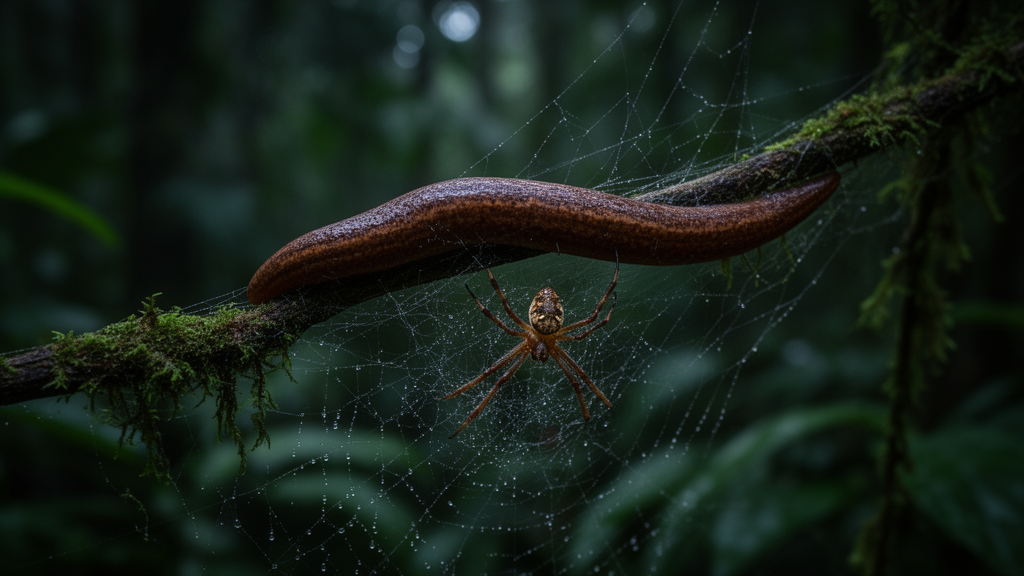
The new report describes the first documented case of predation on a web-building spider by a land planarian. On 19 February 2014, while inspecting the web of Helvibis longicauda, a small theridiid spider whose females average just 2.9 milligrams in weight, researchers found a land planarian identified as Choeradoplana cf. gladismariae constricting the spider and covering it with sticky mucus. The web hung on a riverbank roughly 1.80 meters above the ground, and the event took place in the middle to late afternoon, an unusual time to catch these normally nocturnal animals in action.
What struck the observers most was the spider’s behavior. The female H. longicauda was still alive and clutching her egg sac with her legs, attempting to protect her offspring even as the flatworm tightened its grip. The researchers transported both animals to the research base for photography, and about an hour later the spider had become less active but remained attached to the egg sac, while the planarian appeared to be inserting its pharynx and feeding on its prey. The egg sac itself was left untouched, suggesting the flatworm targeted the spider rather than her reproductive investment.
Land planarians display a range of feeding strategies. Some species specialize in soft-bodied prey such as earthworms, while others are generalists that tackle a broad spectrum of organisms, including arthropods. Capturing such prey demands a sequence of predatory behaviors: intercepting the victim, perforating its exoskeleton, and secreting digestive fluids. Because planarians are furtive, most knowledge of their diet comes from laboratory studies rather than field observations. DNA sequencing of the gut contents of one species, Cephaloflexa bergi, revealed a remarkably diverse menu that included other planarians, woodlice, pygmy grasshoppers, lepidopterans, hymenopterans, harvestmen, and even spiders of the family Sparassidae. Those spiders, however, are fast, active wanderers that build no webs, and since some planarians also scavenge, it remained unclear whether the flatworm had actually caught its spider meal or merely fed on a carcass. A separate report of a planarian feeding on an unidentified spider suffered the same ambiguity.
The new observation removes that doubt. The planarian was caught in the act of constricting a living spider on its own web, providing the first direct evidence that these flatworms can actively capture web-building spiders. The researchers suggest the spider’s strong maternal instincts may have sealed her fate. Previous work showed that H. longicauda females are aggressive toward prey and toward infanticidal males, and that predation pressure on offspring drives an extended period of maternal care. Females rest close to the egg sac, continuously touching its surface and rarely moving away. The female in this encounter was probably overpowered precisely because she stayed near her eggs instead of fleeing.
Perhaps the most remarkable aspect of the event is that the planarian was not trapped by the web. The three-dimensional silk structure of H. longicauda is highly adhesive, studded with viscid droplets that ensnare passing insects. Yet the flatworm moved across the abaxial surface of the leaf supporting the web without becoming stuck. The researchers propose that the mucus secreted by land planarians prevents the viscous threads from adhering, effectively neutralizing the web’s primary defense. If confirmed experimentally, this would mean that even complex, sticky, three-dimensional webs offer little protection against a slow-moving flatworm armed with the right chemistry.
The timing and location of the encounter also challenge assumptions about planarian ecology. Land planarians are highly sensitive to temperature and humidity and are usually nocturnal, hiding during the day under rocks, rotting logs, or leaf litter. Daylight sightings are rare. But the riverbank where this predation occurred maintains mild daytime temperatures, averaging 19.43 degrees Celsius, and very high relative humidity of about 94 percent, conditions that apparently allow daytime foraging. The event occurred at nearly two meters above the ground, and there is a previous record of the same species being observed during the day on a tree at two meters height in São Paulo, indicating that these flatworms can move considerable vertical distances while hunting, well beyond the ground-level habitats where they were thought to confine their search for prey.
Together, these findings broaden the known natural enemies of web-building spiders and add a new item to the diet of land planarians. They demonstrate that flatworms can capture and overpower predatory arthropods that themselves pose risks of injury and death, and that flexible foraging strategies allow planarians to exploit the environment both during the day and at heights far above the forest floor. The researchers hope their observation will open new avenues of research, using spiders and land planarians as model taxa in focal observations and controlled experiments on predator-prey interactions, a pairing that has been almost entirely overlooked until now.
Subject of Research: Predation of a web-building spider by a land planarian in the Brazilian Atlantic Forest
Article Title: Land planarians ( Platyhelminthes ) also prey on web-building spiders
Article References: Cardoso, J. C. F., Carbayo, F., & Gonzaga, M. O. (2023). Land planarians (Platyhelminthes) also prey on web-building spiders. Neotropical Biology and Conservation, 18(3), 157-162. https://doi.org/10.3897/neotropical.18.e103322
Image Credits: AI Generated
DOI: 10.3897/neotropical.18.e103322
Keywords: land planarians, spiders, predation, Atlantic Forest, Choeradoplana, Helvibis longicauda, flatworms, predator-prey interactions, Theridiidae, spider webs, foraging behavior, Neotropical Biology and Conservation
News Source: Margaret Porter. (October 19, 2026). Flatworm Predators Overpower Web-Building Spiders in Brazilian Atlantic Forest. Scienmag.