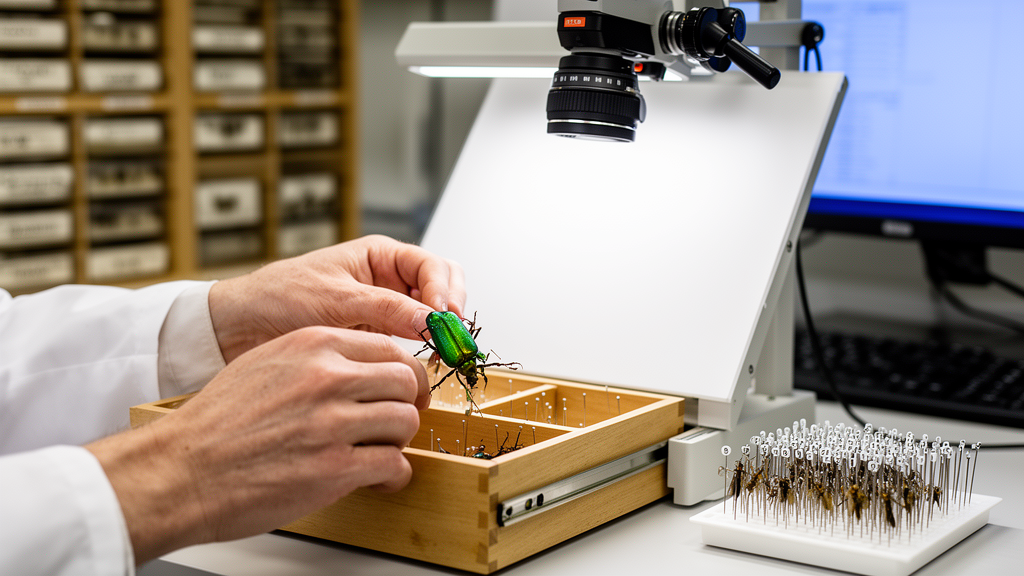
Deep in the mountain forests of Italy, an army of small, often iridescent beetles has been quietly recording ecological history for decades. Now, thanks to a painstaking effort of data curation, thousands of records of carabid beetles collected between 1977 and 1993 have been rescued from scattered, partly inaccessible scientific literature and transformed into an open, standardised dataset that anyone in the world can search, download and reuse. The work, published in the Biodiversity Data Journal, mobilises historical biodiversity data from the Apennines and the Alps into the Darwin Core standard, the shared vocabulary that allows biodiversity records to flow seamlessly into global databases such as the Global Biodiversity Information Facility, or GBIF.
Carabid beetles, commonly known as ground beetles, are one of the most widespread beetle families on Earth and have long been prized by ecologists as model organisms. Because they respond sensitively to changes in habitat structure, temperature and land management, they serve as excellent bioindicators, living gauges of environmental quality. Yet despite the abundance of scientific works on carabid biology, the underlying data have remained surprisingly fragmented. Many Italian studies were published only in hardcopy, often in Italian, preserved in personal archives rather than digital repositories. Without digital object identifiers or machine-readable formats, these papers cannot be directly searched or mined by computers, effectively locking away information that could be fundamental to broader research on woodland ecosystems.
This is precisely the gap the new dataset addresses. The researchers curated a selected pool of field studies conducted across Italian mountain habitats, from the Tuscan-Emilian and Abruzzese Apennines to the Lucanian, Calabrian and Sicilian Apennines, and north to the Lessini mountains in the Alpine area. The 45 sampled sites span altitudes from 150 to 1840 metres above sea level and cover natural and semi-natural environments, with beech forests representing nearly half of all sites at 21 of the 45 locations, followed by pastures with eight sites and oak forests with five. Beech, Fagus sylvatica, is one of Europe’s most widely distributed tree species and carries great historical economic importance for timber production, making its associated beetle communities especially relevant for woodland management.
The standardisation process followed the Darwin Core standard, a controlled vocabulary maintained by the biodiversity informatics community that defines how species occurrences, sampling events and taxonomic names should be encoded. At the event level, site names were standardised within the dwc:eventID field using a consistent format that combines the sampling year, the geographical reference and the specific site name as reported in the original tables. The dwc:habitat field was harmonised using EUNIS codes, the European Nature Information System classification, ensuring a uniform habitat description across all sites. Individual occurrences were documented in the dwc:occurrenceID field through a derived format that concatenates the event identifier with the first four letters of the genus and the first four letters of the specific epithet, creating a hierarchical and traceable connection between every taxonomic record and its sampling context.
The five source studies themselves form a remarkable portrait of Italian carabid research in the late twentieth century. Brandmayr and Zetto Brandmayr’s 1986 ecological-faunistic study analysed carabid and rhysodid beetle communities in beech and fir forests along the Apennines, sampling 14 mountain forest sites in 1976 and 1977 and collecting around 20,000 specimens belonging to approximately 60 species. Pizzolotto and Brandmayr worked in the Nebrodi Mountains of Sicily between 1982 and 1983, covering biotopes from evergreen cork oak forests at lower altitudes to beech and Turkey oak forests above 1300 metres, along with pastures and shrublands. Chemini and Pizzolotto surveyed five woodland sites in the Lessini Mountains in 1982, focusing on hop-hornbeam and beech forests and collecting 22 species. Pizzolotto’s 1993 study on Aspromonte spanned beech and fir forests with variations in altitude, exposure and slope, yielding more than 8,000 specimens of 43 species. Finally, De Felici and collaborators worked at the ENEA Center in Brasimone between 1992 and 1993, collecting 13,607 individuals of 62 species across forest and meadow habitats with different management regimes.
Sampling relied on pitfall traps, the classic tool of ground beetle ecology. In most of the studies, these were plastic cups buried up to the edge, 11 centimetres deep with a mouth diameter of 9.2 centimetres, pierced two-thirds of the way down to let rainwater drain, and filled with 200 millilitres of vinegar mixed with 5 percent formalin. The Lessini study used slightly smaller traps with a 7-centimetre mouth and a saturated solution of potassium bichromate as preservative. Species abundance was evaluated as annual Activity Density, a measure that corrects for uneven sampling effort. Because traps can break for unpredictable reasons, from cows to tourists, the researchers calculated effort units by multiplying the number of traps by the exposure days divided by ten, summed across the year, and then divided the total number of individuals caught by this total annual effort. This formula allowed abundance values to be compared across sites with different trap numbers and exposure periods.
Two genuinely new elements emerged from the curation, information that was not present in the original publications. In the Sicilian study, the authors had omitted four sites from the species list because the collected specimens were still unidentified at the time of publication. Those samples, preserved in the archives of the Department of B.E.S.T. at the University of Calabria, were retrieved and the site information completed, publishing these four sites for the first time. In the Brasimone study, the authors had decided not to evaluate the activity density of 18 species represented by single individuals, the so-called accidental species. Using the sampling effort reported by the original authors, the curators were able to compute activity densities for those 18 species and include them in the final dataset, completing the primary data in a way the original tables never did.
The resulting resource consists of two linked Darwin Core tables. The event table describes the 45 sampled sites, recording identifiers, sampling protocols, trap numbers, sampling effort, event dates, country codes, elevations, EUNIS habitat codes, decimal coordinates with geodetic datum and coordinate uncertainty, and locality information. The occurrence table contains 803 records covering the annual activity density of 177 species, with fields for individual counts, organism quantities and their type, life stage, occurrence status, full scientific names and the complete taxonomic hierarchy from kingdom to specific epithet. All records are based on human observation, and associated references link each occurrence back to its original publication, ensuring traceability from the new dataset to the historical literature.
The dataset now adheres to the FAIR principles, meaning it is Findable, Accessible, Interoperable and Reusable, and it feeds directly into the information on carabid beetles already stored in GBIF. For ecologists, this opens the door to analyses of species occurrence, compositional patterns and ecological structure across Italian mountain systems from the Alps to the Mediterranean. The curators themselves caution that the studies differ in sampling effort, trap density, seasonal coverage and trap exposure duration, so quantitative comparisons of absolute abundance across studies should be interpreted cautiously and possibly after data transformation. The dataset is best suited for occurrence-based and structural analyses rather than direct comparisons of long-term population trends.
Yet the broader significance reaches well beyond beetles. In an era of accelerating climate change, mobilising historical biodiversity data is critical for understanding trends and comparing past and present conditions. By demonstrating how scattered, partly inaccessible and historically fragmented sources can be recovered, harmonised and published in open format, the Italian carabid dataset offers a template for the FAIRification of legacy ecological data everywhere. Records that once required a personal request to the original authors are now a comprehensive, high-quality resource for the international scientific community, proof that the value of decades-old fieldwork can take on new life when it finally becomes interoperable.
Subject of Research: From historical to interoperable data: Darwin Core Standardisation of selected carabid beetles records in Italy (1977–1993)
Article Title: From historical to interoperable data: Darwin Core Standardisation of selected carabid beetles records in Italy (1977–1993)
Article References: Durante, F., & Pizzolotto, R. (2026). From historical to interoperable data: Darwin Core Standardisation of selected carabid beetles records in Italy (1977–1993). Biodiversity Data Journal, 14, Article e186831. https://doi.org/10.3897/bdj.14.e186831
Image Credits: AI Generated
Keywords: biodiversity, carabid beetles, Darwin Core, FAIR data, GBIF, Italy, data standardisation, ecology, historical, interoperable, data, Darwin
News Source: Gavin Prescott. (October 19, 2026). Italy’s Hidden Ground Beetle Records Go Global Through Darwin Core Standardisation. Scienmag.