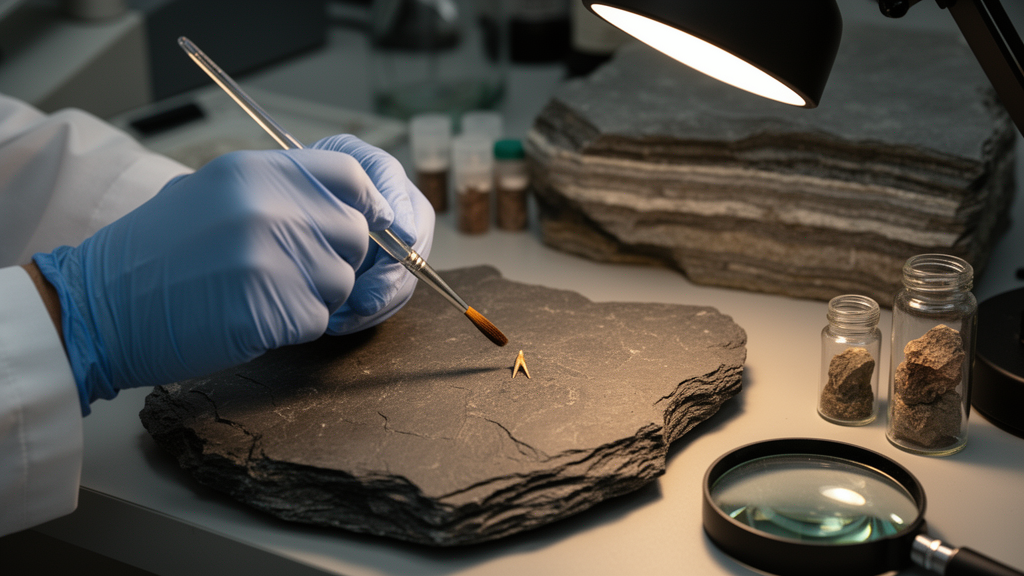
Buried in the dark, silica-rich rocks of western Hubei and eastern Chongqing lies one of China’s most promising shale gas reservoirs, yet geologists have long struggled to answer a deceptively simple question about it: exactly how old are the organic-rich layers that make this region so productive? A new study published in the Journal of Micropalaeontology by Bingyang Zhou, Kui Wu, and colleagues has now delivered a precise answer, using some of the smallest fossils in the geological record. By extracting more than 1,200 specimens of conodonts, the microscopic tooth-like elements of extinct eel-like vertebrates, from five carefully measured rock sections, the team has built a high-resolution timeline for the Late Permian strata of the region and shown that the prized gas-bearing interval is confined to a remarkably narrow slice of deep time.
Conodonts are the unsung heroes of Paleozoic stratigraphy. These animals, which swam in the oceans for roughly 300 million years before vanishing at the end of the Triassic, produced elements composed of calcium phosphate that are extraordinarily resistant to dissolution and evolved rapidly enough to serve as precise chronological markers. Because different species appear and disappear in a predictable succession, geologists can use their first and last occurrences to subdivide rock sequences into biozones that can be correlated across continents. In South China, this approach is especially powerful, as the region hosts three Global Stratotype Sections and Points, the internationally agreed golden spikes that define boundaries of geological time, including the Permian–Triassic boundary at Meishan.
The study area, known as the western Hubei–eastern Chongqing or WHEC region, sits along the northern margin of the South China Block, which during the Permian lay along the eastern edge of the Paleo-Tethys Ocean. Here, thick marine successions record dramatic environmental upheaval: the end-Guadalupian mass extinction, the eruption of the Emeishan Large Igneous Province, a major regression, and a subsequent deepening of the seafloor that allowed thick, organic-rich black shales to accumulate. These shales, belonging to the Dalong Formation, have recently been confirmed to hold substantial industrial-scale shale gas reserves, making them a prime target for unconventional hydrocarbon exploration. But without precise ages, geologists could not be certain whether the gas-rich horizons in different wells and outcrops were actually deposited at the same time.
To resolve this uncertainty, the researchers collected 127 limestone and calcareous mudstone samples from the Longmenba, Huangping, Tongmuyuan, Chenjiawan, and Longjingwan sections. In the laboratory, the samples were crushed and dissolved in dilute acetic acid over seven to ten days, with the residues sieved and then processed using heavy-liquid separation in lithium metatungstate solution to concentrate the dense conodont elements. The method is elegantly simple in principle but demanding in practice, particularly because siliceous and argillaceous rocks, which dominate parts of the Dalong Formation, respond poorly to acid processing. This is why the team focused on interbedded limestones and calcareous horizons that readily yield their fossil cargo.
The results were striking. From 38 productive samples, the team recovered more than 1,200 conodont specimens representing 17 species in four genera: Jinogondolella, Clarkina, Hindeodus, and Iranognathus. These assemblages allowed the recognition of a near-continuous succession of biozones spanning the late Wuchiapingian through the Changhsingian, the two stages that together make up the Lopingian, the final epoch of the Permian Period. The succession begins with Jinogondolella xuanhanensis in the uppermost Guadalupian strata and climbs through a series of Clarkina zones, from C. asymmetrica and C. leveni through C. guangyuanensis, C. transcaucasica, C. orientalis, and C. longicuspidata, before culminating in the C. wangi, C. subcarinata, C. changxingensis, and C. yini zones of the Changhsingian.
This zonal sequence closely matches the internationally calibrated framework established at the Meishan and other reference sections in South China, which means the WHEC strata can now be correlated with global standards. Critically, the first appearance of Clarkina wangi, the species whose debut officially defines the Wuchiapingian–Changhsingian boundary at the Meishan GSSP, was documented in the upper part of the Dalong Formation at both Longmenba and Huangping. This allowed the team to place the stage boundary within the upper Dalong Formation across the study area, with only minor local variations attributable to differences in sedimentary facies and fossil preservation. The Longmenba section emerged as the most complete record, offering the most confident placement of the boundary.
The most consequential finding, however, concerns the age of the shale gas sweet spot itself. By integrating the conodont zones with lithostratigraphic observations, the researchers demonstrated that the organic-rich, siliceous-shale interval in the lower Dalong Formation is temporally restricted to the late Wuchiapingian, corresponding mainly to the upper part of the Clarkina guangyuanensis Zone and extending into the C. orientalis Zone or the lowermost C. longicuspidata Zone. In other words, the gas-productive rocks were deposited within a narrowly defined window of geological time, before fully developed Changhsingian faunas appeared. Comparable age constraints from other gas-bearing sections in the region, including Shangsi, Maoershan, Zhuqiao, Shiligou, Ganxi, and Well Da 201, reinforce the picture that shale gas enrichment across the WHEC region was preferentially concentrated in this single late Wuchiapingian interval rather than scattered randomly through the Late Permian.
Why was this particular window so favorable for organic matter accumulation? The answer lies in a convergence of environmental conditions. Following the end-Guadalupian regression, renewed basin subsidence created deep-water depocenters in the Middle and Upper Yangtze region at approximately 258 million years ago. From that point until the end of the Wuchiapingian, the region experienced reduced input of terrestrial sediment, enhanced accumulation of biogenic silica, and persistent stratification of the water column, conditions that promote high productivity in surface waters and efficient preservation of organic matter on the seafloor. Oxygen isotope evidence from conodont apatite and brachiopod shells further suggests that the C. leveni and C. orientalis zones coincided with relatively cool climatic episodes, which may have enhanced vertical mixing and nutrient recycling, thereby boosting the biological pump that delivered organic carbon to the deep basin.
Adding another layer of intrigue, the late Wuchiapingian also overlaps with the waning eruptive phase of the Emeishan Large Igneous Province. High-precision geochronology constrains the main phase of Emeishan volcanism to between roughly 260.55 and 257.22 million years ago, and evidence of continued activity during the Wuchiapingian comes from volcanic ash layers within the lower Dalong Formation itself, as well as from correlated sections across the region. The authors are careful to note that temporal overlap alone does not prove causation. Basin deepening and the associated paleoceanographic conditions likely exerted the primary control on organic matter enrichment, while volcanism may have acted as a secondary modulating factor, influencing climate, weathering fluxes, nutrient delivery, and silica cycling in ways that indirectly enhanced the conditions favorable for organic-rich shale formation.
Beyond its implications for energy exploration, the study showcases the enduring power of micropaleontology to solve practical problems. The absence of conodonts in two of the five studied sections, Chenjiawan and Longjingwan, was itself informative, pointing to facies-controlled preservational bias rather than true stratigraphic gaps, since siliceous sediments resist acid processing and some settings simply did not host conodont animals. By demonstrating that the WHEC succession is broadly continuous across the Guadalupian–Lopingian transition, punctuated only by a hiatus linked to the Dongwu tectonic uplift, the research provides a robust chronostratigraphic foundation for correlating shale-gas-favorable horizons across wells and outcrops. In doing so, it transforms a collection of tooth-like microfossils, each barely visible to the naked eye, into a precision clock for one of the most economically significant rock units in southern China, and a reminder that some of the biggest answers in Earth science come from its smallest remains.
Subject of Research: Late Permian conodont biostratigraphy of the Dalong Formation in western Hubei–eastern Chongqing, South China, and its implications for shale gas exploration
Article Title: Latest Guadalupian to Lopingian conodonts from western Hubei–eastern Chongqing, South China
Article References: Zhou, B., Wu, K., Song, T., Xu, L., Duan, K., Yuan, J., Yang, L., Zhao, B., Li, J., Wang, D., & Yang, B. (2026). Latest Guadalupian to Lopingian conodonts from western Hubei–eastern Chongqing, South China. Journal of Micropalaeontology, 45(1), 377-403. https://doi.org/10.5194/jm-45-377-2026
Image Credits: AI Generated
Keywords: conodonts, Late Permian, Lopingian, Wuchiapingian, Changhsingian, Dalong Formation, South China, biostratigraphy, shale gas, Emeishan Large Igneous Province, Clarkina, stratigraphy
News Source: Violet Maxwell. (October 9, 2026). Tiny Teeth Fossils Pinpoint the Age of China’s Shale Gas Goldmine. Scienmag.