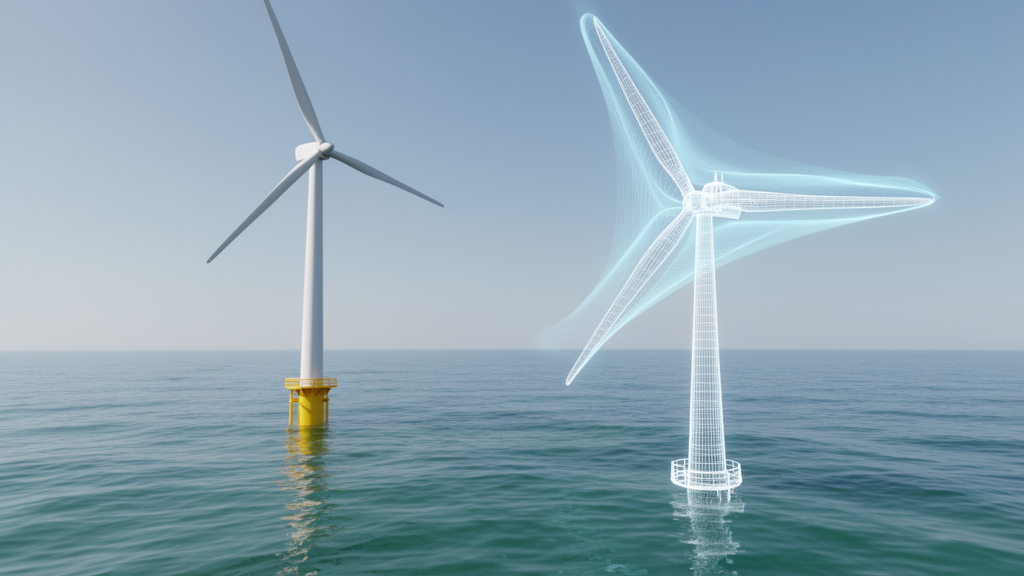
Offshore wind turbines are engineered for a design life of roughly 25 years, but as the first great generation of offshore farms approaches that milestone, operators face a costly and computationally brutal question: how much life is actually left in these machines? A new study published in the journal Wind Energy Science by Franziska Schmidt, Clemens Hübler, and Raimund Rolfes of Leibniz University Hannover and TU Darmstadt offers a strikingly efficient answer. By replacing the industry’s standard brute-force simulation workflow with Kriging meta-models, a form of Gaussian process regression, the team demonstrated that a full lifetime reassessment of an offshore turbine can be performed with less than 0.5 percent of the computing effort required by the exact reference approach, while keeping predictions of lifetime fatigue loads within a few percent of the truth.
The problem the researchers tackled is rooted in the sheer scale of the calculation. To reassess a turbine’s remaining life, engineers must recalculate fatigue damage using the actual combinations of wind and wave conditions the structure has experienced over its service life, rather than the idealized conditions assumed at design time. Because fatigue accumulates over every ten-minute interval of a 25-year career, an exact reassessment would demand on the order of 1.3 million aeroelastic simulations, each of which takes roughly ten minutes of computing time. That is years of continuous computation for a single turbine, which is why current practice, codified in standards such as IEC 61400-3, compresses the problem by reducing the number of environmental conditions considered and extrapolating to the full lifetime using probabilities of occurrence.
That compression, however, introduces uncertainty. The standardized approach bins wind speed, significant wave height, wave peak period, and wind-wave misalignment into discrete classes, and it treats turbulence intensity as a fixed percentile rather than a scattered variable. Combinations that occur rarely in reality, or never, get simulated alongside those that dominate the fatigue budget, while the true richness of the measured climate is lost. Schmidt and colleagues instead asked whether a statistical surrogate could preserve the full set of environmental combinations actually observed at the FINO 3 research platform in the German North Sea, while sidestepping the computational wall entirely.
Their tool of choice, Kriging, is a machine-learning technique that blends a regression trend with a Gaussian process describing deviations from that trend. The underlying assumption is elegant: input conditions that are similar, such as two sea states with comparable wave heights and periods, should produce similar structural responses. The team built separate meta-models for the turbine’s two operating states, normal power production and idling, because the structure behaves fundamentally differently in each. During normal operation the spinning rotor generates strong aerodynamic damping, but when a turbine idles during faults or extreme winds, that damping largely vanishes and wave loads dominate the structural response. For idling rotor blades, the researchers even had to add the initial rotor azimuth angle and mean rotor speed as extra inputs, since blade-root fatigue depends on where the parked rotor happens to stop.
The simulation backbone of the study was the aero-hydro-servo-elastic code FASTv8 from the National Renewable Energy Laboratory, modeling the NREL 5 MW reference turbine on an OC3 monopile with soil-structure interaction. Turbulent wind fields were generated with TurbSim using the Kaimal turbulence model, and irregular waves followed the JONSWAP spectrum. Five environmental parameters were treated as scattered variables: mean wind speed, turbulence intensity, significant wave height, wave peak period, and wind-wave misalignment, all drawn from statistical distributions fitted to FINO 3 measurements. Loads were converted into damage equivalent loads using rainflow counting, the Palmgren-Miner rule, and Wöhler exponents of 3 for steel and 10 for the composite rotor blades.
The benchmark comparison was threefold. The reference method ran a full lifetime reassessment with aeroelastic simulations across all actually occurring environmental combinations, requiring 200,000 simulations for the available-turbine case and 131,490 for the unavailable case after careful convergence studies. The IEC 61400-3 method reduced this to 194,568 simulations, and further trimming of rare combinations brought the requirement down to about 70,000 simulations, roughly 20 percent of the reference effort, while keeping deviations below 10 percent for all monitored internal forces. The meta-model approach needed only 17,000 aeroelastic simulations to train its surrogates, and a convergence study showed even that could be cut dramatically: just 600 training samples for normal operation and 700 for idling sufficed to predict lifetime loads within 5 percent, a total of 1,300 simulations, or less than 0.5 percent of the reference computing effort.
Accuracy held up remarkably well across the board. For a turbine with a typical 90 percent availability, both the IEC method and the meta-model method deviated by less than about 10 percent from the reference lifetime loads for nearly all internal forces at the monopile and the blade root. The exceptions were instructive. In the fully unavailable, idling-only scenario, the meta-model for the side-to-side blade-root bending moment underestimated the reference by roughly 31 percent, likely because the surrogate struggles to capture the strongly wave-driven, lightly damped vibrations that occur when the parked rotor is excited near its natural frequency. Crucially, however, idling contributes so little to the overall fatigue budget of the blade root under realistic availability that the total lifetime prediction remained essentially unaffected.
The study also delivered a practical safety refinement. Meta-model predictions based on the Kriging mean value were not uniformly conservative, meaning they sometimes under-predicted damage relative to the exact simulation. Because Kriging naturally provides a standard deviation alongside every prediction, the researchers simply shifted their predictions to higher percentiles of the Kriging distribution. Using the 65th percentile for normal operation and the 70th percentile for idling made every lifetime prediction conservative, exceeding the reference values while staying within 5 percent of them, a trick that requires no retraining of the models at all.
Perhaps the most provocative finding concerned turbine availability itself. When the team varied availability between 80 and 100 percent, the fore-aft bending moment at the monopile grew dramatically as availability fell, reaching roughly 1.6 times its fully available value at 80 percent availability. The explanation lies in physics rather than statistics: a stopped rotor cannot damp fore-aft motion, so idle time lets waves hammer the structure with far greater effect. For most other load components, including side-to-side monopile forces and blade-root moments, reduced availability actually lowered lifetime damage, since idling loads are generally milder than operating ones. The message for the industry is that downtime is not fatigue-neutral, and idling must be explicitly included in any honest lifetime assessment.
The implications ripple outward. Extending the lives of existing offshore turbines by even a few years multiplies the clean energy yield of steel and concrete already sunk into the seabed, delaying both decommissioning and new manufacturing emissions. With surrogate models, operators could rapidly re-run lifetime calculations whenever conditions change, for instance when a newly built neighboring farm alters the wind climate or when a control strategy is updated mid-life, something impossible with million-simulation workflows. The authors caution that their results are specific to one turbine, one monopile, and one North Sea site, and that transferability to other structures, floating platforms, and onshore machines remains to be demonstrated. But the direction is clear: the fatigue accounting that will decide the fate of the world’s aging offshore wind fleet may soon be done not by supercomputers grinding through millions of simulations, but by lean statistical models trained on a few thousand, delivering answers in a fraction of the time with accuracy to spare.
Subject of Research: Lifetime reassessment of offshore wind turbines using Kriging meta-models under varying operating conditions
Article Title: Lifetime reassessment of offshore wind turbines considering different operating conditions using Kriging meta-models
Article References: Schmidt, F., Hübler, C., & Rolfes, R. (2026). Lifetime reassessment of offshore wind turbines considering different operating conditions using Kriging meta-models. Wind Energy Science, 11(9), 3653-3670. https://doi.org/10.5194/wes-11-3653-2026
Image Credits: AI Generated
Keywords: offshore wind turbines, lifetime extension, fatigue loads, Kriging meta-models, Gaussian process regression, aeroelastic simulation, IEC 61400-3, damage equivalent loads, monopile, idling conditions, FINO 3, computational efficiency
News Source: Faith Mcneil. (October 9, 2026). AI Surrogates Slash Offshore Wind Turbine Lifetime Checks to Under 0.5% of Computing Time. Scienmag.