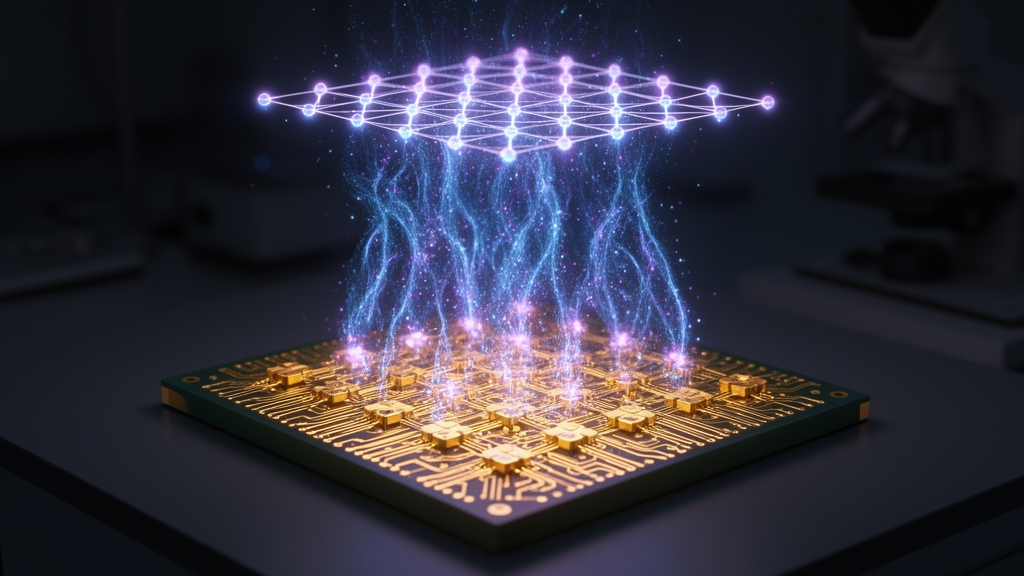
In a result that flips one of quantum computing’s most stubborn liabilities into a working asset, researchers at the University of Florence have shown that the very noise which plagues quantum processors can be harnessed to power generative artificial intelligence. In a study published in Quantum Machine Intelligence, Marco Parigi, Stefano Martina, Francesco Aldo Venturelli and Filippo Caruso describe two physics-inspired protocols that replace or augment the classical noise injection at the heart of diffusion models with genuinely quantum stochastic dynamics. In one approach, simulated quantum stochastic walks produce image generators that are measurably better and more stable than their purely classical counterparts. In the other, the team ran a quantum walk on a real IBM quantum processor and let the machine’s intrinsic hardware noise corrupt the training data during the forward diffusion process, generating recognizable handwritten digits with only four qubits.
To appreciate why this matters, it helps to recall how modern diffusion models work. Systems such as Stable Diffusion and DALL-E learn to create images by reversing a gradual corruption process: a forward chain injects noise into training samples step by step until nothing but structureless randomness remains, and a neural network is then trained to walk that chain backwards, denoising pure noise into novel samples. The forward process is classically stochastic, typically a Markov chain whose transition kernel adds Gaussian or categorical noise at a rate set by a schedule of hyperparameters. The Florence team’s insight was that this noise injection need not be classical at all. Because diffusion itself is a physical phenomenon rooted in non-equilibrium thermodynamics, the forward chain can instead be modeled as a quantum stochastic process, opening the door to quantum effects such as coherence and interference inside the very stage of the pipeline that has always been treated as mere corruption.
The theoretical backbone of the first protocol is the quantum stochastic walk, a framework introduced by Whitfield and colleagues that generalizes both classical random walks and unitary quantum walks within a single equation of motion. The walker’s state is a density matrix evolving under a Kossakowski-Lindblad-Gorini master equation, in which a Hamiltonian term drives coherent, wave-like evolution while Lindblad operators capture incoherent, environment-induced dynamics. A single parameter omega interpolates between the two extremes: at omega equal to zero the walk is purely quantum, at omega equal to one it is purely classical, and intermediate values produce a genuine hybrid. This makes quantum stochastic walks an unusually clean testbed for asking how much quantumness a diffusion process can profitably tolerate, a question the Florence group had previously explored in the context of information transport on complex networks.
For their image-generation experiments, the researchers represented each pixel of a grayscale image as an independent quantum stochastic walker moving on a cycle graph of eight nodes, one node for each possible intensity level after rescaling MNIST pixel values from the range zero to 255 down to zero to seven. The diagonal elements of the walker’s density matrix, its populations, define the categorical distribution from which the pixel’s new value is sampled at each of twenty forward time steps, while the off-diagonal coherences carry the quantum information that a classical chain simply cannot encode. The backward, denoising process was deliberately kept classical and minimal, a multilayer perceptron with shared and time-specialized layers trained by cross-entropy loss, so that any difference in performance could be attributed to the forward dynamics rather than to network architecture.
The results were striking. When the team evaluated generation quality using the Fréchet Inception Distance, a standard metric that measures the statistical distance between distributions of real and generated images, a hybrid dynamics with omega equal to 0.3 produced lower FID scores than the fully classical model at omega equal to 1. Just as importantly, box plots over ten independent training runs showed that the hybrid model’s FID values clustered tightly around the median, whereas the classical runs scattered widely, meaning the quantum-classical blend was not just better on average but statistically more robust. All but one outlier of the hybrid runs outperformed half of the classical runs. The authors trace this advantage to a balance between quantum coherence and stochastic noise that enables more efficient information transport across the eight-node cycle graph, whose diameter of four satisfies the conditions under which hybrid quantum stochastic walks are known to be optimal for transport, a consistency with earlier findings on noisy quantum walks on complex networks.
The second protocol is the more provocative of the two, because it abandons simulation altogether and runs the forward diffusion on actual quantum hardware. Here the pixel walkers are implemented as discrete-time quantum walks on the same eight-node cycle graph, encoded in a quantum circuit requiring only four qubits: three to encode the walker’s position among the eight graph nodes and one for the coin degree of freedom that steers the walk. Because the cycle graph is rotation-invariant, every pixel’s walker can be launched from the same initial state and the measured outcome remapped to the correct pixel value by a simple shift, allowing the entire forward chain for a full image to be executed in a single circuit run. Crucially, the qubit count depends only on the number of grayscale levels, not on image dimensions, which makes the scheme far more scalable than earlier quantum diffusion approaches whose resource requirements ballooned with image size.
Noise enters this hardware implementation not as a nuisance to be suppressed but as the diffusion agent itself. The circuit injects delay operations whose durations follow a sine-squared schedule, in deliberate analogy to the cosine noise schedules of improved classical diffusion models, modulating how much hardware noise accumulates at each time step so that the pixel distribution converges to a uniform prior within twenty steps. The team trained the model on 6,903 full-size 28 by 28 MNIST images of the digit zero, first validating the forward process on the fake_brisbane simulator with one hundred thousand shots and then executing it on the real IBM processor ibm_brisbane with ten thousand shots. The processor’s topology proved well suited to the task, since the coin qubit could interact directly with all three position qubits, and multiple walkers could even run in parallel across different regions of the same chip.
The hardware-based model successfully generated digit images, achieving an FID of 169 between the original and generated datasets, somewhat worse than the 114 obtained with the simulated hybrid quantum stochastic walk. The authors attribute this gap to a structural difference: the circuit-based quantum walk evolves in discrete time, introducing noise more abruptly than the continuous-time quantum stochastic dynamics, which corrupts data more gradually. They also note that the contrast between results on the real device and its simulator underscores how sensitive the approach is to accurate noise characterization, and that error mitigation could eventually be used not to eliminate noise but to tune it precisely. During revision, the team further developed the quantum-walk-based model in collaboration with another group, extending the evaluation to more structured medical imaging datasets, a sign that the technique is already being pushed beyond toy benchmarks.
The broader implications reach well beyond digit generation. Quantum generative models have long been trapped in a scalability bind: the algorithms that promise advantages demand fault-tolerant, error-corrected processors, while today’s noisy intermediate-scale quantum devices are too small and too error-prone to run them. By designing a protocol in which noise is the resource, the Florence group sidesteps that bind and offers a route to useful quantum machine learning on the hardware that exists right now, while potentially avoiding pathologies such as barren plateaus that afflict trainable quantum models. The authors point toward several extensions, including deeper integration of processor topology to widen the range of pixel values, and even physical realizations of the quantum walk that would let the model learn unknown quantum phenomena directly, without any classical embedding, in fields from quantum sensing and metrology to chemistry and biology. For a decade, the quantum computing community has poured effort into fighting noise; this work suggests that in the generative arena, the wiser strategy may be to put it to work.
Subject of Research: Quantum diffusion models that exploit quantum stochastic walks and real quantum hardware noise for generative AI image synthesis
Article Title: Physics-inspired Generative AI models via real hardware-based noisy quantum diffusion
Article References: Physics-inspired Generative AI models via real hardware-based noisy quantum diffusion. (n.d.). https://doi.org/10.1007/s42484-026-00459-5
Image Credits: AI Generated
DOI: 10.1007/s42484-026-00459-5
Keywords: quantum diffusion models, generative AI, quantum stochastic walks, quantum machine learning, quantum noise, NISQ devices, IBM quantum processor, MNIST, Fréchet Inception Distance, denoising diffusion, quantum walks, hybrid quantum-classical algorithms
News Source: Katie Riggs. (October 9, 2026). Quantum Noise Becomes a Friend: Physicists Turn Hardware Errors Into Generative AI Fuel. Scienmag.