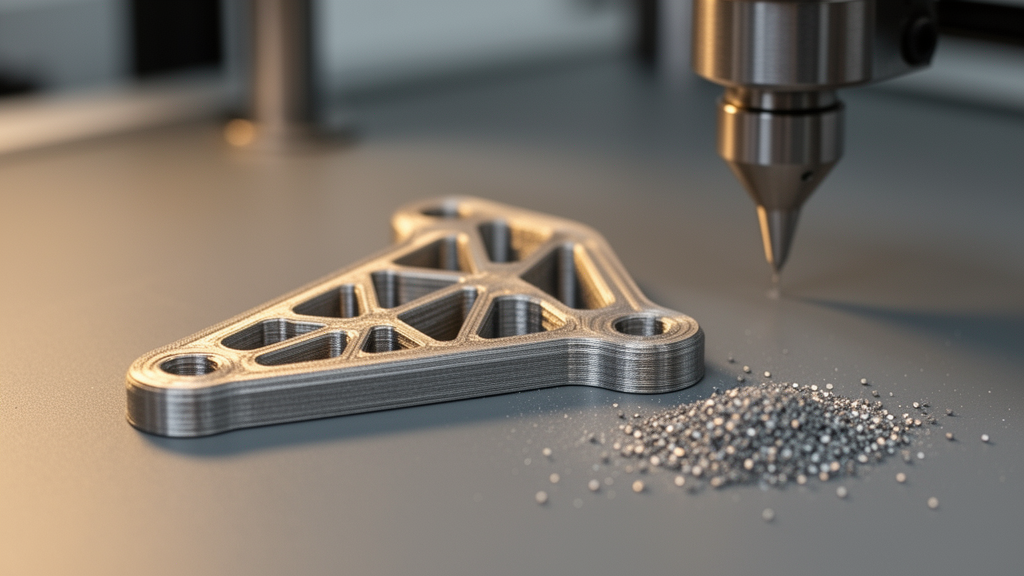
A pinch of iron may be the cheapest upgrade yet for one of the aerospace industry’s most important 3D-printed metals. In a study published in the Journal of Materials Science, researchers report that adding just 1.5 weight percent iron to the titanium alloy Ti-5Al-5Mo-5V-3Cr, better known in the trade as Ti5553, dramatically reshapes the microstructure that emerges from laser powder bed fusion, the dominant 3D-printing process for high-performance metal parts. The result is a printed alloy that is substantially stronger than the unmodified version while retaining almost all of its ductility, a combination that has long eluded engineers working with additively manufactured beta titanium alloys.
Ti5553 is a near-beta titanium alloy prized for its exceptional strength-to-weight ratio and its ability to be aged to very high strength levels, which has made it a candidate material for landing gear components and other heavily loaded airframe structures. But when such alloys are built layer by layer in a laser powder bed fusion machine, the melt pool solidifies under extreme thermal gradients, producing tall, columnar grains that grow along the build direction. These elongated prior-beta grains are a signature of the process, and they can introduce anisotropy, meaning the part is stronger in some directions than others, along with other microstructural quirks that complicate certification for critical applications.
The research team, led by Junchi Xie and corresponding author Yujie Cui of the University of Science and Technology Beijing, systematically varied the iron content of Ti5553 powder at nominal levels of 0, 0.75, 1.5, and 2.25 weight percent, then printed and tested all four compositions under identical conditions. Iron was chosen deliberately: it is a potent beta-phase stabilizer in titanium, it is inexpensive compared with the vanadium and molybdenum already in the alloy, and it has a strong tendency to segregate at the solidification front during solidification, a behavior known as growth restriction that can physically block the advance of columnar grains.
The effect on grain structure was striking. In the as-built condition, the average width of the columnar prior-beta grains fell from 102.69 micrometers in the iron-free alloy to 54.56 micrometers with the 1.5 weight percent iron addition, a reduction of nearly half. The team used the Bo-Md diagram, a well-known molecular-orbital design tool that maps the relative stability of the beta phase based on alloy chemistry, to compare beta-phase stability across the iron-addition series, confirming that iron pushed the alloy toward a more stable beta configuration. Finer grains matter because grain boundaries impede dislocation motion, the fundamental mechanism of plastic deformation, so a finer grain structure translates directly into higher strength.
The mechanical test results bore this out. In the as-built state, the iron-modified alloy with 1.5 weight percent iron achieved an ultimate tensile strength of 1016 megapascals and a yield strength of 1000 megapascals, up from 864 and 828 megapascals respectively for the unmodified Ti5553. Remarkably, this gain in strength came at essentially no cost in ductility: the iron-containing alloy stretched to 18.9 percent elongation before failure, compared with 18.5 percent for the base alloy. In the world of structural metallurgy, where strength and ductility usually trade off against each other like the two ends of a seesaw, preserving elongation while adding roughly 150 megapascals of strength is a genuinely notable outcome.
The story became more nuanced after the printed parts underwent solution treatment and aging, the classic two-step heat treatment that unlocks the full strength potential of near-beta titanium alloys by precipitating fine particles of the alpha phase within the beta matrix. Here the iron addition continued to refine the structure, shrinking the beta grain size from 21.02 to 15.93 micrometers and shifting the phase balance: the alpha-area fraction dropped from 60.12 to 55.56 percent while the retained beta fraction rose from 39.88 to 44.44 percent. The aged iron-modified alloy reached a yield strength of 1416 megapascals, up from 1291 megapascals for the aged base alloy, an increment of 125 megapascals.
That ductility, however, told a cautionary tale. Elongation of the heat-treated material fell from 7.7 percent to 4.4 percent with the iron addition. The authors traced this embrittlement to increased continuity of grain-boundary alpha, the relatively soft alpha phase that forms as a thin film along grain boundaries, and to fracture surfaces showing failure along those same boundaries. When a continuous network of grain-boundary alpha provides an easy crack path, the material fails prematurely along its grain boundaries rather than deforming plastically through its interior, and the benefit of all that precipitate hardening is undermined. This grain-boundary-mediated fracture mode is a known hazard in aged near-beta titanium alloys, and the study shows that iron additions can aggravate it.
To understand where the extra strength came from, the researchers performed a semi-quantitative decomposition of the strengthening contributions, arriving at a total predicted increment of 135.4 megapascals for the aged iron-modified alloy, remarkably close to the 125 megapascals measured experimentally. The two largest contributors were solid-solution strengthening, in which iron atoms dissolved in the beta matrix distort the crystal lattice and resist dislocation motion, and grain refinement strengthening, the Hall-Petch-type effect of the finer grain structure. This kind of mechanistic accounting matters because it tells alloy designers exactly which levers to pull, and it demonstrates that the iron effect is not some mysterious processing accident but a predictable consequence of well-understood physical metallurgy.
The study also drew a hard line on how much iron is too much. At 2.25 weight percent iron, the proportion of processing conditions that produced defective parts jumped from 17.8 percent to 68.9 percent, a catastrophic degradation of printability. Iron changes the thermal behavior of the melt pool and can promote hot cracking and other fusion defects, and the lower as-built properties of some compositions were partly attributed to lack-of-fusion defects, the characteristic voids that form when consecutive layers fail to bond completely. For a manufacturing process in which a single flaw can scrap an expensive aerospace component, this printability cliff is as important as any mechanical property, and it effectively caps the useful iron content well below the level where further beta stabilization might have offered additional gains.
Taken together, the findings position 1.5 weight percent iron as the sweet spot for laser powder bed fusion of Ti5553, offering the best overall balance of strength, ductility, and microstructural refinement among the compositions investigated. The work fits into a broader and rapidly accelerating effort to make additively manufactured titanium alloys both cheaper and better, exemplified by recent high-profile demonstrations of bifunctionally designed printed titanium and iron-toughened titanium-oxygen alloys. Because iron is one of the least expensive alloying elements available, replacing part of the costly vanadium and molybdenum burden with it could shave real money off powder costs at industrial scale, while simultaneously delivering the finer, more isotropic microstructures that certification authorities want to see. The remaining challenge, keeping grain-boundary alpha in check during aging, is now clearly defined, and the quantitative strengthening framework published in this study gives the next generation of alloy designers a head start on solving it.
Subject of Research: Effect of iron additions on the microstructure and mechanical properties of laser powder bed fusion Ti5553 titanium alloy
Article Title: Effect of Fe addition on the microstructure and mechanical properties of Ti5553 alloy fabricated by laser powder bed fusion
Article References: Xie, J., Liu, C., Wu, Z., Yang, R., Guo, L., Wang, T., Jia, W., Liu, K., & Cui, Y. (2026). Effect of Fe addition on the microstructure and mechanical properties of Ti5553 alloy fabricated by laser powder bed fusion. Journal of Materials Science. https://doi.org/10.1007/s10853-026-13816-3
Image Credits: AI Generated
DOI: 10.1007/s10853-026-13816-3
Keywords: titanium alloy, Ti5553, laser powder bed fusion, iron addition, additive manufacturing, beta titanium, grain refinement, solid-solution strengthening, heat treatment, aerospace materials, mechanical properties, microstructure
News Source: Denise Maddox. (October 9, 2026). Tiny Iron Dose Supercharges 3D-Printed Titanium Alloy for Aerospace. Scienmag.