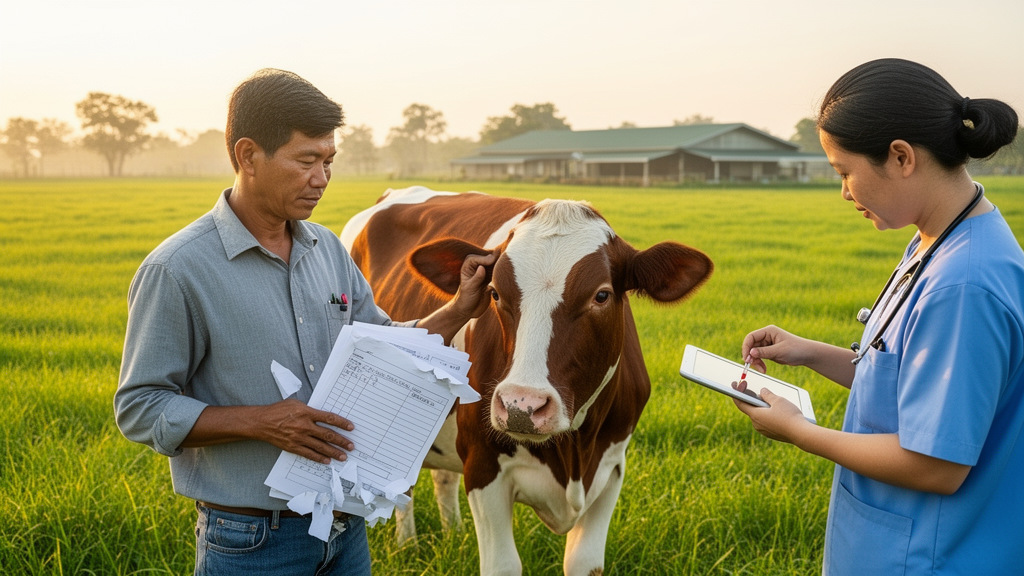
Genomic selection has been heralded as a revolution in livestock breeding, promising to identify superior animals from a simple blood or semen sample. But a new study from Thailand delivers a sobering reality check: even the most sophisticated genomic models cannot fully compensate for sloppy record-keeping. Researchers at Kasetsart University, working with colleagues at Thammasat University and the University of Florida, have shown that when pedigree information — the family trees that connect animals to their ancestors — becomes too incomplete, the accuracy of genomic evaluations collapses, particularly for traits like fertility that are already difficult to improve genetically. The findings, published in Archives Animal Breeding, carry a blunt message for smallholder dairy farmers worldwide: the humble pedigree record remains indispensable, even in the age of the SNP chip.
The Thai dairy sector provided an ideal testing ground for this question. The country’s multibreed cattle population emerged from decades of systematic crossbreeding between taurine breeds — Holstein, Jersey, Brown Swiss, and Red Dane — and indicine breeds including Brahman, Sahiwal, Red Sindhi, and Thai Native cattle. The goal was to combine the tropical adaptability of indicine ancestry with the milk production capacity of taurine genetics. The result is a continuous gradient of breed composition rather than discrete breed groups, with the vast majority of cows — 92.75 percent — carrying Holstein fractions of 75 percent or greater. This admixture, spread across 1,312 smallholder farms in five regions of Thailand, makes accurate estimation of genetic relationships both within and across breeds and generations critically important, and correspondingly difficult.
The research team assembled an impressive dataset: phenotypic records from 14,239 first-lactation cows that calved between 1989 and 2019, a pedigree file covering 25,551 animals, and genotypes from 5,175 animals. The genotypes came from eight different GeneSeek GGP chips ranging from about 9,000 to 150,000 markers, all imputed to a common density of 117,796 single-nucleotide polymorphisms using the Findhap 4 algorithm, which reconstructs haplotypes by combining pedigree transmission information with population linkage disequilibrium patterns. Notably, the imputation pipeline allowed the team to infer genotypes for 172 previously non-genotyped animals — mostly influential sires — whose haplotypes could be reconstructed from chromosomal segments shared among their genotyped offspring. Three economically important traits were analyzed: 305-day milk yield, 305-day fat percentage, and age at first calving.
The heart of the experiment lay in nine carefully constructed pedigree omission scenarios. The first scenario used all available pedigree information as a reference. The next three progressively removed sire identification, dam identification, or both for all genotyped animals, simulating decisions about which animals to prioritize for genotyping when resources are limited. The remaining five scenarios excluded pedigree information for 10, 20, 30, 40, and finally 50 percent of animals with phenotypic records, following a cumulative nested design in which each scenario contained all animals from the previous one plus newly affected individuals. This design ensured that differences between scenarios reflected the incremental loss of pedigree connectivity rather than random re-sampling noise. Each scenario was then run through a three-trait single-step genomic–polygenic model, the workhorse of modern genetic evaluation, which blends pedigree, genomic, and phenotypic information into a single combined relationship matrix.
The results revealed that losing pedigree data does not simply degrade evaluations uniformly — it reshapes them in trait-specific ways. As pedigree completeness declined, additive genetic variance estimates for milk yield tended to increase, rising from 143,550 square kilograms in one intermediate scenario to 177,440 square kilograms under the most extreme omission, and heritability for milk yield climbed from 0.25 to 0.30. This inflation likely reflects a redistribution of variance as the model leaned more heavily on genomic relationships, which alone cannot capture all additive genetic connections in the population. Fat percentage behaved differently: its additive genetic variance stayed relatively stable, but its heritability plummeted from 0.19 to 0.06. Age at first calving proved most fragile, with additive genetic variance dropping from 3.75 to as low as 1.72 square months and heritability falling from 0.18 to 0.10.
These divergent patterns trace back to a fundamental statistical principle: low-heritability traits are the most vulnerable to missing relationship information. Fertility traits such as age at first calving are heavily influenced by environmental factors, leaving a thin additive genetic signal that depends strongly on accurate pedigree-based covariances among relatives to be detected at all. When pedigree links vanish, the model loses the information needed to separate genetic from environmental causes, and the estimated genetic signal shrinks or destabilizes. The genetic correlations between traits also drifted as pedigree completeness declined — the correlation between milk yield and fat percentage became increasingly negative, shifting from −0.40 to −0.91 — indicating growing instability in the estimated covariance structure rather than any real biological change.
The consequences for breeding value prediction were equally revealing. When pedigree information was removed only from genotyped animals, correlations between breeding values from the complete and incomplete scenarios remained high, between 0.95 and 0.99, showing that genomic relationships largely preserved genetic connectedness for these individuals. Moderate random omissions were also tolerable: with up to 20 percent of phenotyped animals lacking pedigree records, correlations stayed above 0.90 for all three traits. But beyond that threshold, the situation deteriorated rapidly. Under the most extreme scenario, with 50 percent of phenotyped animals missing pedigree information, correlations with the reference evaluation fell to 0.86 for milk yield, 0.51 for fat percentage, and 0.76 for age at first calving. Genomic data, the study concluded, can partially compensate for moderate pedigree gaps, but that compensatory capacity is trait-specific and ultimately limited.
Perhaps most striking were the effects on animal rankings, which translate directly into real-world selection decisions. Under the highest selection intensity — the top 5 percent of animals — rank correlations between the complete and most incomplete scenarios collapsed from 0.86 to 0.21 for milk yield in sires and from 0.83 to 0.20 for fat percentage in cows. In practical terms, a breeding program operating on such a compromised dataset would select an almost entirely different set of elite animals than one with complete records, squandering resources and slowing genetic progress. The study also found that losing both parental records hurt more than losing just one, and that dam information mattered slightly more than sire information — a useful guide for farmers and breeding programs deciding which records to prioritize when documentation is incomplete.
For tropical smallholder dairy systems, where infrastructure for systematic record-keeping is often lacking, the message is both cautionary and actionable. Genomic–polygenic evaluations can remain viable when up to 20 percent of pedigree data are missing, offering a realistic buffer for imperfect real-world conditions. But beyond that point, the accuracy of selection quietly erodes, with the damage concentrated in exactly the traits — fertility and milk composition — that determine long-term profitability. The authors argue that promoting systematic pedigree recording among farmers is not a relic of pre-genomic breeding but a foundational requirement for reliable genomic selection. In multibreed, smallholder populations, where crossbreeding already complicates pedigree tracking, the family tree and the SNP chip must work together; neither can carry the weight of genetic improvement alone.
Subject of Research: Impact of pedigree completeness on genomic–polygenic genetic evaluations in Thai multibreed dairy cattle
Article Title: Impact of pedigree completeness on genomic–polygenic evaluations for milk yield, fat percentage, and age at first calving in Thai multibreed dairy cattle
Article References: Jattawa, D., Thiengpimol, P., Suwanasopee, T., Elzo, M. A., Laodim, T., & Koonawootrittriron, S. (2026). Impact of pedigree completeness on genomic–polygenic evaluations for milk yield, fat percentage, and age at first calving in Thai multibreed dairy cattle. Archives Animal Breeding, 69(3), 455-467. https://doi.org/10.5194/aab-69-455-2026
Image Credits: AI Generated
Keywords: genomic selection, pedigree completeness, dairy cattle, multibreed populations, heritability, breeding values, single-step genomic BLUP, smallholder farming, Thailand, milk yield, age at first calving, animal breeding
News Source: Juliet Wilcox. (October 9, 2026). When Family Trees Fail: Missing Pedigree Records Undermine Genomic Selection in Thai Dairy Cattle. Scienmag.