Deep beneath the Earth’s surface, a humble mineral may be doing far more than scientists ever suspected. Phlogopite, a potassium-rich mica common in subduction zones and the metasomatized mantle, has long been known as a carrier of water and fluorine into the deep Earth. Now, a team of German researchers has shown, atom by atom, exactly how this mineral transforms as it heats up, revealing a sequence of changes that could reshape how geophysicists interpret electrical anomalies in the lithosphere. The study, published in the European Journal of Mineralogy, tracked the behavior of iron-bearing fluorophlogopite from room temperature all the way to 1450 kelvin using in situ Raman spectroscopy, a technique that listens to the natural vibrations of atoms within a crystal lattice.
The research team, led by Christian Reinberg and Boriana Mihailova of the University of Hamburg, together with Stylianos Aspiotis of Hamburg University of Technology, Thomas Malcherek, and Stefan T. M. Peters, examined a natural fluorophlogopite crystal from the Cardiff Uranium Mine in Ontario, Canada. The specimen, a dark-brownish tabular crystal roughly 26 by 24 by 6 millimeters, came from the collection of the Museum of Nature Hamburg. It contained about 0.15 atoms per formula unit of divalent iron and approximately 0.40 atoms per formula unit of hydroxyl groups, making it an ideal candidate for probing how iron and water-bearing defects influence the thermal behavior of trioctahedral mica.
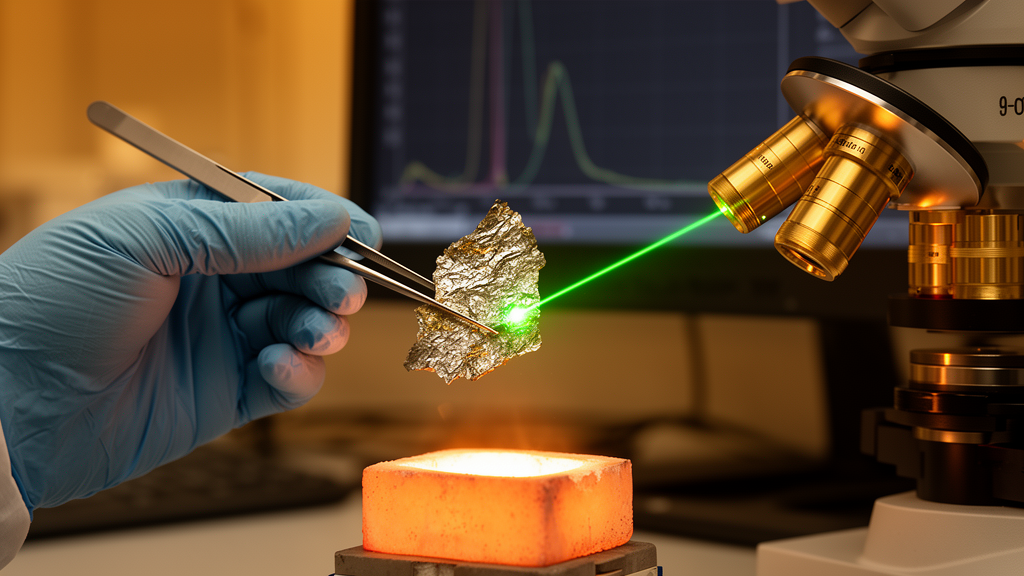
The experimental setup was elegant in its precision. The researchers cut thin rectangular flakes parallel to the crystal’s cleavage plane and heated them in air at 20 kelvin per minute on a calibrated heating stage, collecting Raman spectra with a green argon-ion laser focused to a spot about two micrometers across. Crucially, they extended their measurements down to 15 wavenumbers, capturing the lowest-energy vibrational mode of the crystal, a mode involving out-of-plane translations of the silicate layers that had never before been tracked at high temperature in this mineral. This low-frequency phonon turned out to be the key witness to a hidden structural drama.
Between roughly 550 and 650 kelvin, the team observed classic signatures of a phonon-driven structural instability. The wavenumber of the layer-translation mode near 92 wavenumbers showed a plateau-like minimum, while its linewidth peaked near 600 to 650 kelvin, a combination that typically heralds a phase transition driven by lattice vibrations. At the same time, the phonon expandability of this mode, a measure of how its frequency shifts with temperature, flipped from positive to negative, and the hard mode near 739 wavenumbers, known to be sensitive to the occupancy of the interlayer potassium site, began to rise anomalously with heating. Together, these signals pointed to a rearrangement of the interlayer region that mobilizes potassium cations.
This mobilization has profound geophysical implications. Because potassium ions carry positive charge, their delocalization within the interlayer space between 650 and roughly 1050 kelvin means they can act as charge carriers, contributing to the unusually high electrical conductivity that phlogopite exhibits above 900 kelvin. The process proved fully reversible up to about 1100 kelvin: when the sample was cooled, the spectral anomalies vanished and the crystal returned to its original state. This reversibility suggests that in the Earth’s crust and shallow mantle, where temperatures fall within this range, potassium migration through phlogopite could be an ongoing, dynamic process rather than a one-way chemical alteration.
Around 1150 kelvin, a second, more dramatic change occurred. The hydroxyl-stretching peaks in the Raman spectra, which arise from O-H bonds in the crystal, first intensified sharply, a sign that hydrogen cations were vibrating with greater amplitude just before breaking free from their oxygen anchors. Above that temperature, the peaks disappeared entirely, indicating that all hydrogen cations in the structure had delocalized. Remarkably, when the sample was cooled, the hydroxyl signals returned, showing that most of the hydrogen had not actually left the crystal but had merely been mobilized. Only after heating to 1450 kelvin did a permanent loss emerge, with about 65 percent of the hydroxyl groups recovering at room temperature, implying a 35 percent reduction attributable to dehydroxylation.
The third act of this thermal drama involved iron. Starting near 1300 kelvin, the divalent iron sitting in the octahedral sites of the crystal began to oxidize irreversibly to trivalent iron. The evidence came from a subtle but telling feature: a weak extra Raman signal at 602 wavenumbers that appeared only after the sample had cooled back to room temperature from 1450 kelvin. This signal is a resonance Raman scattering feature, produced when a polar optical phonon couples with an excited electron, a combination that breaks the normal symmetry selection rules of the centrosymmetric crystal. Its persistence after cooling confirmed that the iron oxidation was permanent. A minimum in the temperature trend of the tetrahedral ring-breathing mode at 1300 kelvin provided independent corroboration, reflecting the local puckering of silicate rings as they adjusted to the smaller iron-three-plus octahedra.
Above 1300 kelvin, the mineral began to fall apart, though only partially. Raman mapping of the heated crystal revealed tiny amounts of forsterite, the magnesium end-member of olivine, accounting for roughly one percent of the sample volume. Electron microprobe analysis and single-crystal X-ray diffraction confirmed the chemical picture: a slight shrinkage of the unit cell consistent with iron oxidation and hydroxyl loss, no detectable change in fluorine content, and a potassium loss of only about two percent. The confocal Raman maps delivered a surprise: the forsterite was concentrated in an ultrathin layer on the crystal surface parallel to the cleavage plane, decaying exponentially to negligible levels within about half a micrometer of the surface. The nanometer-scale grains were too small for X-ray diffraction to detect, explaining why earlier studies relying on diffraction alone had missed the spatial details of the decomposition.
The cumulative picture that emerges is one of a mineral that does not fail catastrophically at a single threshold but instead passes through a choreographed sequence of transformations, each with its own temperature window and its own consequences for charge transport. Between 500 and 650 kelvin, the bonds linking tetrahedral and octahedral sheets weaken, priming the interlayer for potassium mobilization. From 650 to 1050 kelvin, mobile potassium cations enhance conductivity along the cleavage plane. Near 1150 kelvin, hydrogen joins the ranks of mobile charge carriers. At 1300 kelvin, iron oxidation begins, and by 1400 to 1450 kelvin, dehydroxylation triggers partial structural collapse and the nucleation of forsterite. The authors note that the specific temperatures of each stage likely depend on the initial iron and hydroxyl contents of the sample and on the surrounding atmosphere, meaning that natural phlogopites with different chemistries may transform at somewhat different points.
For Earth scientists, the implications extend well beyond the laboratory. Phlogopite is a principal vehicle for transporting water and halogens into the upper mantle through subduction zones, reaching depths of roughly 180 to 200 kilometers before breaking down. The new results suggest that the mobility of charge carriers within this mineral begins at far lower temperatures than the established pressure-temperature stability fields would imply, meaning that mantle metasomatism, the chemical alteration of the mantle by fluids and melts, may operate over a wider temperature range and a larger depth profile than previously appreciated. Because fluorine substitution for hydroxyl groups extends the thermal stability of phlogopite, fluorine-rich varieties may carry these crystallochemical transformations to even greater depths, modulating the deep volatile cycle in ways that geophysical models are only beginning to capture. What happens to a single crystal on a heating stage in Hamburg, it turns out, echoes through the electrical structure of the deep Earth.
Subject of Research: Thermally activated structural and crystallochemical transformations in iron-bearing fluorophlogopite mica studied by in situ high-temperature Raman spectroscopy
Article Title: Thermally activated multistep alteration of Fe2+-bearing fluorophlogopite revealed by in situ Raman spectroscopy
Article References: Reinberg, C., Aspiotis, S., Malcherek, T., Peters, S. T. M., & Mihailova, B. (2026). Thermally activated multistep alteration of Fe 2+ -bearing fluorophlogopite revealed by in situ Raman spectroscopy. European Journal of Mineralogy, 38(4), 461-475. https://doi.org/10.5194/ejm-38-461-2026
Image Credits: AI Generated
Keywords: phlogopite, fluorophlogopite, Raman spectroscopy, high temperature, potassium mobility, charge carriers, iron oxidation, dehydroxylation, forsterite, electrical conductivity, mantle metasomatism, subduction zones
News Source: Bethany Barker. (October 9, 2026). Raman Spectroscopy Reveals Step-by-Step Breakdown of Iron-Bearing Mica Under Heat. Scienmag.