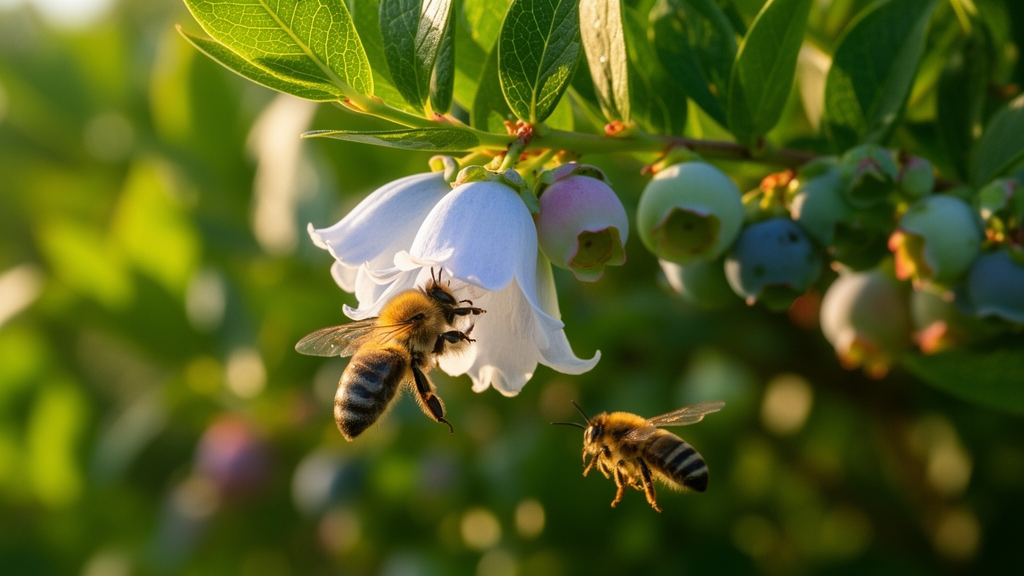
Blueberries are one of the world’s most fashionable fruit crops, and their production depends almost entirely on insects willing to do the delicate work of moving pollen from flower to flower. But a blueberry flower is not an open buffet. It hangs upside down, shaped like a narrow tube, with anthers that release pollen only through tiny pores and nectar hidden deep at the base of the corolla. A new study from Portugal, published in the journal Web Ecology, shows that this architecture is not a mere botanical curiosity. It is a gatekeeping system, and the size of the gate varies dramatically from cultivar to cultivar, deciding which bees can enter legitimately, which ones are excluded, and which ones resort to breaking in.
Researchers from the Centre for Functional Ecology at the University of Coimbra, led by Helena Castro, set out to answer a question that has been surprisingly neglected in blueberry science. While much attention has been paid to how many pollinators visit a field and how abundant they are, far less is known about how the shape of the flowers themselves filters visitor behaviour. The team took advantage of an experimental field at the Agrarian Field Station of Viseu, in the Centro region of Portugal, where nineteen blueberry cultivars grow side by side under identical conditions. The collection included ten northern highbush varieties such as Bluecrop, Chandler and Aurora, eight southern highbush varieties including Biloxi, Misty and Star, and one rabbiteye cultivar, Ochlockonee. Because all the plants shared the same soil, climate and management, any differences in visitor behaviour could be traced back to the plants themselves.
The first step was to measure the flowers. The researchers collected six to ten flowers from each of five randomly selected bushes per cultivar, preserved them in ethanol and measured three traits with a digital calliper: corolla length from the base of the floral tube to the opening, corolla width at its broadest point, and the diameter of the corolla opening, the narrow doorway through which a bee must push its head. The measurements revealed striking variation. Corolla length ranged from 6.21 millimetres in the cultivar Star to 11.85 millimetres in Chandler, nearly a doubling of tube length. Corolla width spanned from 4.18 millimetres in Rebel to 7.97 millimetres in Draper, and the opening diameter ranged from a tight 2.26 millimetres in Rebel to a generous 5.13 millimetres in Aurora. Southern highbush cultivars tended to have smaller corollas than their northern cousins, with the rabbiteye cultivar falling in between.
With the floral geometry mapped, the team turned to the visitors. Over the flowering season from mid-March to late April 2023, observers watched the bushes on sunny days in five-minute periods distributed from nine in the morning to five in the afternoon, accumulating more than fifty hours of surveillance. For every insect that touched a flower, they recorded its identity, the number of flowers it visited, and crucially its behaviour: whether it was a legitimate visitor inserting its proboscis or head into the corolla, a primary nectar robber biting holes through the base of the flower, or a secondary robber siphoning nectar through holes made by someone else.
Thirteen insect species were recorded interacting with the flowers, but just three of them accounted for 93.8 percent of all interactions. The most frequent visitor was the wild buff-tailed bumblebee, Bombus terrestris, with a proboscis of intermediate length at 6.50 millimetres and an overall visitation rate of 4.71 percent of open flowers. Second came the solitary hairy-footed flower bee, Anthophora plumipes, equipped with the longest tongue of the trio at 9.00 millimetres. The managed honeybee, Apis mellifera, with the shortest proboscis at 5.00 millimetres, ranked third, a position likely influenced by the absence of beehives at the study site and by a nearby apple orchard whose open flowers overlap in bloom with blueberry and offer easier rewards.
The pattern that emerged when visitation rates were matched against flower size is the heart of the study, and it is remarkably tidy. Using a principal component analysis that combined corolla length, width and opening into a single gradient of flower size, the researchers fitted generalised additive models to test how each main visitor responded. Honeybees, the short-tongued specialists of easy access, tended to visit cultivars with the smallest flowers. The long-tongued Anthophora plumipes did the opposite, visiting more flowers on cultivars with large corollas. Bombus terrestris, whose tongue sits between the two, peaked on cultivars with intermediate-sized flowers. In effect, each bee species sorted itself onto the cultivars whose floral dimensions best matched its own anatomy, a textbook case of functional matching and resource partitioning within a single crop field.
The explanation lies in foraging economics. A bee whose proboscis is shorter than the corolla tube must work harder and longer to reach nectar, raising the cost of each flower visit. Pollinators prefer flowers they can handle efficiently, because higher handling efficiency translates into a better cost-benefit ratio and higher fitness. Previous work on lavender showed that when corolla length was experimentally reduced, honeybee handling time dropped accordingly. The Portuguese data suggest the same logic operates across blueberry cultivars: each of the three main visitors selects flowers that fit its morphology, allowing faster nectar extraction and more flowers visited per unit of time. Even long-tongued bees, which can physically access both long and short corollas, tend to favour flowers matched to their tongues because handling is swifter.
The study also documented a darker side of floral specialisation: nectar robbing. The carpenter bee Xylocopa cantabrita acted as a primary robber, piercing holes at the base of the corolla to reach the nectaries directly, while bumblebees and honeybees followed as secondary robbers, exploiting the holes made by the carpenter bees. Robbing varied sharply among cultivars and was highest in Chandler, the cultivar with the longest corollas and the lowest rate of legitimate visits, at just 5.36 percent of flowers, compared with 16.5 percent in the small-flowered Aurora. This supports the team’s hypothesis that longer corollas and smaller apertures constrain legitimate visitors and push insects toward illegitimate routes. Nectar robbing can reduce nectar availability and make flowers less attractive to pollinators, potentially lowering fruit set, although carpenter bees are known to deposit pollen on blueberry stigmas during their visits, particularly in cultivars with protruding stigmas, so the relationship is not entirely one-sided.
The practical implications reach all the way from breeding programmes to orchard design. The authors argue that corolla size variation should be an explicit criterion in cultivar selection and field planning. A grower who relies on managed honeybee colonies should favour cultivars with shorter and wider corollas, ideally with extruding pistils that allow contact with pollen-carrying hairs on the bee’s body. A grower who wants to harness wild pollinator communities should promote natural areas with diverse floral and nesting resources, ensuring the presence of species with a range of proboscis lengths and, importantly, species capable of buzz pollination. Blueberry anthers are poricidal, meaning pollen is released only when a bee vibrates them at high frequency, a skill mastered by bumblebees and Anthophora but not by honeybees, which need many more visits to pollinate a single flower.
Ultimately, the study reframes pollination as a three-dimensional fitting problem rather than a simple numbers game. It is not enough to have bees in the field; the bees must fit the flowers. With more than 75 percent of food crops depending at least partly on animal pollination, and pollination services valued at up to 387 billion US dollars annually, understanding how a few millimetres of corolla tissue can redirect entire pollinator communities has consequences far beyond one berry crop. For blueberries, the message is clear: choose cultivars that match the tongues you can attract, and the bees will do the rest.
Subject of Research: The influence of blueberry floral morphology and pollinator proboscis size on visitation, behaviour and nectar robbing
Article Title: Blueberry floral morphology influences pollinator visitation and behavioural patterns
Article References: Blueberry floral morphology influences pollinator visitation and behavioural patterns. (n.d.). https://doi.org/10.5194/we-26-83-2026
Image Credits: AI Generated
Keywords: blueberry, pollination, floral morphology, bees, Apis mellifera, Bombus terrestris, Anthophora plumipes, nectar robbing, proboscis length, cultivar selection, buzz pollination, agroecosystems
News Source: Drew Townsend. (October 9, 2026). Blueberry Flower Shape Decides Which Bees Visit and Which Bees Steal. Scienmag.