More than 520 million years ago, shallow tropical seas covering what is now southern China were teeming with microscopic life that would quietly reshape the planet’s carbonate factories. A new study published in the Journal of Micropalaeontology documents an extraordinary diversity of calcified cyanobacteria preserved in Cambrian Series 2 limestones of the Yangtze Platform, revealing that these humble microbes were far more widespread and taxonomically rich than previously appreciated. The research, led by Jinwen Shen, Jiawei Zheng, Lijing Liu, and Rui Wang of Northwest University in Xi’an together with Robert Riding of the University of Tennessee, identifies 15 species in 10 genera of calcified cyanobacteria alongside 5 species in 3 genera of enigmatic microfossils known as Microproblematica, including two species entirely new to science.
The team examined 10 outcrop sections spread across five regions of the Yangtze Platform: western Hunan, northeastern Guizhou, eastern Hubei, southern Shaanxi, and northern Sichuan. These strata, assigned to Cambrian Series 2 Stages 3 and 4, include both classic archaeocyath sponge reefs and quieter non-reefal carbonate settings. The scale of the work is staggering: 13,094 thin sections were prepared and scrutinized under a polarizing microscope, yielding more than 4,000 photomicrographs. Fossils were identified using diagnostic features such as filament diameter, length, branching pattern, sheath thickness, and overall morphology, with classifications cross-referenced against both fossil material and living cyanobacteria.
Among the headline discoveries are two new species: Streptubularia robustus, a robust curved tube with a thick micritic wall reaching external diameters of 85 to 125 micrometers, and Xianella mollis, an unbranched, wavy filament forming distinctive U-shaped mat-like bundles up to 3.3 millimeters long. The researchers interpret Xianella mollis as the calcified sheath of a cyanobacterium comparable to living Phormidiaceae such as Phormidium, whose modern bundles curve in strikingly similar ways. Streptubularia, by contrast, is compared with oscillatoriacean sheaths, though its sheer size and Y-shaped branching set it apart from better-known genera like Girvanella.
Perhaps the most consequential single finding concerns Acuasiphonoria, a genus of long, straight, needle-tipped filaments previously known only from Late Ordovician rocks of the Tarim Basin in northwest China. Its presence in the Qingxudong Formation of Hunan Province pushes the fossil record of this genus back roughly 40 million years, from the Late Ordovician into Cambrian Series 2. The study also reports the first occurrences in South China of six additional genera: Razumovskia, Subtifloria, Xianella, Bija, Botomaella, and Acuasiphonoria itself, substantially closing a biogeographic gap between the famously well-studied Cambrian floras of Siberia and the more fragmentary records elsewhere.
The systematic framework assigns the fossils to two cyanobacterial orders. Girvanella, Subtifloria, Razumovskia, Acuasiphonoria, Xianella, and Streptubularia belong to the Oscillatoriales, filamentous forms whose calcified sheaths tangle, bundle, or anastomose into cable-like strands. Kordephyton, Bija, Hedstroemia, and Botomaella are placed in the Nostocales, bushy, fan-like, radially branching forms resembling modern rivulariaceans such as Rivularia. The associated Microproblematica, including the dendritic Epiphyton, the chambered Renalcis, and the cleft-walled Izhella, remain of uncertain affinity, though some evidence, including direct indications of photosynthesis reported in earlier work, points toward a cyanobacterial or bacterial origin for at least some of them.
Why do these microbes calcify at all? The answer lies in their physiology. Cyanobacterial photosynthesis raises pH within and around the extracellular polysaccharide sheath, promoting the precipitation of calcium carbonate on or within the sheath itself. Because this process depends on seawater carbonate saturation state and atmospheric carbon dioxide levels, the abundance and diversity of calcified cyanobacteria through geological time can serve as a proxy for ancient ocean and atmosphere chemistry. Riding’s 1992 concept of cyanobacterial calcification episodes, or CCEs, formalizes this idea: intervals of enhanced marine cyanobacterial calcification alternate with episodes of reduced calcification, tracking secular shifts in the carbon cycle.
The Cambrian and Early Ordovician have long been recognized as major CCEs, and the new South Chinese data reinforce that picture with unprecedented regional detail. The assemblages from the Yangtze Platform closely resemble those of the Siberian Platform and North China, establishing that at least 15 genera of calcified cyanobacteria had achieved a genuinely global distribution in shallow marine waters by the early Cambrian. This is a striking contrast with North America and Europe, where early Cambrian calcified microfossil diversity is comparatively depauperate, commonly limited to Girvanella and Botomaella.
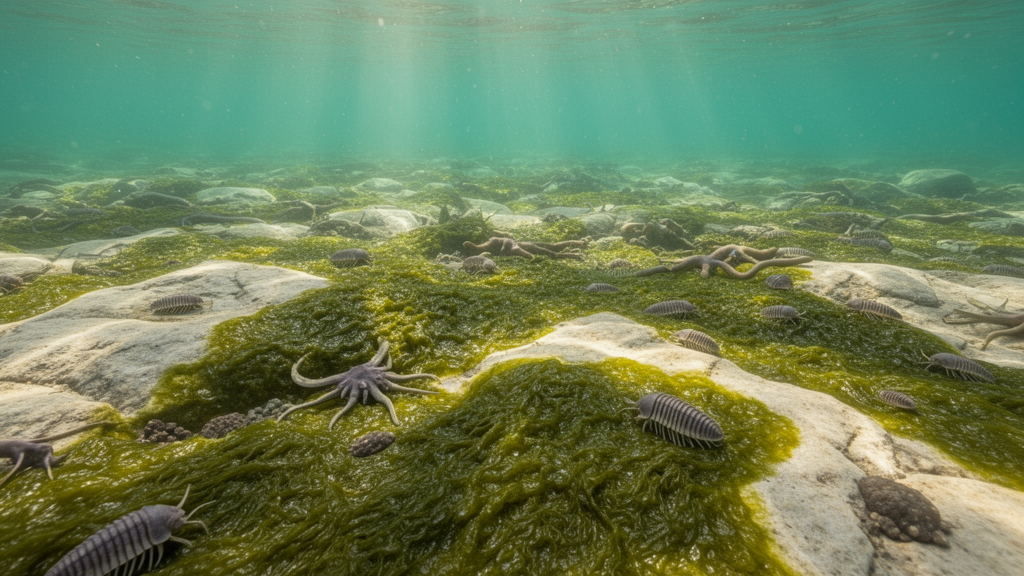
The study also reveals how these microbes built and organized ecosystems through time. During deposition of the Xiannüdong Formation in Stage 3, microbial-archaeocyath reefs developed, but calcified cyanobacteria were scarce, with Epiphyton and Renalcis merely encrusting sponge frameworks amid substantial terrigenous clastic input. In the Tianheban Formation of Stage 4, archaeocyaths still formed the reef skeleton, but calcified cyanobacteria such as Kordephyton, Streptubularia, and Bija took on important encrusting and binding roles. Then, when archaeocyaths went extinct, reefs in the Qingxudong Formation were constructed entirely by calcimicrobes, whose diversity and abundance surged. Filamentous mats reduced water flow and trapped sediment, while chambered Epiphyton and Renalcis clusters reinforced the framework and filled interstitial spaces, demonstrating a complete ecological handover from animals to microbes.
Notably, the research documents for the first time that calcified cyanobacteria flourished not only in reefs but also in non-reefal shallow-marine carbonate facies in South China, where they occur in low-energy settings, though in depauperate assemblages. The taxonomic composition tracks sedimentary environment closely, with diversity and abundance peaking in reefal facies whose character was set by the other reef builders present. The authors suggest that the gradual evolution from simple oscillatoriacean-dominated assemblages to more diverse communities including Phormidiaceae and Rivulariaceae may have been driven by ecological competition with archaeocyaths, by declining terrigenous detrital input, or by both factors together.
Beyond its taxonomic contributions, the study carries implications for understanding the dawn of the Phanerozoic Eon, the interval during which nearly all major animal phyla appeared. While the Cambrian explosion transformed animal life, the microbial world was undergoing its own quiet revolution, with calcifying cyanobacteria proliferating across reefs and open shelves alike. Because cyanobacterial calcification responds to atmospheric carbon dioxide and oceanic carbonate saturation, these fossil assemblages offer an independent window into the environmental conditions that accompanied the rise of complex animal ecosystems. The authors argue that continued study of these globally distributed floras will sharpen our understanding of cyanobacterial evolution, biogeography, and their environmental significance at one of the most pivotal moments in Earth history, when the chemistry of the oceans and atmosphere set the stage for half a billion years of animal-dominated life.
Subject of Research: Diversity and systematics of early Cambrian calcified cyanobacteria and associated microfossils in shallow-marine carbonates of the Yangtze Platform, South China
Article Title: Diversity and systematics of calcified cyanobacteria and associated microfossils in Cambrian Series 2 shallow-marine carbonates, Yangtze Platform, South China
Article References: Shen, J., Zheng, J., Liu, L., Wang, R., & Riding, R. (2026). Diversity and systematics of calcified cyanobacteria and associated microfossils in Cambrian Series 2 shallow-marine carbonates, Yangtze Platform, South China. Journal of Micropalaeontology, 45(2), 513-546. https://doi.org/10.5194/jm-45-513-2026
Image Credits: AI Generated
Keywords: calcified cyanobacteria, Cambrian Series 2, Yangtze Platform, South China, microfossils, cyanobacterial calcification episode, archaeocyath reefs, Girvanella, Acuasiphonoria, Microproblematica, paleoceanography, systematic paleontology
News Source: Drew Townsend. (October 9, 2026). Ancient Blue-Green Algae Left a Global Fossil Signature in Cambrian Seas. Scienmag.