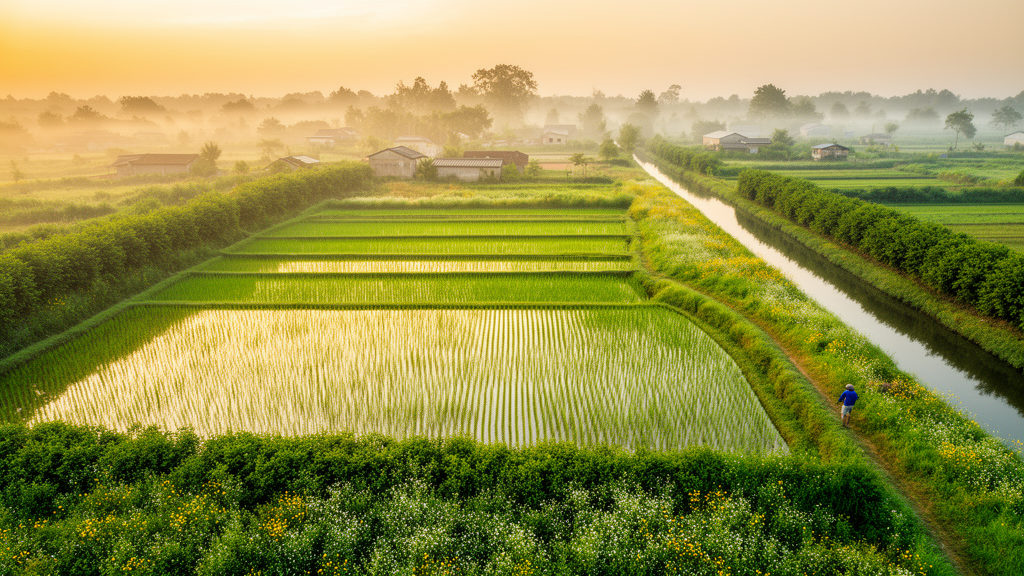
In the floodplains of northern Guinea-Bissau, where women farmers cultivate rain-fed rice parcels by hand and scattered trees rise from the earthen bunds that divide the paddies, an international team of researchers has completed one of the first rigorous assessments of what shapes bird diversity in West African smallholder rice systems. Their conclusion is striking: the character of the surrounding landscape matters more for bird species richness than the fine details of how each rice field is managed. The finding, published in the journal Web Ecology, carries significant implications for how conservation and food production might be reconciled across a region where rice cultivation is expanding rapidly and farmland birds worldwide are in steep decline.
The stakes are considerable. More than one-third of the planet’s land surface is now devoted to agriculture, and bird species tied to farmland are suffering some of the steepest declines recorded anywhere. In the European Union, agricultural and grassland birds have fallen by 35 percent since 1980; in North America, farmland birds have lost 74 percent of their abundance since 1966. Africa has been less thoroughly monitored, but an 18-year study in Nigeria found that declining species were predominantly those associated with open and grassland habitats, and some regions of the continent have lost more than 30 percent of their native grassland cover in recent decades. Against this backdrop, understanding which features of tropical farmland sustain bird communities has become an urgent scientific and practical question.
Rice is a particularly compelling case. Africa had more than 18.7 million hectares under rice cultivation in 2023, most of it in West Africa, where production is dominated by smallholders using labour-intensive practices and minimal chemical inputs. Traditional rice fields in the region are typically established in rain-fed floodplains, characterised by narrow, irregular configurations, and dotted with isolated trees or small tree clumps retained for fruit, soil fertility, shade, and moisture retention. Such low-intensity systems often support higher biodiversity than mechanised agriculture, yet the bird communities of West African rice fields have remained remarkably poorly studied, with previous research focused largely on waterbirds in intensive production systems elsewhere.
To fill this gap, researchers from the University of Lisbon and Universidade Lusófona da Guiné-Bissau surveyed birds along nine transects crossing seven rice fields in the Oio region, repeatedly sampling them across two rice-growing cycles in 2021 and 2022. In total they conducted 224 transect surveys, each beginning at sunrise and completed within a three-hour window, recording every bird seen or heard within the fields. Each species was assigned to one of four trophic guilds based on diet data from the AVONET database: frugivores, granivores, invertivores, and omnivores. The effort paid off handsomely: 150 bird species from 53 families were identified, with an estimated mean of 18.2 species per individual survey.
The team then quantified environmental structure at two distinct scales. At the field scale, they measured average field width, parcel area as a proxy for the vegetated earthen bunds between parcels, and the percentage cover of trees and shrubs, all derived from satellite imagery. At the landscape scale, they mapped land cover within concentric buffers ranging from 100 to 3200 metres around each field and calculated metrics of landscape diversity, fragmentation, and edge complexity. Species richness for each survey was estimated with Bayesian models that account for imperfect detection, and the resulting estimates were related to environmental predictors using linear mixed models, with principal component analysis used to distil correlated variables into composite gradients of field openness and landscape structure.
The field-scale results revealed a complementary pattern. Tree cover boosted the richness of invertivores and frugivores, increasing their richness by 17.0 and 16.4 percent of a standard deviation respectively, likely because scattered trees provide foraging substrates, perches, nesting sites, and fruit. Species such as the winter thorn, Faidherbia albida, are known to support diverse arthropod communities, while fig trees like Ficus lutea are important components of West African food webs. Conversely, wider fields favoured granivores and omnivores, with increases of 5.6 and 18.4 percent of a standard deviation respectively, presumably because open expanses concentrate accessible grain resources. Intriguingly, parcel area, used as a proxy for bund vegetation, had no detectable effect on any group, suggesting that not all forms of field-scale heterogeneity carry equal ecological weight.
The landscape-scale results were more powerful still. Bird richness declined with increasing fragmentation for all groups, and, counterintuitively, also declined with increasing landscape diversity, with the strongest drops among frugivores, at 22.6 percent of a standard deviation, and invertivores, at 19.2 percent. The authors interpret this as a warning about the ecological meaning of heterogeneity metrics: in this region, high landscape diversity often reflects human-modified mosaics shaped by settlement expansion, selective tree removal, and shifting cultivation, so compositional variety can coincide with fragmentation and habitat loss. Edge complexity, by contrast, was consistently positive, with irregular patch boundaries increasing habitat interfaces and facilitating the movement of birds and resources between fields and semi-natural vegetation.
Different guilds also responded at different spatial scales. Frugivores, invertivores, and omnivores were primarily shaped by landscape attributes within a 1600-metre radius of the rice fields, consistent with the dispersed and unpredictable distribution of fruit and arthropod prey across tropical landscapes. The entire community and the granivores, however, showed stronger associations at an intermediate scale of 800 metres, suggesting that granivores integrate resources over shorter distances. When field and landscape predictors were pitted against each other in combined models, landscape structure emerged as the consistently stronger and more significant driver for the whole community and for every trophic guild, while field openness affected only frugivores, invertivores, and omnivores and left overall and granivore richness untouched.
The authors are candid about the limitations of their work. Nine transects limit spatial replication, remotely sensed imagery may miss fine-scale features such as vegetation along bunds, and assigning flexible feeders to discrete dietary guilds is inevitably a simplification. Future studies, they suggest, should examine water depth, field permanence, and uncultivated parcels, and test whether the balance between local and landscape drivers shifts in unusually dry or wet years, when microhabitat conditions may become critical for bird persistence. Long-term monitoring would clarify how inter-annual climatic variation mediates these relationships.
Even so, the management implications are clear and potentially transformative. Sustaining bird diversity in smallholder rice landscapes, the study argues, requires landscape-level planning that limits excessive fragmentation while maintaining edge complexity, complemented by field-scale actions such as retaining and planting scattered trees, which support invertivorous birds that contribute natural pest control and may reduce reliance on chemical inputs. Just as importantly, the findings caution against assuming that landscape heterogeneity is universally beneficial: the same metric can signal thriving habitat variety in one region and human-driven degradation in another. As rice cultivation continues to expand across West Africa, the fate of its birds may depend less on what happens within any single paddy than on how the entire agricultural mosaic is woven together.
Subject of Research: Multi-scale drivers of bird species richness in West African smallholder rice agroecosystems
Article Title: Landscape context outweighs field-scale features in structuring bird communities in West African smallholder rice agroecosystems
Article References: Lopes, P., Lacerda, I., Chaves, P., de Lima, R. F., Camará, M., Lecoq, M., Palmeirim, J. M., & Rainho, A. (2026). Landscape context outweighs field-scale features in structuring bird communities in West African smallholder rice agroecosystems. Web Ecology, 26(2), 103-118. https://doi.org/10.5194/we-26-103-2026
Image Credits: AI Generated
Keywords: agroecosystems, birds, biodiversity, Guinea-Bissau, landscape ecology, rice fields, smallholder farming, trophic guilds, habitat fragmentation, West Africa, species richness, conservation
News Source: Alan Morgan. (October 8, 2026). What Surrounds the Rice Field Matters More Than What Happens Inside It. Scienmag.