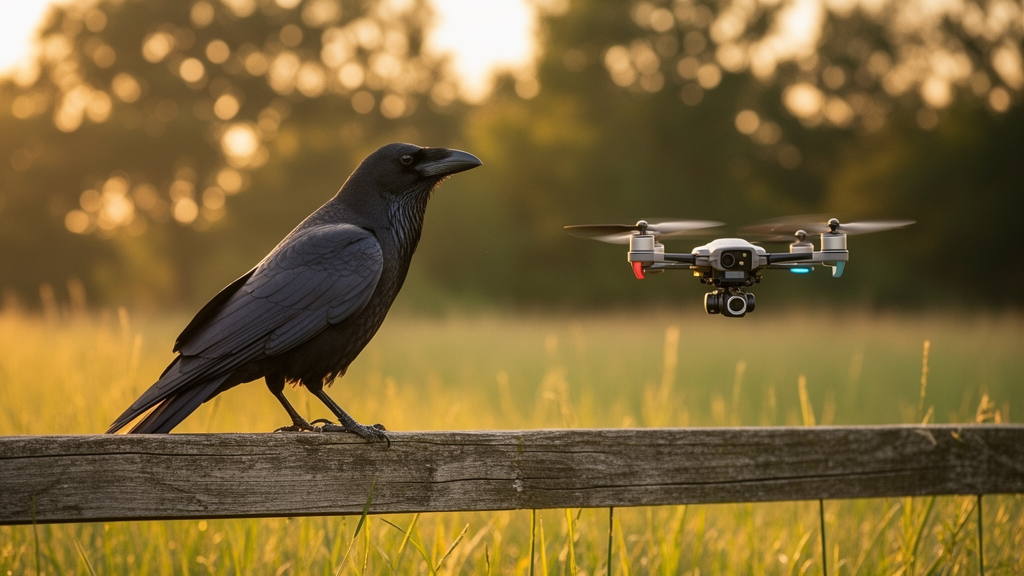
A team of Turkish researchers has rebuilt one of the most popular nature-inspired optimization algorithms from the ground up, reporting sweeping gains across mathematical benchmarks, engineering design problems, and even the altitude control of a quadcopter drone. The new method, called MSD-CSA, is described in a study published in Cluster Computing by Gonca Ozmen Koca of Fırat University, Yagmur Olmez of Malatya Turgut Ozal University, and Muhammed Kıvanc Kurnaz of Kastamonu University. Their work addresses a stubborn weakness that has limited the Crow Search Algorithm since its introduction: a tendency to get lost in complex search spaces and settle for solutions that are good but not the best.
The Crow Search Algorithm, or CSA, belongs to a broad family of swarm-based metaheuristics that translate animal behavior into mathematical search procedures. The original inspiration is the habit of crows to follow one another to find hidden food caches. In the computational version, each candidate solution is treated as a crow moving through a multidimensional search space, and the algorithm alternates between two complementary modes. Exploration spreads the crows widely across the space to discover promising regions, while exploitation concentrates the search around the best positions found so far to refine them. The balance between these two phases largely determines whether an optimizer succeeds on a given problem.
Despite its intuitive appeal and strong space-search capabilities, the standard CSA has a well-documented structural flaw. During exploration it relies on randomly selected individuals and random probabilities to decide where crows move next, and its search mode remains fundamentally simple. On rugged, high-dimensional landscapes studded with local optima, this randomness can cause the swarm to wander without direction, missing the global best solution entirely. The authors of the new study set out to correct precisely this deficiency by replacing the algorithm’s weakest components with more disciplined, strategy-driven mechanisms borrowed and adapted from other successful optimizers.
The resulting MSD-CSA introduces a hybrid updating strategy for the exploration phase that combines the guiding strategy of the Jellyfish Search Optimizer with a technique known as refraction-based learning. The jellyfish-inspired component steers crows toward high-quality regions of the search space rather than letting them drift at random, while refraction-based learning acts as a corrective lens, repositioning solutions so that promising areas are examined from new angles. Together, these mechanisms give the exploration phase a sense of purpose: instead of scattering blindly, the swarm is systematically directed toward regions likely to contain the global optimum.
Refinement of the exploitation phase comes from a spiral-based motion strategy. Spiral trajectories, popularized by the Whale Optimization Algorithm, allow candidate solutions to circle inward around the best-known position, tightening the search progressively rather than jumping chaotically around a promising basin. In MSD-CSA this spiral mechanism enhances the efficacy of the exploitation phase, ensuring that once the swarm identifies a fertile region, it extracts the best possible solution from it. The interplay between directed exploration and spiral-guided exploitation is what the authors identify as the key to the algorithm’s improved balance between global and local search.
Validating a new metaheuristic requires exhaustive comparison, and the researchers staged an unusually thorough evaluation. MSD-CSA was tested against the original CSA, six established algorithms — Particle Swarm Optimization (PSO), Grey Wolf Optimizer (GWO), Moth-Flame Optimization (MFO), Whale Optimization Algorithm (WOA), Multi-Verse Optimizer (MVO), and Teaching-Learning-Based Optimization (TLBO) — and three improved competitors, eKGSA, EJAYA, and CCSA. The battleground consisted of eleven well-known unimodal benchmark functions, which have a single optimum and test convergence speed, and nine multimodal functions, which contain many local optima and test the ability to escape premature convergence. Across this suite, MSD-CSA achieved the best results on 63 percent of the unimodal functions and 89 percent of the multimodal functions, a margin the authors interpret as evidence that their multi-strategy design pays off most where classical algorithms struggle most.
Statistical rigor underpinned these comparisons. The team performed a series of statistical tests on the benchmark results and analyzed convergence curves to characterize how the algorithm behaves on problems with different features. They also probed robustness by running the tests at various problem dimensions, checking whether performance degrades as the search space grows. This dimension-scaling analysis matters for practical applications, where the number of variables in an engineering model can range from a handful to hundreds, and an optimizer that collapses at high dimension is of limited use. The reported results indicate that MSD-CSA maintains its advantage across these dimensional variations.
Benchmarks alone rarely convince engineers, so the authors turned to four real-world design problems: gear train design, the multi-disk clutch brake design problem, gas transmission system design, and reactor network design. Each of these problems involves nonlinear constraints and discrete or continuous variables, and each has served for years as a proving ground for optimization algorithms. MSD-CSA was pitted against other optimization methods on all four, and the experimental results showed its superiority, delivering the best designs among the compared methods. For engineers, the message is that the algorithm’s benchmark dominance translates into tangible improvements on problems with direct industrial relevance, from mechanical drivetrains to chemical process networks.
Perhaps the most striking demonstration came from control engineering. The team designed a robust control model for quadcopter altitude control based on MSD-CSA, using the optimizer to tune the controller that governs a drone’s vertical motion. In the analyses, the MSD-CSA-based controller reached the reference altitude in a short time, achieved an overshoot of just 0.0489, and recorded an error rate of 6.05e-04. For a flying vehicle, low overshoot means the drone does not lurch past its target height before settling, and a small steady-state error means it holds that height accurately. These figures suggest that metaheuristic-tuned controllers can meet the demanding stability requirements of aerial robotics, where every millisecond of response and every centimeter of altitude deviation counts.
The study, supported by the Scientific Research Projects unit of Fırat University under grant TEKF.21.12, arrives amid a wave of multi-strategy enhancements to nature-inspired optimizers, including boosted variants of whale, sparrow, dung beetle, and marine predators algorithms. What distinguishes the MSD-CSA work is the completeness of its validation pipeline, spanning statistical testing, dimensional robustness checks, constrained engineering design, and dynamic control of a physical system. By grafting the guiding intelligence of jellyfish search and the corrective power of refraction learning onto the crow’s exploratory flight, and by adding spiral motion for precision refinement, the researchers have produced an optimizer that balances exploration and exploitation with unusual effectiveness. As optimization problems in cloud computing, robotics, and engineering design grow ever more complex, hybrid algorithms of this kind may become the default tools for finding the best possible answers in vast and treacherous search spaces.
Subject of Research: A multi-strategy enhanced Crow Search Algorithm for global optimization and engineering design applications
Article Title: Multi-strategy driven crow search algorithm for global optimization and engineering problems
Article References: Koca, G. O., Olmez, Y., & Kurnaz, M. K. (2026). Multi-strategy driven crow search algorithm for global optimization and engineering problems. Cluster Computing, 29(13), Article 751. https://doi.org/10.1007/s10586-026-06543-6
Image Credits: AI Generated
DOI: 10.1007/s10586-026-06543-6
Keywords: Crow Search Algorithm, metaheuristics, swarm intelligence, global optimization, Jellyfish Search Optimizer, refraction-based learning, spiral-based strategy, engineering design optimization, quadcopter altitude control, benchmark functions, exploration and exploitation, Cluster Computing
News Source: Denise Maddox. (October 8, 2026). Crows Teach a Smarter Algorithm: Multi-Strategy Upgrade Tackles Optimization and Drone Control. Scienmag.