Soot is one of the most consequential particles humans release into the atmosphere. Produced whenever fossil fuels, biofuels or biomass burn incompletely, these tiny carbonaceous fragments absorb sunlight with remarkable efficiency, warming the air directly and altering the way clouds form around them. Yet despite decades of study, a fundamental optical property of soot — its complex refractive index, the number that describes both how fast light travels through the material and how strongly the material absorbs it — remains stubbornly uncertain. A new laboratory study, published as a preprint under review in the journal Aerosol Research, shows that part of that uncertainty may come not from the soot itself but from the mathematical lens through which scientists choose to view it.
The research, led by Johannes Heuser and Claudia Di Biagio of the Laboratoire Interuniversitaire des Systèmes Atmosphériques (LISA) in France, together with colleagues from institutions across France and Italy, was carried out in a large atmospheric simulation chamber. The team generated soot aerosols under carefully controlled combustion conditions, producing particles that ranged from nearly pure black carbon to organic-rich material dominated by brown carbon. By systematically varying the maturity and physico-chemical character of the particles, they created a family of laboratory soots spanning the diversity found in real emissions, from diesel-style flames to smouldering biomass.
The quantity at the heart of the study is written m = n − ik. The real part, n, governs scattering: how much light bends and deflects when it encounters a particle. The imaginary part, k, governs absorption: how much light energy is converted to heat. Both matter enormously for climate, because the balance between scattering and absorption determines whether an aerosol cools or warms the planet. For soot, k is among the largest of any atmospheric aerosol, which is why black carbon is generally considered the most important light-absorbing particle in the atmosphere — and why getting n and k right is essential for satellite retrievals, radiative transfer models and climate projections alike.
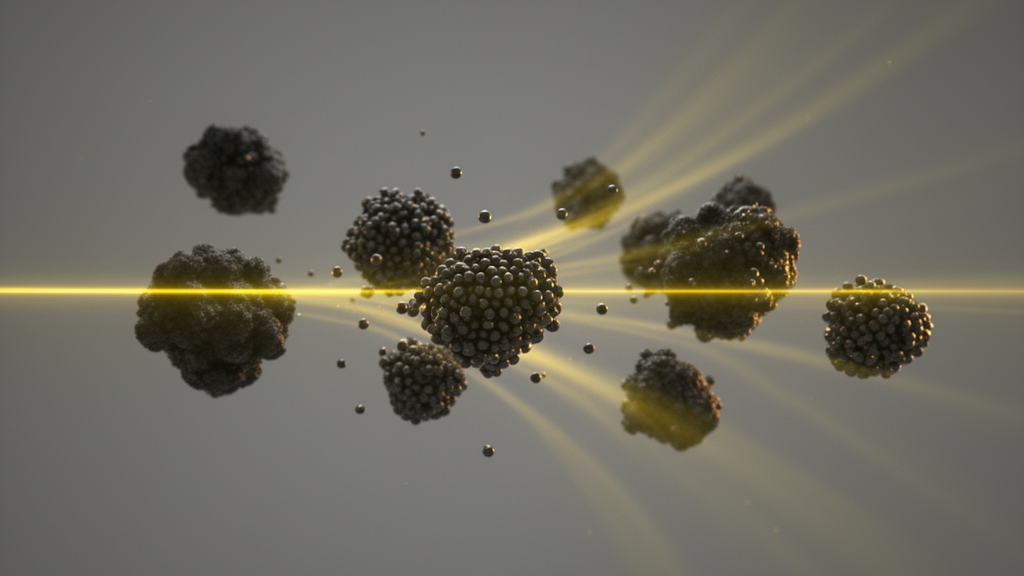
Retrieving these values from measurements is not straightforward. The team measured an extensive suite of particle properties inside the chamber: size distributions, morphological parameters, density, and the particles’ scattering, absorption and extinction coefficients across wavelengths from 450 to 630 nanometres. They then fed these inputs into two very different optical theories. The first, Mie theory, is the classical workhorse of aerosol optics. It computes exactly how light interacts with homogeneous spheres — a convenient but physically inaccurate picture of soot, which in reality forms branched, fractal aggregates of tiny spherules, like microscopic bunches of grapes.
The second approach, Rayleigh–Debye–Gans theory for fractal aggregates, or RDG-FA, was designed with that reality in mind. Instead of pretending each particle is a sphere, it treats the aggregate as a collection of small interacting units whose collective scattering and absorption depend on the fractal geometry of the whole structure. In principle, RDG-FA should describe soot more faithfully. In practice, it requires assumptions about particle morphology — the fractal dimension, the number and size of the primary spherules — and those assumptions carry their own uncertainties. The French-led team wanted to know how much each theory’s internal limitations would distort the refractive indices it returned.
To answer that question quantitatively, the researchers turned to Monte Carlo simulations. Rather than computing a single refractive index from a single set of inputs, they repeatedly perturbed the measured input parameters within their experimental uncertainties and recalculated the retrieval thousands of times. The resulting spread of output values reveals how sensitive each method is to errors in size, morphology, density and the optical coefficients themselves. This kind of uncertainty propagation is rare and laborious, but it transforms the retrieved numbers from bare point estimates into statements with defensible error bars — exactly what modellers need when deciding which laboratory values to adopt.
The headline finding is striking: both theories can reproduce the measured absorption and scattering of the chamber soot, yet the refractive indices they retrieve differ substantially. For soot whose elemental-to-total carbon ratio ranged from 0.79, representing black-carbon-dominated particles, down to 0, representing brown-carbon-dominated material, the Mie-based retrievals spanned real parts n of 1.35 to 2.68 and imaginary parts k of 0.38 to 0.31. The RDG-FA retrievals gave a narrower and generally different picture: n between 1.68 and 2.07 and k between 0.20 and 0.09. In other words, the same particles, measured in the same chamber, yield meaningfully different optical fingerprints depending on the theory used to interpret the data.
The Monte Carlo analysis explains why. Mie-based retrievals proved only weakly sensitive to ordinary measurement uncertainties in the input parameters, but they were strongly affected by particle coagulation and size growth inside the chamber. As soot aggregates collide and stick together, the spherical approximation underlying Mie theory degrades, and the retrieved refractive index absorbs the error. The RDG-FA retrievals, by contrast, remained stable even as the particles coagulated, because the theory naturally accommodates growing aggregates — but they depended strongly on the uncertainty of the assumed particle morphology. Each method, it turns out, has a characteristic weak point: Mie stumbles on shape, RDG-FA on assumed structure.
The practical implication is a call for consistency. Climate models, remote-sensing algorithms and laboratory databases often quote a single refractive index for soot without specifying which optical theory was used to derive it. This study shows that such a number cannot be treated as theory-independent. A refractive index retrieved with Mie theory should only be applied in models that also represent soot as spheres; an RDG-FA-derived value belongs with models that explicitly treat fractal aggregates. Mixing the two — plugging a Mie-retrieved k into an aggregate-based radiative calculation, for example — risks compounding errors in the estimated warming effect of black carbon, one of the largest single uncertainties in the human perturbation of the climate system.
The work also carries a broader lesson about how laboratory science handles imperfect models. Rather than asking which theory is simply correct, the researchers mapped where each one breaks down and quantified the consequences. The data sets and software underlying the retrievals have been released with persistent identifiers, allowing other groups to test alternative morphological assumptions or extend the analysis to other wavelengths and soot types. As the preprint moves through peer review, its central message is already clear: the light-absorbing power of soot is not just a property of the particle, but of the partnership between the particle and the physics used to describe it. For a substance with an outsized role in atmospheric warming, that partnership deserves the closest possible scrutiny.
Subject of Research: Retrieval of the complex refractive index of flame-generated soot aerosols using Mie and RDG-FA optical theories in an atmospheric simulation chamber
Article Title: Complex refractive indices of flame soot from different combustion conditions retrieved using Mie and RDG-FA theories: a simulation chamber study
Article References: Heuser, J., Di Biagio, C., Yon, J., Cazaunau, M., Bergé, A., Pangui, E., Zanatta, M., Renzi, L., Marinoni, A., Yu, C., Chevaillier, S., Ferry, D., Maillé, M., Formenti, P., Picquet-Varrault, B., & Doussin, J.-F. (2026). Complex refractive indices of flame soot from different combustion conditions retrieved using Mie and RDG-FA theories: a simulation chamber study. https://doi.org/10.5194/ar-2026-31
Image Credits: AI Generated
DOI: 10.5194/ar-2026-31
Keywords: soot, black carbon, refractive index, Mie theory, RDG-FA, fractal aggregates, aerosol optics, simulation chamber, light absorption, Monte Carlo uncertainty, combustion aerosol, climate modelling
News Source: Russell Cooper. (October 8, 2026). Soot’s Light-Bending Secret: Why the Optical Model You Choose Changes the Answer. Scienmag.