In one of the largest studies of its kind, veterinarians reviewing a decade of shelter records have found that dogs infected with heartworm can undergo routine spay and neuter surgery using completely standard, unmodified anesthesia and surgical protocols with remarkably low complication rates. The retrospective study, published in Parasites & Vectors, followed 1,011 heartworm-positive dogs sterilized at Miami-Dade Animal Services in Florida between 2014 and 2024, and recorded not a single perioperative death across the entire cohort.
The findings address a long-standing anxiety in shelter medicine. Adult heartworms, Dirofilaria immitis, live primarily in the pulmonary arteries, where they trigger endarteritis, fibrosis, and increased vascular resistance. Heavy worm burdens and chronic infections can drive pulmonary hypertension, pulmonary thromboembolism, and pneumonitis, potentially progressing to right-sided heart failure. Because anesthesia depresses cardiac output and reduces functional lung volume, veterinary anesthesiologists have worried that heartworm-positive patients could be pushed into hypoxia or thromboembolic crises during elective surgery. Laboratory evidence of prothrombotic and thrombocytopenic tendencies in infected dogs added to those concerns.
Despite these theoretical risks, the practice of sterilizing dogs before adulticide treatment is widespread. In a survey of shelter veterinarians, 82.1 percent of 158 respondents reported performing elective sterilization before melarsomine, the drug that kills adult heartworms, while only 8.9 percent typically waited until after treatment. Until now, however, the empirical safety data rested on tiny studies of 15 to 40 dogs, all carefully preselected as clinically stable.
The new study changes that picture dramatically in scale. Researchers identified dogs at least seven months old that tested positive for heartworm antigen at intake, showed only Class 1 or Class 2 disease under American Heartworm Society guidelines, meaning asymptomatic signs or cough and activity intolerance, and were sterilized within 180 days of diagnosis. Dogs with severe disease, including right heart failure or caval syndrome, were excluded. Severity was judged on physical examination alone, without radiography, echocardiography, or extensive laboratory workup.
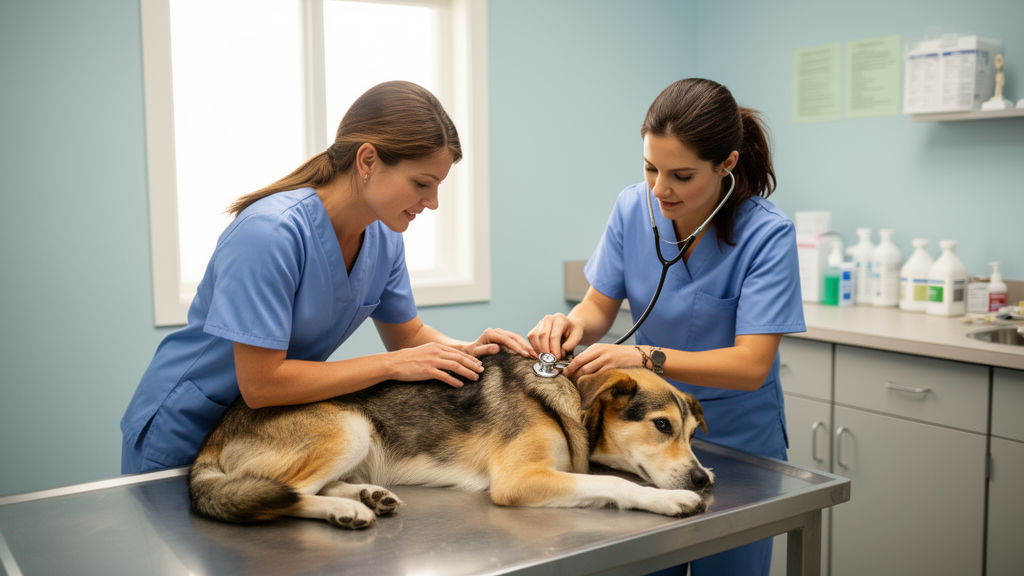
Every dog received the shelter’s standardized anesthetic protocol: a combination of dexmedetomidine, ketamine, and butorphanol, followed by intubation and maintenance on isoflurane and oxygen, with preoperative carprofen for analgesia. Nothing was modified because of heartworm status. Of the 1,011 dogs, 440 were female and 571 male, with a median age of 36 months and median weight of 23.8 kilograms. Nearly all procedures, 92.2 percent, were routine spays or castrations; the remainder were classified as complex due to pregnancy, pyometra, cryptorchidism, scrotal ablation, or concurrent surgeries.
The results were striking. No perioperative deaths occurred. Major complications, defined as life-threatening events, severe surgical problems, or aborted procedures, affected just 12 dogs, or 1.2 percent of the cohort. Only three of these were anesthetic events of unclear etiology that could not be definitively attributed to heartworm disease: one dog showed watery discharge from the nose and mouth with a transient abnormal respiratory pattern, one had delayed recovery with mild hypothermia, and one developed apnea at induction, prompting the team to abort that surgery; the dog was spayed uneventfully six weeks later. The remaining nine major complications were surgical-site problems requiring revision, including seven postoperative scrotal hematomas resolved by subsequent scrotal ablation.
Minor complications occurred in 39 dogs, or 3.9 percent, mostly superficial incisional issues that resolved without surgery, plus three cases of transient hematuria. Notably, complications clustered by sex and procedure type rather than by parasite burden: males experienced complications at 7.4 percent versus 2.0 percent in females, driven almost entirely by postoperative surgical-site issues after castration compared with spay. The cardiopulmonary complications that clinicians fear most appeared in only 0.3 percent of dogs, and all animals recovered fully.
The study’s operational implications are substantial. Heartworm-positive dogs in shelters face longer stays, reduced adoption appeal, and elevated euthanasia risk, partly because adopters hesitate to take on treatment costs and the prolonged exercise restriction that adulticide therapy demands. Sterilizing before melarsomine treatment allows earlier adoption and smoother shelter throughput. In this cohort, 93.6 percent of dogs were ultimately adopted, with most others returned to owners or transferred to other organizations. Intriguingly, 12 dogs received their first melarsomine injection during postoperative anesthetic recovery without any complications, a strategy the authors say warrants further study because it avoids separate sedation and reduces shelter resource use.
The authors caution that their findings come with important caveats. Nearly all dogs received doxycycline and macrocyclic lactone preventives before surgery, which reduce inflammation and thromboembolic severity by depleting Wolbachia, a pro-inflammatory bacterial endosymbiont of the heartworm, and this near-universal adjunctive therapy is a key confounding variable. The retrospective, single-site design lacked a heartworm-negative control group, and limited postoperative follow-up may have under-detected some complications. The results also apply only to clinically stable dogs with mild to moderate disease in high-volume settings; they cannot be extrapolated to severe cases, low-volume clinics, different anesthetic protocols, or regions where doxycycline and macrocyclic lactones are unavailable.
Even with those limits, the message for veterinarians in heartworm-endemic regions is reassuring. Since heartworm status is unknown for many dogs arriving at sterilization appointments, one high-volume clinic in the southern United States found 11.7 percent of dogs testing positive at surgery, practitioners routinely and unknowingly operate on infected patients. This study suggests that, for dogs with mild to moderate heartworm disease, standard high-quality, high-volume spay-neuter protocols can proceed safely, supporting earlier adoptions without compromising patient welfare.
Subject of Research: Perioperative safety of surgical sterilization in heartworm-infected dogs using standard shelter anesthesia protocols
Article Title: Low observed perioperative complication rates associated with surgical sterilization of 1,011 heartworm-infected dogs using standard, unmodified anesthesia and surgical protocols
Article References: Low observed perioperative complication rates associated with surgical sterilization of 1,011 heartworm-infected dogs using standard, unmodified anesthesia and surgical protocols. (n.d.). https://doi.org/10.1186/s13071-026-07514-x
Image Credits: AI Generated
DOI: 10.1186/s13071-026-07514-x
Keywords: heartworm disease, Dirofilaria immitis, shelter medicine, surgical sterilization, spay-neuter, anesthesia, perioperative complications, melarsomine, doxycycline, veterinary medicine, retrospective study, Miami-Dade Animal Services
News Source: William Thompson. (October 8, 2026). Heartworm-Positive Shelter Dogs Safely Sterilized With Standard Protocols in Study of 1,011 Cases. Scienmag.