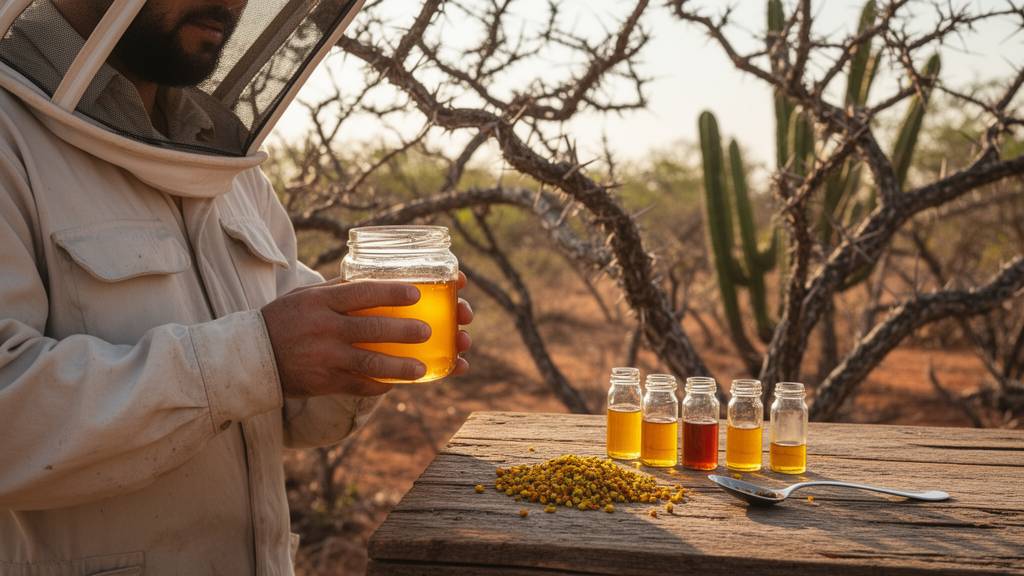
In the semi-arid backlands of northeastern Brazil, honey is more than a sweetener; it is a livelihood stitched to one of the world’s most distinctive and overlooked biomes. A new study published in Food Science & Nutrition has now mapped, in remarkable detail, the sensory identity of honeys produced by the European honey bee Apis mellifera in the Caatinga region of Paraíba, connecting the pollen grains locked inside each jar to the words consumers use to describe what they see and smell. The work, led by researchers at the Federal University of Paraíba, combines melissopalynology, focus group methodology, consumer testing and affective analysis into a single integrated framework, and the result is the first comprehensive sensory wheel built specifically for honeys of this endemic Brazilian biome.
The Caatinga is found nowhere else on Earth. Its thorny shrubs and hardy trees, including species of Mimosa, Croton and Ziziphus, have evolved to flourish through alternating rainy and dry seasons, producing near-continuous flowering that sustains beekeeping year-round. According to Brazil’s 2017 Agricultural Census, more than 94 percent of the beekeeping establishments in the northeast are concentrated in this semi-arid zone, where water scarcity limits other forms of agriculture and apiculture offers communities a crucial income stream. Environmental stress also drives plants to ramp up secondary metabolism, enriching nectar with phenolic compounds, and this biochemical backdrop is thought to contribute to the singular character of the region’s honey.
To ground the sensory work in verifiable botany, the team collected twelve honey samples between 2023 and 2024 through three local cooperatives, selecting beekeepers on the basis of traceable floral and geographic origin and on production volume per flowering event. Melissopalynological analysis, the microscopic counting and identification of pollen grains, confirmed the botanical provenance of each sample. Seven honeys qualified as monofloral, meaning a single pollen type exceeded 45 percent of the count, and these were named after their dominant blooms: angico do morro from Anadenanthera peregrina, calumbi, jurema, jurema preta and malícia from various Mimosa species, marmeleiro from Croton sonderianus, and sabiá from Mimosa caesalpiniifolia, which reached an extraordinary 96.6 percent dominance. The remaining five samples were polyfloral blends of these and other Caatinga sources.
The sensory lexicon was built from the ground up. Twenty-seven untrained but experienced evaluators took part in three focus group sessions, each lasting roughly ninety minutes, during which they examined the honeys’ color, appearance and aroma without ever being told the floral origin. Panelists stirred the samples to release volatile compounds, reset their noses with coffee beans, and recorded every descriptor that came to mind. The exercise generated 551 raw terms, which the researchers then filtered in two stages: a semantic pass that merged synonyms, removed opposites, hedonic judgments, intensity words and irrelevant terms, cutting the list to 154, followed by a frequency threshold requiring each surviving descriptor to be cited at least five percent of the time for at least one sample. Sixty-three terms made the final cut.
Those sixty-three descriptors were organized into a three-tier sensory wheel. The outermost layer holds fifty-five specific attributes; the middle layer groups them into nineteen broader categories; and the core contains just two dimensions, aroma and visual. The wheel paints the Caatinga honey matrix as shiny, translucent, homogeneous and viscous, with colors spanning light amber to dark brown, and an aromatic bouquet built on sugary notes of caramel, molasses and sugarcane alongside floral, fruity, woody and herbaceous tones. Notably, the panel also identified off-notes such as smoke, fermented, animal and medicinal aromas. The authors suggest these may stem partly from beekeeping practice, since Africanized bees require smokers during harvesting, and from high relative humidity that can favor fermentation despite low rainfall.
Botanical origin left a clear imprint on the vocabulary. Monofloral honeys yielded forty-two aroma descriptors, thirty-five positive and seven negative, while polyfloral samples produced only thirty-one, their blended pollen muddling the aromatic signature. Thirteen descriptors appeared exclusively in monofloral honeys, including wax, white sugar, molasses, leather, sulfur, caramel syrup and tobacco, whereas polyfloral honeys uniquely contributed sweat and cashew. Color told a parallel story: monofloral honeys covered all six shades on the wheel, while polyfloral samples clustered in the amber range, with one exception, the mofumbo honey, which fell into light brown. Honeys dominated by Croton pollen were consistently described as light amber, and those from certain Mimosa blooms as dark brown.
The consumer phase brought one hundred participants, drawn from a larger pool of 148, who completed two sessions evaluating all twelve honeys using the Check-All-That-Apply method with twenty-eight descriptors derived from the focus groups. Cochran’s Q test revealed significant differences among samples in nearly every attribute, with color the only class in which every term discriminated between honeys. Correspondence analysis, explaining 73.25 percent of the sample-attribute relationships, split the honeys into two coherent clusters: darker honeys, almost all Mimosa-dominated, aligned with woody, smoky, toasted and sugarcane aromas, while lighter honeys from Croton and Anadenanthera grouped with sweet, floral, fruity and bee-related notes. Hierarchical clustering confirmed that these groupings followed pollen composition rather than chance.
Penalty analysis then asked which attributes actually move consumer preference. Eight descriptors significantly boosted overall liking, and the drivers of liking turned out to be the very qualities that define the region’s honey: shiny, homogeneous and translucent appearance, plus honey, sweet and floral aromas. Crucially, the off-flavors detected by the trained panel, smoke, animal and fermented notes, were cited too infrequently and carried too little negative weight to dent consumer acceptance. In other words, the imperfections that a descriptive panel can isolate are largely invisible to ordinary buyers, a reassuring finding for producers working with Africanized colonies in demanding conditions.
Acceptance scores ranged from 6.3 to 7.9 on a nine-point scale, and purchase intention from 3.1 to 4.3 on a five-point scale, with every honey scoring positively. The top performers included the polyfloral blend of juazeiro, angico and jurema preta alongside the monofloral angico do morro, marmeleiro and sabiá honeys, all sharing lighter color and classic sweet, floral and citrus aromatics. The lowest-rated sample, the jurema monofloral honey, carried the highest smoke citation and darker color, landing on the negative side of the perceptual map. Yet the data also delivered a pleasant surprise for the industry: polyfloral honeys, often valued below monofloral products, matched the best monofloral samples statistically, suggesting that blends from this biome hold genuine commercial appeal.
The authors are careful to frame the sensory wheel as an exploratory tool whose wider applicability must be tested with independent samples, different harvests, trained panels and additional production regions, and they note that climate, harvesting, ripening, processing and storage all modulate the final profile alongside botanical origin. Even so, the study delivers something the Caatinga beekeeping sector has lacked: a structured, evidence-based vocabulary for its product, and a demonstrated chain of evidence running from pollen grain to consumer wallet. For a region where honey is one of the few viable crops, that vocabulary could underpin quality standards, geographical indication certification and, ultimately, better prices for honeys whose identity science has finally put into words.
Subject of Research: Sensory characterization of Apis mellifera honeys from the Caatinga biome of Paraíba, Brazil, linking melissopalynological botanical origin to descriptive sensory profiles and consumer acceptance
Article Title: The Sensory Identity of Caatinga Honeys: From Pollen Profile to Consumer Response
Article References: The Sensory Identity of Caatinga Honeys: From Pollen Profile to Consumer Response. (n.d.). https://doi.org/10.1002/fsn3.72378
Image Credits: AI Generated
DOI: 10.1002/fsn3.72378
Keywords: Caatinga, honey, Apis mellifera, melissopalynology, sensory wheel, focus group, Check-All-That-Apply, monofloral honey, polyfloral honey, consumer acceptance, Paraíba, food science
News Source: Alan Morgan. (October 8, 2026). Brazil’s Caatinga Honey Gets a Sensory Fingerprint, From Pollen to Palate. Scienmag.