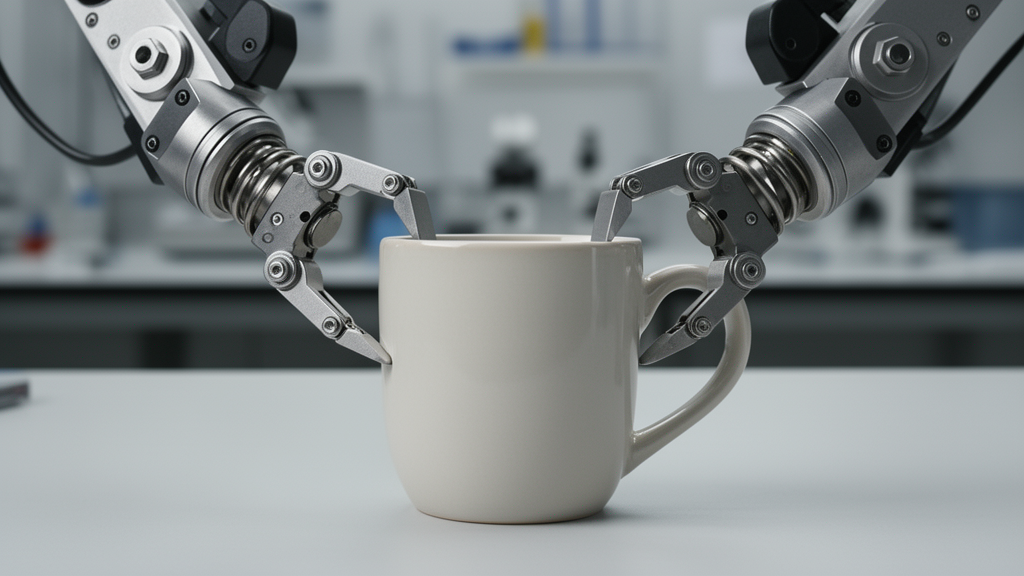
Robotic hands have long faced an awkward truth: the more rigid and precise a gripper is, the worse it tends to cope with the messy variety of the real world. A conventional rigid gripper grips confidently, but only when the object matches its expectations. Hand it an egg, a soft pouch, or a component whose dimensions vary from batch to batch, and the same mechanism that excels on the factory line can crush, drop, or simply fail to close around its target. A team of mechanical engineers in China now proposes a deceptively simple answer, built not from exotic soft materials but from one of the oldest workhorses in the kinematician’s toolbox: the parallelogram linkage.
In a preprint posted on 29 September 2026 and currently under review for the journal Mechanical Sciences, Dabao Fan and colleagues at Suqian University and Dongguan University of Technology describe an adaptive grasping device whose fingers are built from improved parallelogram units. The key innovation lies in how the classic mechanism is modified. In a standard parallelogram linkage, opposite links stay parallel throughout motion, which is precisely why the geometry is so useful for transmitting predictable motion. The researchers took this familiar arrangement and introduced elastic elements, allowing the linkage to deform passively under load. When the gripper closes on an object, the springs within each parallelogram unit yield in a controlled way, letting the finger surfaces conform to the object’s size and shape without any additional sensing or control effort.
This passive adaptability is the conceptual heart of the design. Rather than measuring an object and computing a grasp, the device lets physics do the computation. The elastic deformation of the springs acts as a mechanical buffer: stiff enough to hold a workpiece securely, compliant enough to absorb dimensional variation and protect fragile or flexible items from excessive contact forces. According to the authors, this allows the gripper to effectively adapt to objects of different sizes while preserving the integrity of the grasped workpieces, addressing two of the most persistent complaints about traditional rigid grippers: poor environmental adaptability and easy damage to delicate goods.
Adaptive fingers, however, still need to be driven, and this is where the team’s second contribution comes in. Each gripper unit is actuated by a 2-RRR planar parallel mechanism, a configuration in which two chains of three revolute joints each connect a fixed base to a moving platform. Parallel mechanisms of this kind are prized for their stiffness, accuracy, and load capacity, since the load is shared among multiple kinematic chains rather than cantilevered off a single serial arm. The trade-off is usually a complicated analysis problem: understanding exactly how the platform can move requires a careful accounting of the mechanism’s degrees of freedom and its constraints.
The researchers tackled that analysis with screw theory, a mathematical framework that represents both the rotational and translational motions of rigid bodies as screws, combining an axis, a pitch, and an amplitude. Using screw theory together with an explicit kinematic model, the team characterized the degree of freedom and the constraint characteristics of the 2-RRR driving mechanism, establishing rigorously which motions the gripper unit can perform and which are locked out by the parallel architecture. This kind of validation matters in practice, because a gripper whose kinematics are only loosely understood tends to surprise its designers when it meets an object it was not analyzed against.
Perhaps the most immediately practical element of the work is its treatment of actuation. Adaptive grippers with multiple independently moving finger segments often accumulate driving redundancy: many motors, each requiring its own controller, driver electronics, and wiring, all coordinated by software that must keep them synchronized. The authors report that traditional schemes of this family can demand as many as six motors. Their solution is a linkage transmission structure built around bevel gear sets, which mechanically couples the motion so that the entire device is driven in a dual-motor mode. Bevel gears, which transmit rotation between shafts at angles to one another, allow a single input to distribute coordinated motion across the linkage network. The result, the team states, is a significant reduction in driving redundancy and overall control cost, a benefit that compounds over production runs of thousands of units.
To verify that the theory translated into function, the researchers carried out grasping condition analyses for objects of different sizes. These tests confirmed, they report, that the device possesses excellent dimensional adaptability and grasping stability. In other words, the same hardware could close reliably around a range of target dimensions without reconfiguration, and once closed, it held its payload stably, with the spring-loaded parallelogram units maintaining conformal contact rather than fighting against the object’s geometry. For applications such as bin picking, agricultural handling, or assembly of parts with manufacturing tolerances, that combination of range and stability is exactly what determines whether a gripper is usable or a nuisance.
The significance of the work lies less in any single component than in the design philosophy it demonstrates. Soft robotics has made enormous strides by replacing rigid links with elastomers, granular jamming, and pneumatic chambers, but soft hands often sacrifice precision, load capacity, and manufacturability. The Suqian and Dongguan team’s approach stays firmly within the world of rigid links and conventional joints, achieving compliance only where it is needed, through deliberately introduced elasticity. This keeps the device cheap to fabricate, easy to model, and compatible with standard precision manufacturing, while still delivering the gentle, shape-following behavior that soft systems achieve through material compliance. It is a reminder that mechanism design, the oldest branch of robotics, still has room for genuinely new ideas.
The authors position the results as providing a reliable theoretical basis and technical reference for two audiences at once: engineers seeking innovative optimization of traditional mechanical mechanisms, and designers of flexible adaptive grasping equipment for engineering applications. Because the analysis is grounded in screw theory and formal kinematic modeling rather than ad hoc prototyping alone, the framework could be adapted by other groups designing grippers with different link geometries, spring stiffnesses, or actuation layouts. The dual-motor bevel gear transmission, in particular, offers a template for taming the actuation complexity that adaptive mechanisms typically incur.
As the preprint moves through peer review, with its public discussion open until 7 November 2026, the broader robotics community will be watching to see how the design performs beyond the laboratory: under dynamic loads, in three-dimensional grasps where fingers interact with one another, and at production scale. What is already clear is that the humble parallelogram, a linkage familiar to every mechanical engineering student, still has untapped potential when its geometry is paired with the right elasticity. In a field captivated by learning-based control and dexterous five-fingered hands, there is something quietly compelling about a gripper that solves the adaptability problem with springs, gears, and four-bar linkages, no neural network required.
Subject of Research: Adaptive robotic grasping using improved parallelogram mechanisms with passive spring compliance and a 2-RRR parallel drive
Article Title: Design and Analysis of an Adaptive Grasping Device Based on Parallelogram Mechanism
Article References: Design and Analysis of an Adaptive Grasping Device Based on Parallelogram Mechanism. (n.d.). https://doi.org/10.5194/ms-2026-170
Image Credits: AI Generated
DOI: 10.5194/ms-2026-170
Keywords: robotics, adaptive gripper, parallelogram mechanism, screw theory, kinematics, 2-RRR parallel mechanism, bevel gear transmission, compliant grasping, mechanism design, actuation redundancy, Mechanical Sciences, preprint
News Source: Denise Maddox. (October 8, 2026). Spring-Loaded Parallelogram Gripper Adapts Its Fingers to Any Object Shape. Scienmag.