Deep in a Finnish pine forest, in the summer of 2024, six of the world’s most sensitive atmospheric chemistry instruments were pointed at the same air. The goal was deceptively simple: to find out whether they would all tell the same story. The answer, published in Atmospheric Measurement Techniques by a team led by Cecilia Righi and Nina Sarnela of the University of Helsinki, is a qualified but encouraging yes, and it carries real weight for anyone trying to understand how the air we breathe seeds the particles that brighten clouds and shape the climate.
The instruments in question are chemical ionization mass spectrometers, or CIMS, the workhorses of modern atmospheric science. They are the only tools capable of sniffing out the ultra-trace gases that drive new particle formation, chiefly sulfuric acid and highly oxygenated organic molecules known as HOMs. These condensable vapors exist at concentrations ranging from parts per trillion down to parts per quadrillion, they stick tenaciously to any surface they touch, and they must be electrically charged before they can be detected at all. Each of those steps is a potential source of error, and because different research groups have built their instruments differently, results from one study have not always been comparable to another. That fragmentation has long frustrated efforts to build a global picture of how new particles form.
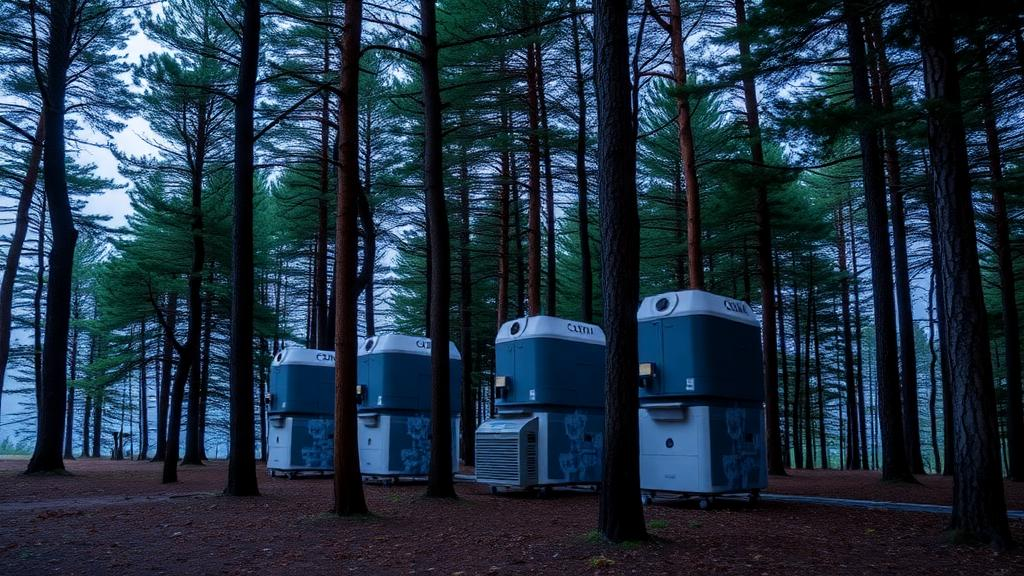
To confront the problem, the European research infrastructure ACTRIS organized its first dedicated CIMS field intercomparison, known as CI-FI1, over two weeks beginning on 26 July 2024 at the SMEAR II station in Hyytiälä, southern Finland. The site, surrounded by managed pine forest with only limited local pollution, is a classic location for studying new particle formation. Five of the six instruments were atmospheric pressure interface time-of-flight mass spectrometers, three fitted with traditional Eisele-type inlets and two with the newer multi-scheme MION inlets capable of rapidly switching between reagent ions. The sixth was a Vocus bipolar time-of-flight instrument coupled to a low-pressure AIM reactor, operated with iodide and benzene cluster cations. All six ran in their routine configurations, and all were calibrated using standard procedures, exactly as they would be during a normal field campaign.
The first week was devoted to side-by-side sampling of ambient air, with every inlet facing the same direction to guarantee that all instruments breathed identical air. The second week focused on calibration: sulfuric acid calibrations using a well-established method, background measurements through HEPA filters, and transmission calibrations that probe how efficiently each instrument detects ions of different masses. The conditions were far from ideal for making easy comparisons. Air temperatures ranged from 13 to 25 degrees Celsius, relative humidity averaged a damp 82 percent, and rain fell on several days, suppressing photochemistry and pushing ambient concentrations of the target vapors close to the instruments’ detection limits. In a sense, that made the exercise more valuable, not less, because it tested the instruments where they are most fragile.
For sulfuric acid measured in nitrate mode, the results were moderately good. The conventional sulfuric acid calibration, which has been the community standard for over a decade, brought the five CI-APi-ToF instruments into reasonable agreement, with a coefficient of determination of about 0.58 across the ensemble. The agreement was strongest during the daytime, when photochemical production pushed sulfuric acid concentrations to their peaks. At night, when concentrations dropped, the instruments diverged, and the scatter plots revealed a fan-like pattern with increasing dispersion at lower concentrations. Intriguingly, the data points clustered not by reagent ion chemistry but by inlet type: the three Eisele-type instruments behaved like one another, and the two MION instruments like each other.
That pattern became even more striking for the heavier molecules. When the team examined monoterpene-derived HOM monomers, spanning mass-to-charge ratios of roughly 240 to 390, and HOM dimers, from 480 to 630, sulfuric acid calibration alone was not enough to make the measurements comparable. The missing ingredient was the mass-dependent transmission of each instrument, the fact that ions of different masses are transmitted through the vacuum interface and detector with unequal efficiency. Correcting for this transmission, measured by depleting the reagent ions with a series of perfluorinated acids, substantially improved agreement for the closed-shell HOM monomers, yielding coefficients of determination of 0.68 for non-nitrate monomers and 0.81 for organonitrate monomers, rising to 0.83 and 0.89 when one problematic instrument was excluded. But the study also delivered a caution: for one instrument whose transmission curve fell to nearly zero at high masses, applying the correction produced absurdly large adjustment factors and actually worsened agreement. The lesson is that transmission corrections must be critically evaluated, not blindly applied.
The dimers told a more stubborn story. Even after all corrections, agreement for these heavy, low-volatility molecules remained poor, with a clear separation between the Eisele-type and MION instruments that persisted across the full range of concentrations. The MION instruments, with their shorter inlet tubes and more efficient delivery of ionized sample to the detector pinhole, showed both lower detection limits and higher relative transmission in the dimer mass range, allowing them to distinguish real signal from background noise more effectively. For the lighter organic and inorganic acids below mass 250, agreement was also weaker than for sulfuric acid, and the team could not pinpoint the cause, noting that applying transmission corrections did not help. These compounds, the authors conclude, remain genuinely challenging to quantify.
One of the most consequential findings concerns bromide ionization, a reagent ion scheme prized for its sensitivity to less-oxidized organic compounds but long suspected of being fragile in humid air. During the campaign, relative humidity ranged from 39 to 100 percent, well above the 20 to 40 percent threshold at which bromide sensitivity is known to decline. Yet the two MION instruments, switching every ten minutes between nitrate, bromide, and a non-ionizing mode, showed good agreement with each other for semi-volatile organic compounds, with a coefficient of determination of 0.853. Comparing bromide and nitrate measurements of the same compounds suggested that humidity did not strongly distort the relative performance of the two modes. Bromide-mode measurements, the results imply, may be more robust under real field conditions than laboratory studies had suggested, at least for compounds that form sufficiently stable clusters with the bromide ion.
Perhaps the most important conclusion of the entire campaign is about what does and does not matter. The team compared how the same compounds were detected across nitrate, bromide, and iodide modes, and found that instruments sharing the same inlet design behaved more alike than instruments using the same reagent ion. The way the three Eisele-type instruments detected a five-oxygen organic compound, for example, was clearly distinguishable from the behavior of the two MION instruments, regardless of which reagent ion was in play. The iodide-mode instrument, with its fundamentally different low-pressure reactor, stood apart from all the rest. Reagent ion chemistry matters, but the physical plumbing of the instrument, its inlet geometry, flows, pressures, and voltages, appears to shape the measurement at least as strongly.
The practical message for the atmospheric science community is twofold. First, harmonized, comparable measurements of condensable vapors across different laboratories and field sites are genuinely achievable, provided that calibration factors, inlet-loss corrections, and mass-dependent transmission corrections are all carefully measured and critically applied. Second, the community needs agreed-upon guidelines, including a consistent definition of the limit of detection, which the study showed can swing conclusions depending on how it is calculated. With new particle formation recognized as a major influence on global aerosol numbers and cloud properties, the ability to trust every instrument’s numbers is not a technical nicety. It is the foundation on which the next generation of climate models, and our understanding of how forests, oceans, and human emissions conspire to seed the sky, will be built.
Subject of Research: Intercomparison of chemical ionization mass spectrometers for measuring condensable vapors involved in atmospheric new particle formation
Article Title: Towards harmonized measurements of condensable vapors: insights from the intercomparison of six chemical ionization mass spectrometers at a boreal forest site
Article References: Righi, C., Ciobanu, M., Deot, N., Jokinen, T., Liu, C., Yuan, Q., Quéléver, L. L. J., Jorga, S., Pospisilova, V., Beck, L. J., Simon, M., Zauner-Wieczorek, M., Kürten, A., Soler, R., Vera, T., Muñoz, A., Ahonen, L. R., Yan, C., Petäjä, T., & Sarnela, N. (2026). Towards harmonized measurements of condensable vapors: insights from the intercomparison of six chemical ionization mass spectrometers at a boreal forest site. Atmospheric Measurement Techniques, 19(19), 6357-6378. https://doi.org/10.5194/amt-19-6357-2026
Image Credits: AI Generated
Keywords: chemical ionization mass spectrometry, condensable vapors, sulfuric acid, highly oxygenated organic molecules, new particle formation, boreal forest, ACTRIS, instrument intercomparison, atmospheric aerosols, SMEAR II, reagent ions, mass spectrometry calibration
News Source: Russell Cooper. (October 8, 2026). Six Mass Spectrometers, One Forest: Scientists Close In on a Standard Way to Measure the Seeds of Cloud-Forming Particles. Scienmag.