Hypertension remains one of the most stubborn challenges in modern primary care, a condition that is easy to diagnose but notoriously difficult to manage over the long haul. Now, a team of Indonesian nursing researchers has unveiled a carefully engineered, two-part self-care bundle designed to close the gap between what patients do at home and what nurses see in the clinic. The study, published in BMC Nursing, details the development and expert validation of a dual-module, person-centered nursing self-care bundle for hypertension management, and its results suggest the toolkit has crossed an important early threshold of scientific credibility.
The problem the researchers set out to solve is familiar to anyone who has worked in chronic disease care. Sustained self-care is central to long-term blood pressure control, yet in busy primary care settings it often remains suboptimal. Patients may struggle with daily blood pressure monitoring, lifestyle modification, medication adherence, securing adequate family support, and keeping up routine follow-up appointments. Existing self-management materials typically offer either education or monitoring support, but few are designed to connect a patient’s daily home-based self-care records with structured, nurse-led review during routine primary care visits. That disconnect, the authors argue, is where blood pressure control quietly fails.
The research team, led by Ni Putu Ayu Ratna Dewi of the Faculty of Nursing at Airlangga University in Surabaya and the Institute of Technology and Health Bali in Denpasar, together with colleagues Nursalam Nursalam, Sriyono Sriyono, Israfil Israfil, and Komang Ardidhana Nugraha Putra, approached the challenge systematically. Their study was a sequential intervention-development and expert-validation project with both qualitative and quantitative components, conducted with support from primary healthcare centers in Gianyar Regency, Bali. The work received ethical approval from the Ethics Committee of the Institute of Technology and Health Bali and was carried out in accordance with the Declaration of Helsinki.
Phase I of the study examined the contextual relevance of four predefined self-care domains. The researchers conducted focus group discussions with three distinct stakeholder groups: patients living with hypertension, family caregivers who support them at home, and healthcare providers who treat them. This triangulation of perspectives is technically significant because it grounds the intervention in lived experience rather than clinical assumption. Input from these discussions, along with stakeholder feedback and preliminary expert review, was then integrated into the design of two separate but linked modules, one for patients and one for nurses.
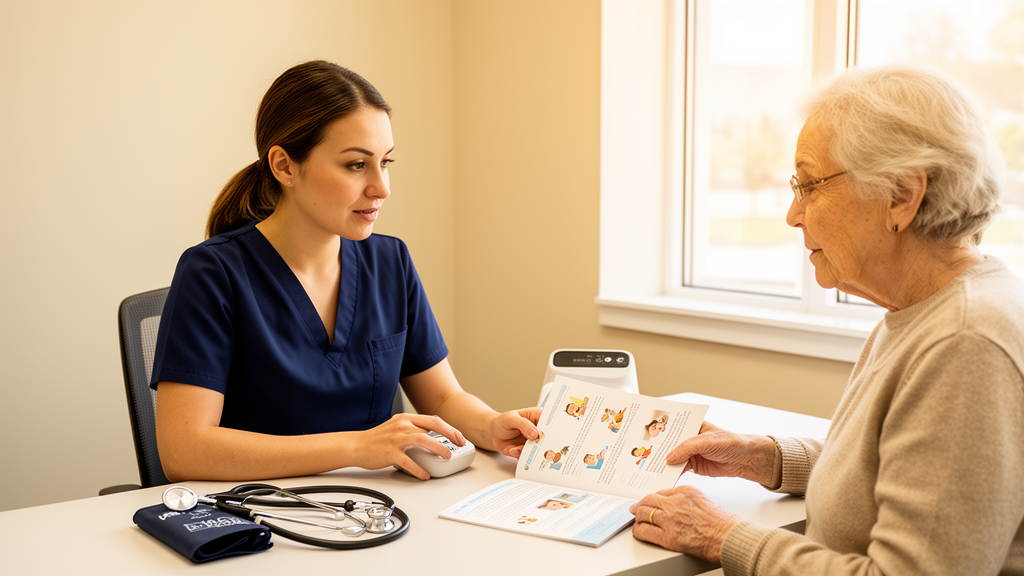
The architecture of the resulting bundle reflects a deliberate division of labor. The patient module is structured as a self-care guide, a daily record, a checklist, and a communication tool. In practice, this means a hypertensive patient can log daily readings, track lifestyle behaviors, tick off self-care tasks, and carry a structured summary of that information into their clinic visit. The nurse module, by contrast, provides guidance for education, record review, monitoring, individualized feedback, documentation, and follow-up. Together, the two modules form a feedback loop: the home record becomes the raw material for the nurse’s structured review, and the nurse’s feedback shapes the patient’s next round of self-care.
Phase II put the draft modules in front of seven experts, who assessed them across five dimensions: content, presentation, language, graphic design, and suitability as health-promotion media. The quantitative backbone of this evaluation was the content validity index, a standard psychometric tool in instrument development. At the item level, the researchers calculated the item-level Content Validity Index, or I-CVI, while at the scale level they used the average of item scores, known as S-CVI/Ave. For the four non-content domains, the same proportional calculations were used to summarize domain-specific expert agreement. Qualitative comments from the experts guided subsequent refinement of the modules.
The numbers tell a story of strong expert confidence. Content-domain S-CVI/Ave values came in at 0.89 for the patient module and 0.91 for the nurse module, both comfortably within the range conventionally interpreted as acceptable content validity. Domain-average agreement for presentation, language, graphic design, and media suitability ranged from 0.93 to 1.00, while overall multidomain agreement reached 0.94 for the patient module and 0.95 for the nurse module. The team had prespecified a threshold of 0.86, and three items fell below it. Those items were revised, and the experts subsequently confirmed that the requested changes had been addressed. Notably, the researchers did not obtain repeat ratings or post-revision content validity estimates, a transparency point they acknowledge in their reporting.
The theoretical framing of the bundle is as important as its statistics. The intervention is built on person-centered nursing, an approach that treats patients as active partners in their own care rather than passive recipients of instructions. By embedding a daily record and checklist into the patient module, the design gives patients a tangible role in generating the data that drives their care. By equipping nurses with a structured review and feedback protocol, it ensures that the information patients generate is actually used. This bidirectional design is what distinguishes the bundle from the many one-way educational leaflets that have historically dominated hypertension self-management efforts.
The authors are careful about the limits of what they have shown, and that caution matters for how the findings should be read. The non-content ratings, they note, reflect expert judgment rather than target-user usability. In other words, seven professionals believed the modules were well designed, clearly written, visually appropriate, and suitable as health-promotion media, but patients and nurses in real clinics have not yet been tested with the bundle. Expert validation is a necessary early gate in intervention science, but it is only a gate. The study establishes that the toolkit is credible and coherent; it does not yet establish that it works in the field.
That is precisely where the research agenda now points. The authors call for further studies to examine feasibility, implementation fidelity, patient usability, nurse adherence, and preliminary effects on self-care behavior and blood pressure control. Each of these questions addresses a distinct failure mode: feasibility asks whether the bundle can be delivered at all in resource-constrained primary care; fidelity asks whether it is delivered as designed; usability and adherence ask whether patients and nurses will actually sustain it; and the outcome measures ask whether any of this translates into lower blood pressure. If subsequent trials bear out the promise of this early validation work, the dual-module bundle could offer primary care systems, particularly in Indonesia and comparable settings, a practical, structured way to turn daily self-care records into better hypertension control.
Subject of Research: Development and expert validation of a dual-module person-centered nursing self-care bundle for hypertension management in primary care
Article Title: A dual-module person-centered nursing self-care bundle for hypertension management: development and expert validation
Article References: Dewi, N. P. A. R., Nursalam, N., Sriyono, S., Israfil, I., & Putra, K. A. N. (2026). A dual-module person-centered nursing self-care bundle for hypertension management: development and expert validation. BMC Nursing. https://doi.org/10.1186/s12912-026-05377-2
Image Credits: AI Generated
DOI: 10.1186/s12912-026-05377-2
Keywords: hypertension, self-care, person-centered nursing, primary health care, content validity, nursing intervention, patient education, blood pressure control, expert validation, care bundles, Indonesia, chronic disease management
News Source: Ophelia Keating. (October 8, 2026). New Nurse-Led Self-Care Toolkit Wins Expert Backing for Hypertension Care. Scienmag.