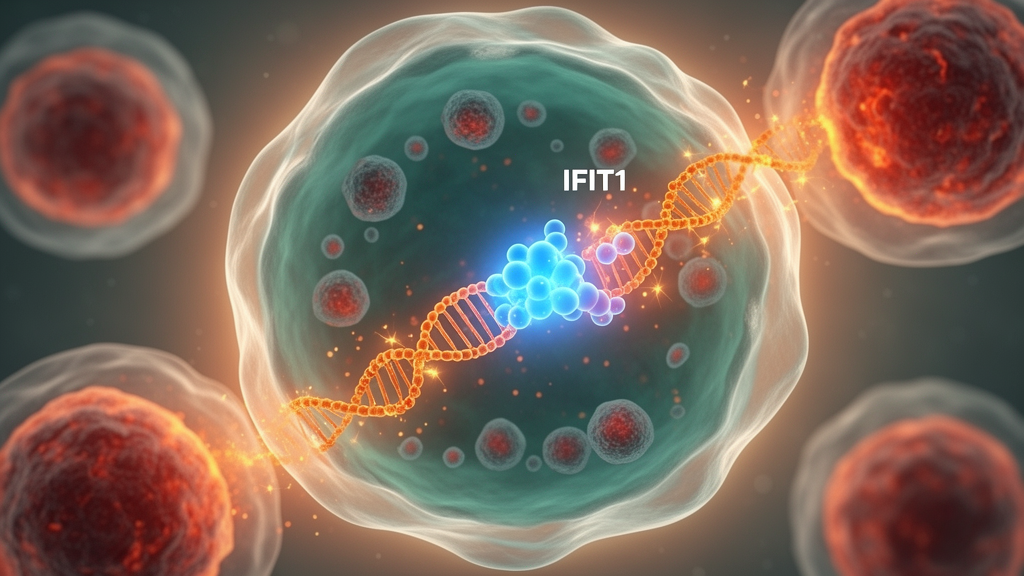
A protein that normally helps human cells fend off viral infections appears to play a surprising role in systemic lupus erythematosus, one of the most complex and unpredictable autoimmune diseases. According to a new study published in the Archives of Dermatological Research, interferon-induced protein with tetratricopeptide repeats 1, better known as IFIT1, is markedly elevated in the immune cells of lupus patients and appears to fuel two central processes of the disease: the premature death of circulating immune cells and the overproduction of inflammatory signaling molecules. The findings, reported by a team of researchers based in Hefei, China, add a new piece to the long-standing puzzle of how type I interferon signaling translates into the tissue damage and immune dysregulation that define lupus.
Systemic lupus erythematosus is a chronic autoimmune condition in which the immune system attacks the body’s own tissues, affecting the skin, joints, kidneys, blood cells, and nervous system. It disproportionately affects women and follows an unpredictable course of flares and remissions. For decades, researchers have recognized that patients with lupus show a molecular signature of interferon activation, the same response the body mounts against viral infection. This so-called interferon signature has been linked to disease activity, but the specific downstream genes that convert interferon signaling into cellular dysfunction have remained only partially mapped. The new study focuses on one of those downstream genes, IFIT1, and asks whether it is merely a passive marker of inflammation or an active participant in disease progression.
IFIT1 belongs to a family of interferon-stimulated genes that encode proteins with tetratricopeptide repeat motifs, structural elements that mediate protein-protein interactions. In its canonical antiviral role, IFIT1 acts as a sensor and effector: it recognizes viral RNA that lacks proper 2′-O methylation at its 5′ end, a modification characteristic of host messenger RNA, and binds to it to block translation of viral proteins. This makes IFIT1 a frontline defender against a range of RNA viruses. However, the same properties that make IFIT1 useful in antiviral defense raise questions about what it does when chronically expressed in a non-infectious inflammatory setting, as occurs in lupus, where sustained type I interferon production is a hallmark.
To investigate, the research team led by Ge-Ge Jiang and Zheng Cai, with Xiao-Yi Jia and Min Zhang as corresponding authors, combined bioinformatic screening with laboratory experiments on patient samples. The investigators first analyzed the publicly available GSE121239 gene expression dataset to assess whether IFIT1 messenger RNA is differentially expressed in lupus. They then collected peripheral blood samples from patients with systemic lupus erythematosus and healthy controls, isolating peripheral blood mononuclear cells, the mixed population of lymphocytes and monocytes that carries much of the immune burden in the disease. Quantitative measurement confirmed that IFIT1 expression was significantly elevated in the PBMCs of lupus patients compared with healthy donors, and that its expression levels correlated with clinical indicators of disease.
A key question was what drives the elevated IFIT1 expression in the first place. Because type I interferons are the principal inducers of IFIT family genes, the team stimulated PBMCs with interferon-alpha 2b, a recombinant form of the cytokine frequently implicated in lupus pathogenesis. The stimulation produced a gradient-dependent upregulation of IFIT1, meaning that higher concentrations of interferon-alpha 2b drove progressively stronger IFIT1 expression. This dose-response relationship supports a mechanistic chain in which the excessive interferon production characteristic of lupus continuously pushes IFIT1 expression upward in circulating immune cells, potentially sustaining a feed-forward loop of immune activation.
The most consequential part of the study concerns what IFIT1 does once it is expressed. The researchers used flow cytometry, a technique that allows individual cells to be analyzed and sorted based on fluorescent markers, to quantify apoptosis, the controlled process of programmed cell death, in PBMCs from lupus patients and controls. Apoptosis levels were significantly elevated in the patients’ cells, consistent with earlier reports of accelerated lymphocyte death in lupus. This matters because apoptotic cells release nuclear material, and defective clearance of that material is thought to expose the immune system to autoantigens such as DNA and nucleosomes, driving the production of the autoantibodies that define the disease. When the team knocked down IFIT1 expression, apoptosis in the PBMCs dropped, indicating that IFIT1 actively promotes, rather than merely accompanies, the heightened cell death seen in lupus.
The study also examined inflammatory cytokines, the soluble signaling proteins that orchestrate immune responses and tissue inflammation. Using enzyme-linked immunosorbent assays, the researchers measured cytokine levels in the patient samples and found that expression of inflammatory factors was significantly elevated in lupus patients relative to controls. Crucially, IFIT1 knockdown lowered these cytokine levels as well, mirroring its effect on apoptosis. Taken together, the results suggest that IFIT1 sits upstream of both cellular death and inflammatory output in patient immune cells, positioning it as a potential amplifier of the self-perpetuating cycle in which dying cells release autoantigens, autoantigens stimulate interferon production, and interferon induces more IFIT1.
The findings fit into a broader body of evidence implicating the interferon pathway in lupus. Previous work has linked IFIT1 to clinical features of lupus patients, and animal studies have reported IFIT1 expression in podocytes of MRL/lpr mice, a model of lupus nephritis, associated with renal pathological changes. IFIT family members have also been implicated in other autoimmune and inflammatory conditions, including rheumatoid arthritis, where interferon-stimulated gene 56, another name for IFIT1, has been linked to disease processes. Beyond autoimmunity, IFIT1 has been studied in cancer contexts, where it has been reported to influence proliferation, migration, and immune evasion in several tumor types, underscoring that the protein’s functions extend well beyond antiviral defense. A death-promoting role has also been described for its family member IFIT2, suggesting that pro-apoptotic activity may be a shared feature of parts of the IFIT family.
From a translational standpoint, the study points to IFIT1 as a candidate biomarker and therapeutic target. If IFIT1 expression tracks with disease activity, measuring it in PBMCs could complement existing clinical indicators for monitoring patients. More ambitiously, if reducing IFIT1 activity dampens both apoptosis and cytokine production, it could offer a strategy for interrupting the interferon-driven amplification loop at a point downstream of interferon itself, potentially with fewer broad immunosuppressive effects than global cytokine blockade. The authors caution, however, that their work establishes correlation and mechanistic plausibility in cell-based experiments rather than demonstrating therapeutic efficacy, and that the precise molecular pathway by which IFIT1 promotes apoptosis in lupus immune cells remains to be fully defined.
The research, funded in part by the National Natural Science Foundation of China and provincial science foundations in Anhui Province, was published on 8 October 2026 in the Archives of Dermatological Research as an original paper by Jiang, Cai, Meng, Jia, Zhang and colleagues. For a disease that affects millions worldwide and still relies heavily on broad-acting immunosuppressants, identifying a specific interferon-stimulated effector that links cell death and inflammation offers a concrete new thread to pull. Whether targeting IFIT1 can slow lupus progression in patients will require further study, but the present findings sharpen the picture of how the antiviral machinery, when chronically engaged, may turn against the body it evolved to protect.
Subject of Research: The role of the interferon-stimulated gene IFIT1 in apoptosis and inflammation in systemic lupus erythematosus
Article Title: IFIT1 promotes SLE disease progression by upregulating PBMC apoptosis and inflammatory factor levels
Article References: Jiang, G.-G., Cai, Z., Meng, X.-W., Jia, X.-Y., & Zhang, M. (2026). IFIT1 promotes SLE disease progression by upregulating PBMC apoptosis and inflammatory factor levels. Archives of Dermatological Research, 318(1), Article 511. https://doi.org/10.1007/s00403-026-04950-8
Image Credits: AI Generated
DOI: 10.1007/s00403-026-04950-8
Keywords: IFIT1, systemic lupus erythematosus, PBMCs, apoptosis, inflammatory cytokines, interferon-alpha, autoimmune disease, type I interferon, interferon-stimulated genes, lupus nephritis, biomarker, Archives of Dermatological Research
News Source: Ophelia Keating. (October 8, 2026). Antiviral Protein IFIT1 Emerges as a Driver of Lupus Progression. Scienmag.