In the intensively farmed landscapes of southern Germany, one of Europe’s most widespread yet least studied wild bees is quietly telling a story about how modern agriculture reshapes even its smallest inhabitants. A new field study of the masked bee Hylaeus communis, published in Ecology and Evolution, shows that the type of farming surrounding a bee’s nest leaves measurable fingerprints not only on how many bees emerge but also on the delicate chemical coating that covers their bodies. Because that coating governs waterproofing and mate recognition in solitary bees, the findings suggest that agricultural management may reach far deeper into wild bee biology than simple counts of individuals have previously revealed.
The research team, working across seventeen farms in Baden-Württemberg, installed artificial nesting stations, commonly called bee hotels, at nine organic and eight conventional farming sites. Each site hosted stations built from PVC pipes filled with reed stems of varying diameters, offering the hollow cavities that masked bee females seek out for nesting. The traps were set out in April 2021, left in the field for roughly six months, and then collected in September. Occupied nests were individually sealed in labeled tubing, transported to a greenhouse in Ulm, and later overwintered in a climate chamber at four degrees Celsius before being returned to the roof of the university building, where adult bees finally emerged in spring 2022.
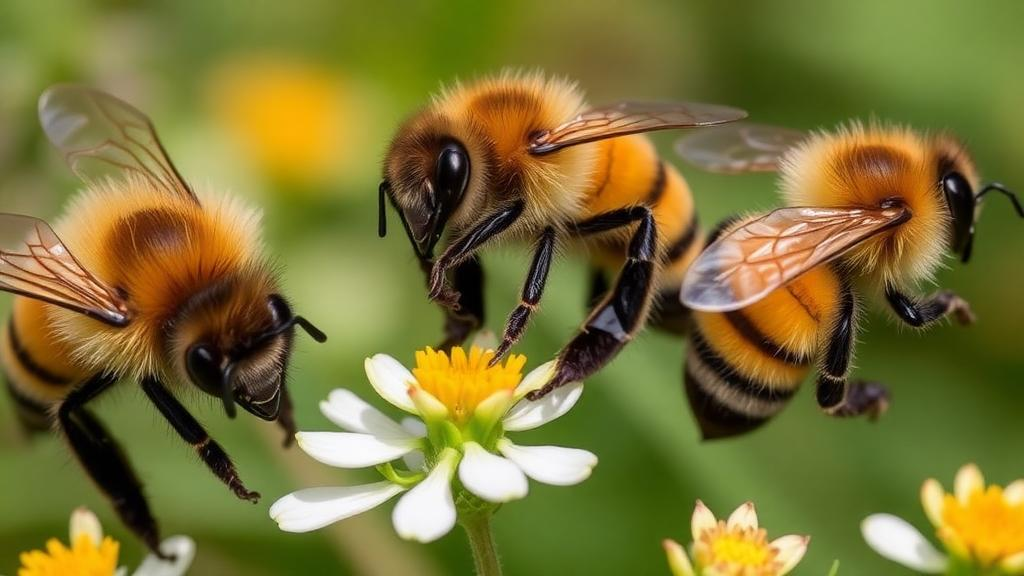
Masked bees are striking creatures despite their diminutive size. Nearly hairless, black, and wasp-like in appearance, they carry distinctive white or yellow facial markings that give the genus its common name. Germany hosts forty-five solitary Hylaeus species, and unlike honeybees or bumblebees, these insects nest alone in plant stems and hollow twigs, sealing each brood cell with a silky, membranous material. Hylaeus communis, the most widespread member of the genus in Europe, is a pronounced generalist that pollinates a wide range of plants, making it an ideal sentinel species for probing how agricultural environments affect small-bodied pollinators that previous research has largely overlooked.
The study’s first major finding concerned the flowers themselves. Surveys conducted within a hundred meters of the nesting stations showed that organic farms supported dramatically richer floral environments than conventional ones. Flower species richness averaged 5.42 species per survey at organic sites compared with just 1.44 at conventional farms, a statistically significant difference. Total flower abundance told an even starker story: organic sites recorded nearly sixty thousand flowers across the sampled plots, while conventional sites recorded barely two thousand. Because floral resources were measured only once, the authors treat these differences as a plausible mechanism rather than a proven driver, but the contrast in the local flowering environment between the two farming systems was unmistakable.
When the researchers counted the bees that emerged, the pattern favored organic farming. Across all Hylaeus species, 148 nests were recorded at organic sites against 57 at conventional ones, and 298 bees emerged from organic sites compared with 105 from conventional ones. At the level of Hylaeus communis specifically, the difference was statistically significant: abundance was markedly higher under organic management, with model estimates showing a clear positive effect of the organic farming system. Notably, the proportion of organically managed land in the surrounding landscape did not show a significant association, suggesting that the local farming system itself, rather than the broader agricultural matrix, was the decisive factor for this species.
Forest cover told a more complicated story. The abundance of Hylaeus communis declined significantly as the proportion of forest within a five-hundred-meter radius increased, a radius chosen because it matches the known foraging range of small cavity-nesting bees. The authors propose two non-exclusive explanations. Masked bees forage mainly on herbaceous flowering plants, which are typically more abundant in open agricultural habitats and field margins than under closed canopy. Alternatively, forests may offer plentiful natural nesting substrates in dead wood and stems, reducing the bees’ reliance on the artificial trap nests and thus lowering the numbers recorded in them. Either way, the result challenges any simple assumption that more semi-natural habitat is always better for every wild bee species.
Perhaps the most intriguing result concerned offspring sex ratios. The sex ratio of Hylaeus communis became significantly more female-biased with increasing forest cover, while organic sites produced significantly more male-biased broods than conventional sites. Because female offspring are energetically costlier to produce, and because females are the sex that establishes the next generation of nests, this balance matters for population persistence. The authors suggest that the larger populations at organic farms may simply permit greater production of cheaper male offspring, while forests, with their lower exposure to fertilizers and pesticides and their rich edge habitats, may create conditions favoring female production or survival. The data cannot yet separate maternal sex allocation from differences in habitat use or dispersal between the sexes.
Body size, measured as the intertegular distance between the wing bases, responded only to sex. Females were significantly larger than males, consistent with the greater energetic demands of foraging, nest construction, and brood provisioning that fall entirely on solitary bee females. Surprisingly, neither the farming system nor the extent of organic farming in the landscape had any measurable effect on body size. The authors attribute this resilience to the species’ extreme dietary generalism: even where flower communities differ sharply between organic and conventional farms, both environments apparently supply enough resources for larvae to reach similar adult dimensions, buffering this small-bodied bee against nutritional variation that might affect more specialized species.
The chemical analysis delivered the study’s most novel contribution. Using gas chromatography and mass spectrometry, the team detected fifty-six characteristic cuticular lipid peaks in Hylaeus communis, identifying thirty-six of them, including seventeen alkanes, eighteen alkenes, and one monounsaturated fatty acid. The composition of these lipid profiles differed significantly between the sexes and, strikingly, between farming systems, with the separation holding independently for both males and females. Because cuticular lipids serve as the primary barrier against desiccation and function as chemical signals in nest recognition and mate choice, the finding implies that the farming environment can alter the chemical phenotype of individual bees. The authors note that the divergence was visually more pronounced in females, raising the hypothesis that altered female chemical profiles could influence mating success, a mechanism that might help explain the smaller populations observed at conventional sites, though it was not directly tested.
Taken together, the results position farming management as a genuine determinant of small wild bee populations, shaping abundance, sex ratios, and even the chemistry of individuals. The authors argue that expanding organic farming within predominantly conventional agricultural regions could materially improve conditions for cavity-nesting bees, and they point to Germany’s national goal of reaching thirty percent organic agricultural land by 2030 as a concrete opportunity to act on that evidence. At the same time, the study is careful about its limits: it concerns cavity-nesting Hylaeus sampled with bee hotels and should not be generalized to entire wild bee communities, and a single floral survey cannot capture the full seasonal dynamics of resources. Yet for a species as small, generalist, and ubiquitous as Hylaeus communis, the message is clear. Even bees that appear to thrive everywhere are not untouched by the way humans manage the land, and the consequences of that management are written into their bodies at a molecular level.
Subject of Research: Effects of organic and conventional farming and forest cover on the population dynamics, sex ratio, body size and cuticular lipids of the solitary masked bee Hylaeus communis
Article Title: Agricultural Landscapes and Forest Fragments Shape Population Dynamics, Cuticular Lipids and the Conservation of the Masked Bees, Hylaeus communis
Article References: Olberz, S., Jansen, S., Ayasse, M., & Boff, S. (2026). Agricultural Landscapes and Forest Fragments Shape Population Dynamics, Cuticular Lipids and the Conservation of the Masked Bees, Hylaeus communis. Ecology and Evolution, 16(10), Article e74436. https://doi.org/10.1002/ece3.74436
Image Credits: AI Generated
DOI: 10.1002/ece3.74436
Keywords: Hylaeus communis, masked bees, wild bees, organic farming, conventional farming, agricultural landscapes, forest cover, cuticular lipids, sex ratio, bee conservation, pollinators, solitary bees
News Source: Margaret Porter. (October 7, 2026). Masked Bees Reveal How Organic Farms and Forest Fragments Reshape Wild Bee Populations. Scienmag.