Every year, pineapple farms around the world discard tons of thick, fibrous stems after the fruit has been harvested, treating them as little more than agricultural refuse. A team of food scientists in Thailand now argues that this overlooked by-product could become one of the most interesting functional ingredients in the bakery aisle. In a study published in Food Science & Nutrition, researchers at Mahidol University and their collaborators extracted starch from pineapple stems and used it to build gluten-free biscuits that are not only acceptable to consumers but also dramatically slower to digest than their conventional rice-flour counterparts. The work sits at the intersection of two pressing concerns: the search for healthier, lower-glycemic snack foods and the drive to squeeze value from crop waste that would otherwise be burned or discarded.
The key to the innovation lies in the unusual composition of pineapple stem starch, abbreviated PSS by the researchers. Earlier work by the same group had shown that starch drawn from pineapple stems contains roughly 30 percent amylose, a linear starch molecule, which is substantially higher than commercial rice, corn, or cassava starches. That high amylose content translates into unusually large fractions of slowly digestible starch and resistant starch, the latter being a carbohydrate that escapes digestion in the small intestine and behaves, physiologically, much like dietary fiber. Resistant starch has attracted considerable attention in nutrition research because it moderates blood glucose responses after meals and may help protect against obesity, type 2 diabetes, and other chronic metabolic conditions. Unlike chemically modified resistant starches, PSS delivers these properties in its native form, requiring no industrial alteration before use.
Turning the stems into a food-grade ingredient began on a pineapple farm in Kanchanaburi, Thailand, where the team collected twenty kilograms of stems from mature Smooth Cayenne plants after harvest. Using a wet-milling process, the stems were washed, peeled, ground with water, and passed through a series of progressively finer mesh screens to strip away fibrous material. Centrifugation, repeated washing, and overnight drying at 45 degrees Celsius yielded just over one kilogram of fine white starch powder, a yield of about 10.7 percent based on the peeled stem weight. Because PSS had never before been used in a baked product, the researchers subjected it to a battery of safety tests before any biscuit dough was mixed.
Those safety results were reassuring on every front. Atomic absorption spectrophotometry detected no lead and no cadmium in the extracted starch, indicating that the growing environment and processing conditions were clean. Microbiological testing found Escherichia coli levels below three MPN per gram, while Salmonella and Staphylococcus aureus were entirely absent from the sample quantities tested, satisfying Thai food safety standards. The starch also arrived with a moisture content just under ten percent and a water activity of 0.27, far below the 0.6 threshold at which microbes can grow, meaning the powder is inherently stable in storage. The authors note one limitation: antinutritional compounds were not directly quantified, though prior literature suggests pineapple by-products carry only negligible levels, and the extensive aqueous washing during extraction likely removes any water-soluble antinutrients.
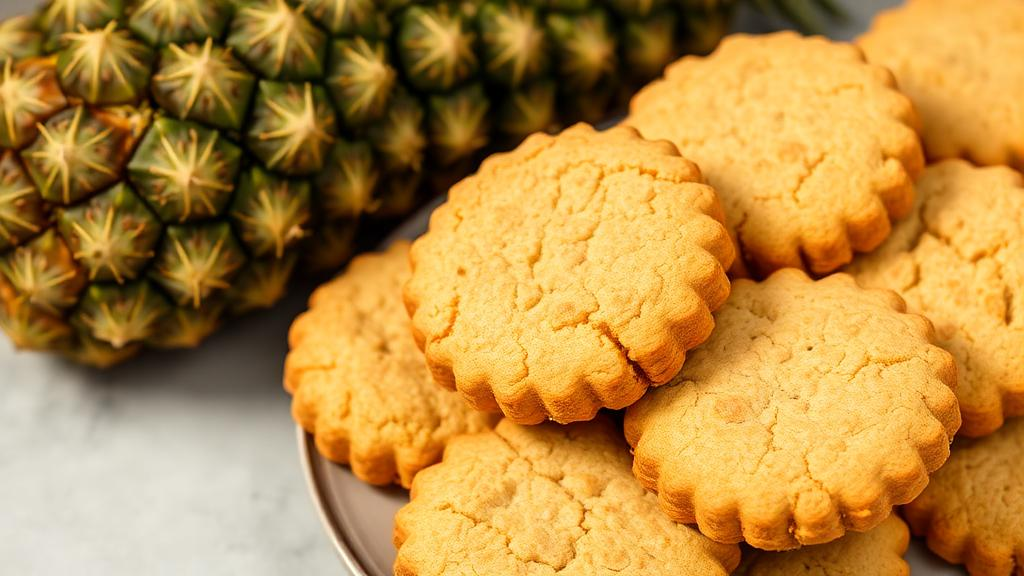
With a safe ingredient in hand, the team formulated biscuits in which rice flour was replaced by PSS at 25, 50, 75, and 100 percent by weight. Because neither rice flour nor PSS contains gluten, the recipe relied on soy protein isolate and carboxymethyl cellulose to provide structure, while butter was swapped for shortening rice bran oil and sugar for calorie-free monk fruit sweetener, moves designed to cut saturated fat and eliminate added sugar simultaneously. The physical consequences of substitution were striking. As PSS levels rose, dough became softer and stickier, with hardness falling from about 312 newtons in the all-rice control to 195 newtons in the all-PSS version. That softer, weaker dough expanded more freely during baking, producing biscuits that were wider, longer, and up to forty percent thicker than the control. Finished biscuit hardness dropped in parallel, from 8.41 newtons to 4.75 newtons, a trend the authors attribute both to the loss of gluten-forming protein and to the water-binding capacity of resistant starch. Surface color, remarkably, barely changed across all formulations, with lightness and yellowness values remaining statistically indistinguishable.
The nutritional payoff emerged from in vitro digestion experiments, in which ground biscuits were exposed to pepsin, pancreatin, and amyloglucosidase under conditions simulating the human digestive tract. After two hours of enzymatic attack, the all-rice control biscuits had released 88.3 percent of their starch as glucose, while the 100 percent PSS biscuits released only 36.6 percent. The starch fractions told the same story: rapidly digestible starch plummeted from 59.6 percent in the control to just 6.25 percent in the all-PSS biscuit, while resistant starch climbed from 11.7 percent to 63.4 percent. From these hydrolysis curves, the researchers calculated a hydrolysis index relative to white bread and then an estimated glycemic index, or eGI. The control biscuits scored 85.13, firmly in the high-glycemic category, whereas the 100 percent PSS biscuits scored 52.32, crossing into the low-glycemic range defined as an eGI at or below 55. Formulations at 50 and 75 percent substitution landed in the medium range, between 60 and 67.
Digestibility, however, means little if nobody wants to eat the result. Thirty untrained panelists, recruited under an approved ethics protocol from the Mahidol University community, rated each biscuit on a nine-point hedonic scale covering appearance, color, flavor, texture, and overall acceptability. Somewhat counterintuitively, the all-rice control fared worst, earning the lowest scores for appearance, flavor, texture, and overall liking, likely because its dense, hard structure left an oily surface. Preference rose steadily as PSS increased, peaking with the 75 percent substitution formulation, which scored 6.83 overall, between slight and moderate liking, and won the top marks for appearance, flavor, and texture. Only at full substitution did scores dip again, as the near-total absence of protein left the biscuits soft and crumbly. Crucially, every formulation scored above the acceptability threshold of five, and the winning 25:75 rice-to-PSS blend combined the best sensory profile with a medium eGI of 60.04.
Proximate analysis of that optimal biscuit revealed further advantages. Its dietary fiber content of 1.65 percent was double that of the control, a direct consequence of the resistant starch it carried, while total carbohydrate rose to about 61 percent. Protein fell from 10.9 to 8.3 percent, reflecting the low protein content of PSS relative to rice flour, though the added soy protein isolate and egg kept levels respectable. Fat, ash, and energy values were essentially unchanged, with both biscuits supplying roughly 520 kilocalories per 100 grams. The authors acknowledge that vitamins and minerals were not measured, leaving micronutrient profiling as a task for future work.
Shelf life proved equally encouraging. Samples of the control and the 75 percent PSS biscuit were sealed in foil and stored at 45 degrees Celsius for two months, an accelerated regime that, by Arrhenius estimates, models roughly eight months at room temperature. Lipid oxidation was tracked through peroxide values, which mark early-stage hydroperoxide formation, and TBARS measurements, which capture the secondary breakdown products responsible for rancid odors. Both biscuits oxidized slowly for the first twenty days and then accelerated, with the PSS biscuit oxidizing somewhat faster, plausibly because rice flour contributes antioxidant phenolics that PSS lacks. Even so, at day sixty the peroxide values of 7.17 and 10.50 milliequivalents per kilogram of fat and the TBARS values of 2.03 and 2.73 milligrams of malonaldehyde per kilogram all remained within accepted quality limits, a resilience the authors credit partly to the natural tocopherols, tocotrienols, and oryzanols in rice bran oil.
The study’s authors are careful to frame the findings as a beginning rather than an endpoint. Animal and human feeding trials will be needed to confirm that the low eGI measured in the laboratory translates into genuine glycemic benefits in people, and microbiological testing during storage should complement the chemical oxidation data in future shelf-life studies. Still, the core message is compelling: a starch recovered from stems that farmers throw away can replace most of the flour in a gluten-free biscuit, double its fiber, cut its glycemic index from high to low-to-medium, and win over a taste panel, all without chemical modification of the ingredient. If subsequent clinical work holds up, the humble pineapple stem may find itself promoted from farm waste to functional food, one biscuit at a time.
Subject of Research: Development of gluten-free biscuits using pineapple stem starch as a resistant starch source to reduce glycemic index
Article Title: Development of Gluten‐Free Biscuits From Rice Flour‐Pineapple Stem Starch Blends: Physicochemical Properties, In Vitro Starch Digestibility, Estimated Glycemic Index, Sensory Evaluation, and Storage Stability
Article References: Sriprablom, J., Phansuea, P., Sahasakul, Y., Disnil, S., Aursalung, A., Srisangwan, N., Keeratichamroen, A., Srisungwan, S., & Wongsagonsup, R. (2026). Development of Gluten‐Free Biscuits From Rice Flour‐Pineapple Stem Starch Blends: Physicochemical Properties, In Vitro Starch Digestibility, Estimated Glycemic Index, Sensory Evaluation, and Storage Stability. Food Science & Nutrition, 14(10), Article e72449. https://doi.org/10.1002/fsn3.72449
Image Credits: AI Generated
DOI: 10.1002/fsn3.72449
Keywords: pineapple stem starch, gluten-free biscuits, resistant starch, glycemic index, starch digestibility, food science, agricultural waste, rice flour, monk fruit sweetener, rice bran oil, sensory evaluation, storage stability
News Source: Alan Morgan. (October 7, 2026). Pineapple Stem Waste Becomes the Secret Ingredient in Low-Sugar, Gluten-Free Biscuits. Scienmag.