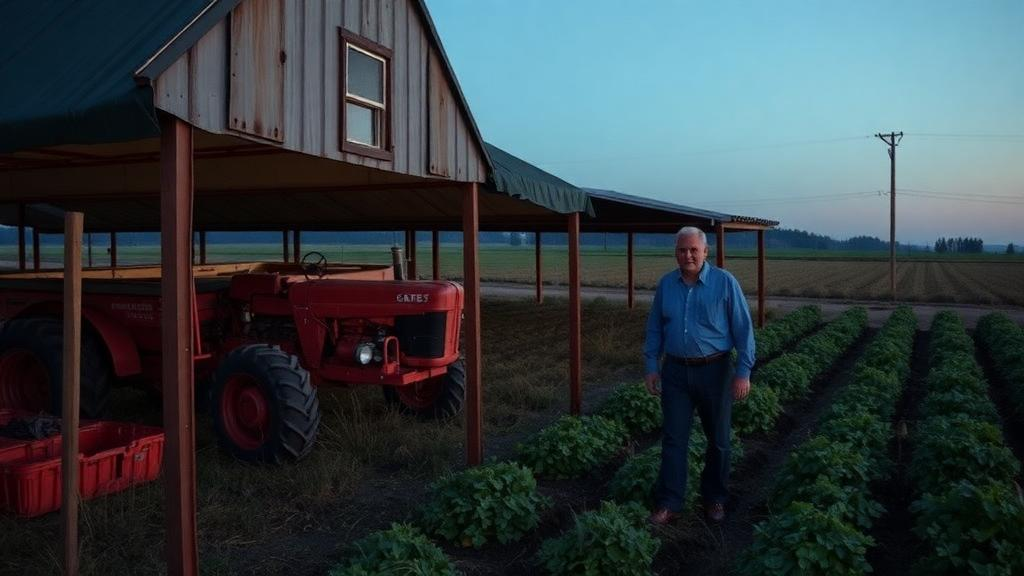
For three decades, an organization that most Americans have never heard of shaped the lives of tens of thousands of rural Black boys across the United States. The New Farmers of America, founded as a national body in 1935 and active until 1965, taught agricultural skills, cultivated leadership, and opened career pathways in farming for a generation of young people whose options were otherwise constrained by segregation and economic exclusion. Yet despite its scale and influence, the NFA has remained largely invisible in mainstream histories of American agriculture. A new book by Bobby J. Smith II, professor of African American studies at the University of Illinois Urbana-Champaign, sets out to correct that omission. Titled Black Farm Boys: The Untold Story of the New Farmers of America and published by the University of North Carolina Press, the book argues that the organization represents one of the most significant, and most neglected, chapters in the history of Black rural life.
Smith’s central claim is that the NFA has too often been treated as a footnote to a better-known story. The organization was, in effect, a Black counterpoint to the Future Farmers of America at a time when FFA chapters throughout the South were segregated. Because of that structural relationship, historians have tended to view the NFA only through its connection to the FFA, casting it in a supporting role rather than as a movement with its own origins, logic, and achievements. Smith contends that this framing distorts the historical record. The history of Black farming in America has been told predominantly as a narrative of oppression, a story of slavery, sharecropping, and dispossession. As Smith writes in the book, decades of scholarship on Black people’s historical relationship to agriculture have predominantly framed agriculture as a domain of exploitation, subjugation, and racial exclusion. Those framings are accurate as far as they go, but they are incomplete.
What the NFA story adds, according to Smith, is a dimension of empowerment and agency. The organization mobilized Black youth to consider careers in agriculture at a moment when such careers were rarely presented as aspirational for Black children. It built relationships and social networks through which entire communities celebrated farming rather than associating it only with hardship. I want people to know it existed, Smith said, noting how powerful it was that these Black boys and their adult mentors were trying to change the face of agriculture and were doing it very well. The point is not to minimize the barriers that Black farmers faced, which were severe and well documented, but to insist that Black rural communities were also sites of ambition, expertise, and institution-building.
Although the NFA became a national organization in 1935, Smith traces its roots back roughly half a century earlier, to what he calls the Black Youth Farm Movement. This movement encompassed the establishment of the 1890 land-grant Historically Black Colleges and Universities in the South, the Negro 4-H, and eventually the NFA itself. Together, these institutions embedded farming in Black education and community life in a systematic way. The 1890 land-grant universities, created as the Black counterparts to the white land-grant institutions funded under the Morrill Act, provided higher education in agriculture and the mechanical arts at a time when Southern Black students were barred from most white institutions. The Negro 4-H extended agricultural learning to younger children, and the NFA carried that work into high schools, creating a pipeline that connected classroom instruction, extracurricular activity, and eventual careers in farming and related fields.
The NFA was not simply a school club; it was woven into the fabric of rural communities. Chapters organized events that brought whole towns together to celebrate the accomplishments of participating boys. Livestock shows displayed the animals that members had raised and groomed, while father-son banquets featured menus drawn from food the boys had produced themselves, turning agricultural education into a shared family and community experience. Members competed in local, regional, state, and national competitions, giving rural Black youth arenas in which their skills could be formally recognized. Black farmers also benefited directly, learning the latest farming methods through collaborations between NFA chapters and the 1890 land-grant HBCUs. In this way, the organization functioned as a conduit for agricultural science, moving new techniques from research institutions into the fields of small Black-owned farms across the South.
Smith’s book documents the reach of the organization through vivid episodes. At a national NFA convention in New Jersey, members participated in the 1939 New York World’s Fair, presenting exhibits, performing with the NFA band, and taking part in a radio show, all while learning about agriculture on a global scale. For young men from isolated rural communities, the fair represented an encounter with international ideas about food and farming, delivered on one of the largest public stages of the era. Smith also recounts the history of an NFA summer camp in North Carolina, later named in honor of Sidney B. Simmons, a University of Illinois alumnus and national NFA leader. The camp combined recreation with leadership development, using outdoor activities to strengthen the social skills and confidence of the campers. These programs show that the NFA understood something that modern youth development research has repeatedly confirmed: leadership grows through practice, mentorship, and community recognition, not through instruction alone.
The classroom dimension of the story is equally important. Smith examines agricultural education at the high school level through the eyes of Lorenza Crosby, an agriculture teacher, and the NFA chapter at Randolph High School in La Grange, Texas. Black agriculture teachers, Smith argues, built a class of world leaders by teaching boys that they could use what they learned about farming to shape their communities and the nation. That conviction, he writes, was the essence of the land-grant mission: knowledge generated and transmitted through public institutions should return public benefit. In segregated Texas, a well-taught agriculture classroom became a site of civic formation as much as vocational training, and teachers like Crosby acted as both instructors and community leaders.
The end of the NFA came in 1965, when the organization was absorbed by the FFA, and Smith’s account of that merger is pointed. Black agricultural leaders had long been asking for representation within the agriculture education branch of the U.S. Department of Education. Instead of gaining a seat at the table on equal terms, they saw the federal agency’s powerful leadership use the antidiscrimination language of the Civil Rights Act to force a merger that Smith describes as really a hostile takeover. Desegregation, in this instance, did not preserve the institutions that Black communities had built; it dissolved them. The consequences were measurable. The number of Black boys participating in the FFA after the merger was dramatically lower than the number who had been part of the NFA, a decline that suggests how much organizational infrastructure, mentorship, and community support was lost when the NFA disappeared as an independent body.
Yet the story did not end in 1965. In 1994, Corey Flournoy, another University of Illinois alumnus, became the first Black president of the national FFA organization, and Smith sees that milestone as part of the continuing NFA story, a delayed fruit of the pathways the earlier organization had opened. Today, the challenges Smith documents remain stark: a steady decline in the number of Black farmers, driven partly by lack of access to credit, underfunding of agriculture programs at HBCUs, the stigmas attached to Black participation in agriculture, and a lack of Black representation in academic programs. At the same time, he observes a burgeoning interest among young Black people in resurrecting their historical relationship to agriculture through urban farming programs, food justice initiatives, and organizations such as Minorities in Agriculture, Natural Resources and Related Sciences and the National Black Food and Justice Alliance. Smith argues that the NFA should serve as a national historical model for maintaining the interest of Black youth in agriculture and exposing them to career opportunities. As he writes, the NFA offered Black farm boys a clear pathway to use agriculture as a site for Black self-determination, community uplift, economic vitality, educational achievement, and career training, and its untold story illuminates a pathway to understand the future of Black people’s connection to agriculture, creating what he calls a Black agricultural blueprint for the nation and the world.
Subject of Research: The history and legacy of the New Farmers of America and Black youth agricultural education
Article Title: Book tells the untold story of how New Farmers of America transformed rural Black life
Article References: Book tells the untold story of how New Farmers of America transformed rural Black life. (n.d.). Original publication
Image Credits: AI Generated
DOI: Not provided
Keywords: New Farmers of America, Black farming, agricultural education, Future Farmers of America, 1890 land-grant HBCUs, rural Black communities, Bobby J. Smith II, Black Youth Farm Movement, Negro 4-H, Civil Rights Act merger, food justice, Black agricultural legacy
News Source: Alan Morgan. (October 6, 2026). New book recovers the forgotten legacy of the New Farmers of America. Scienmag.