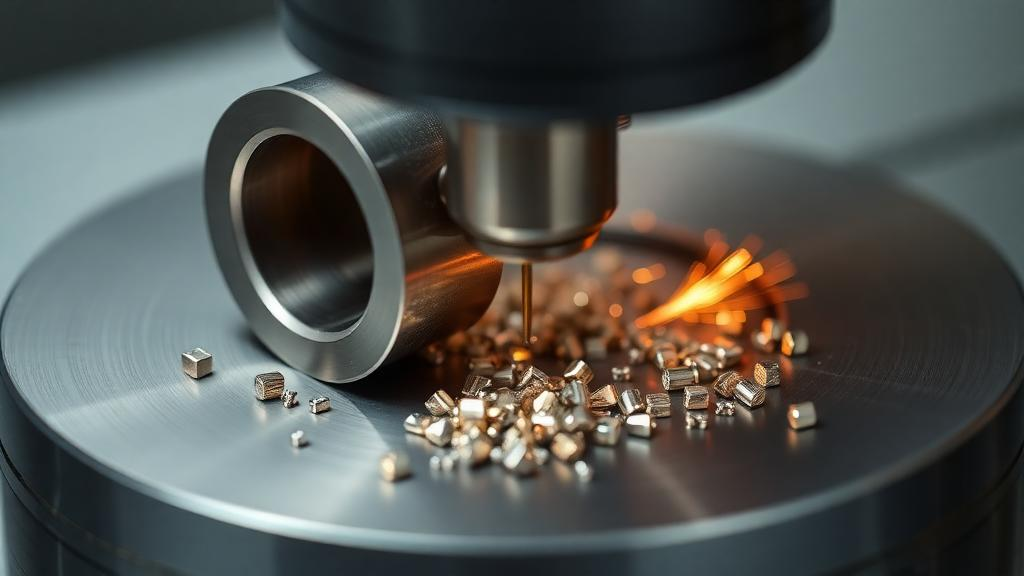
A thin layer of nitride just a few micrometers thick stands between a cutting tool and catastrophic failure. At the speeds and temperatures of modern high-performance machining, tool edges routinely reach several hundred degrees Celsius while sliding against hot metal chips at enormous contact pressures. Oxidation eats away at the coating, wear grinds it down, and friction generates still more heat in a vicious feedback loop. A comprehensive review published in the Journal of Materials Science by Leiping Guo, Haoqiang Zhang, and colleagues at Henan University of Science and Technology, together with collaborators in China and at Pusan National University in South Korea, now synthesizes the state of the art in one of the most effective countermeasures materials engineers have found: alloying physical vapor deposition (PVD) nitride coatings with refractory metals such as tantalum, molybdenum, vanadium, niobium, and tungsten.
The workhorse coatings in question are TiAlN and CrAlN, face-centered cubic nitrides that have dominated metal-cutting applications for decades. Their strength comes from a clever combination of constituents: titanium nitride provides hardness, while aluminum forms a dense, protective aluminum oxide scale when the coating is exposed to heat, slowing further oxidation. Yet even these coatings have limits. As cutting speeds rise, interface temperatures climb past the point where the cubic solid solution begins to decompose, spinodally separating into c-TiN and wurtzite AlN domains that undermine mechanical integrity. The review’s central message is that adding a carefully chosen refractory metal to the nitride lattice can push those limits substantially further, and that each alloying element achieves this through a distinct and now reasonably well understood set of mechanisms.
Tantalum and niobium emerge from the survey as the premier hardeners and stabilizers. Substituting Ta atoms onto the metal sublattice of TiAlN produces solid-solution strengthening, distorting the lattice and impeding dislocation motion, which raises hardness. More importantly, computational and experimental studies reviewed by the authors show that Ta delays the spinodal decomposition of the cubic phase, extending the temperature range over which the coating retains its structure. Ta alloying also improves oxidation resistance: tantalum oxide incorporated into the growing scale optimizes its microstructure, slowing inward oxygen transport and outward aluminum diffusion. Studies of arc-evaporated Ti-Al-Ta-N coatings report improved mechanical properties, thermal stability, and oxidation resistance compared with their ternary predecessors, and Ta has additionally been shown to enhance fracture toughness, a property often sacrificed when hardness is increased.
Niobium behaves in a related but distinct fashion. Nb-alloyed Ti-Al-N coatings display enhanced thermal stability, and ab initio thermodynamics has clarified how Nb shifts the high-temperature phase equilibria of the decomposing solid solution. Beyond solid-solution effects, Nb additions have been linked to toughness enhancement in highly alloyed Ti-Al-N films, and in CrAlNbN systems they contribute to oxidation resistance and mechanical performance. Recent work on TiAlNbN films has even revealed mechanisms of nanopore regulation and crack suppression during oxidation, suggesting that niobium influences not only the bulk lattice but also the way damage initiates and propagates in the protective oxide and the coating beneath it. For designers, the practical implication is that Ta and Nb are the elements of choice when the priority is hardness retention, phase stability, and resistance to oxidative degradation at extreme temperatures.
Molybdenum and vanadium play an entirely different role: they turn the coating into a self-lubricating system. When Mo- or V-containing nitrides are heated in the presence of oxygen at sliding interfaces, their oxides do not form rigid protective scales in the same way aluminum oxide does. Instead, molybdenum and vanadium oxides can form Magnéli-phase oxides, crystallographic shear structures with intrinsically low shear strength, or even liquid oxide films at sufficiently elevated temperatures. These shearable or molten layers act as a lubricant generated in situ exactly where friction is worst, at the chip-tool contact, reducing the coefficient of friction and cutting the heat generated by sliding. The review highlights how this adaptive, tribologically active behavior has been exploited in TiAlVN, AlCrVN, CrAlVN, TiAlMoN, CrAlMoN, and related systems, with documented improvements in cutting performance during demanding operations such as dry machining of titanium alloys and stainless steels.
Tungsten occupies an intriguing middle ground, exhibiting both solid-solution strengthening and high-temperature lubricating characteristics. Ti-Al-W-N films have been grown as dense, hard, low-stress nanocomposites even without external substrate heating, and computational studies attribute unusual plastic resistance in cubic Ti-W-N alloys to favorable electronic structure and lattice ordering. W-alloyed Ti-Al-N coatings show improved thermal stability alongside mechanical and tribological benefits, and multilayer architectures pairing nitrides with WN or W2N phases have delivered superlattice hardening in systems such as CrAlSiN/W2N. The dual functionality makes W attractive when a single coating must simultaneously resist deformation and manage friction, although the review makes clear that the balance of these effects depends sensitively on composition and deposition conditions.
Perhaps the most forward-looking section of the review concerns the synergy between refractory metal alloying and multilayer design. Rather than relying on a single chemically modified composition, engineers can alternate layers of different nitrides, for example TiAlN with TaN, VN, NbN, or TaAlN, at nanometer-scale periods. The interfaces between layers block dislocation motion and impede crack propagation, adding interface strengthening on top of the solid-solution and self-lubricating effects. Nanoscale TiAlN/VN multilayers, among the earliest adaptive hard coatings, demonstrated frictional self-adaptation calorimetrically, with vanadium oxides lubricating the surface while the layered structure maintained hardness. Similarly, TiAlCrN/NbN and TiAlCrN/WN nano-multilayers exhibited self-adaptive wear behavior under severe machining conditions, and architecturally designed Ti-Al-Ta-N multilayers have shown improved fracture properties. Combining the right chemistry with the right architecture, the authors argue, produces coating systems whose overall performance exceeds what either strategy achieves alone.
The review also situates these developments within the practical realities of coating manufacture. PVD techniques, including cathodic arc evaporation, magnetron sputtering, and hybrid high-power impulse processes, determine the density, defect content, residual stress, and droplet population of the deposited film, all of which interact with alloy chemistry. Substrate bias, sputtering pressure, and ion energy influence how much of the refractory metal is incorporated and in what bonding state, and machine learning approaches have recently been applied to map how process bias and composition jointly control phase formation in Ti-Al-Nb-N coatings. Energy-efficient deposition strategies, such as using energetic W ions to densify films without external heating, point toward industrial coatings that are both high-performing and cheaper to produce. Surface pretreatment of cemented carbide substrates further governs adhesion and scratch-induced failure, completing the chain of variables that must be optimized together.
What makes this synthesis timely is the convergence of several pressures on the machining industry. High-speed dry machining and minimum quantity lubrication are increasingly favored to cut coolant costs and environmental impact, but they expose tools to harsher thermal and tribological conditions. Difficult-to-machine alloys, including titanium alloys and super duplex stainless steels, concentrate heat and stress at the cutting edge in ways that rapidly destroy conventional coatings. The element-by-element design map assembled in this review, Ta and Nb for hardness, phase stability, and oxidation resistance; Mo and V for Magnéli-phase and liquid-film lubrication; W for a combination of both; and multilayer architectures for interface strengthening and crack inhibition, offers a theoretical basis for matching coating chemistry to specific working conditions rather than seeking a single universal solution.
The authors present their work as design guidance for the next generation of PVD protective coatings, and the underlying literature they survey suggests the field is moving from empirical trial and error toward mechanism-driven composition and architecture selection. With ab initio calculations guiding alloy development, machine learning assisting process optimization, and adaptive tribological concepts maturing from laboratory curiosities into industrial coatings, the humble few-micrometer nitride film is becoming one of the most sophisticated functional materials in manufacturing. For anyone watching the quiet revolution in how metal is cut, shaped, and finished, refractory-metal-alloyed nitride coatings are a technology worth following closely.
Subject of Research: Refractory metal alloying of PVD nitride hard coatings for improved microstructure and properties
Article Title: Tailoring PVD nitride coatings via refractory metal alloying—microstructural evolution and property optimization
Article References: Guo, L., Zhang, H., Geng, D., Guo, X., Zhang, W., Chen, C., Mao, F., Xu, L., Wei, S., & Kim, K. H. (2026). Tailoring PVD nitride coatings via refractory metal alloying—microstructural evolution and property optimization. Journal of Materials Science. https://doi.org/10.1007/s10853-026-13845-y
Image Credits: AI Generated
DOI: 10.1007/s10853-026-13845-y
Keywords: PVD coatings, nitride coatings, refractory metals, TiAlN, CrAlN, tantalum alloying, molybdenum alloying, vanadium alloying, niobium alloying, tungsten alloying, oxidation resistance, self-lubrication
News Source: Denise Maddox. (October 6, 2026). Refractory Metal Additives Supercharge Wear-Resistant Nitride Coatings for High-Speed Machining. Scienmag.