A good night’s sleep has long been treated as a lifestyle issue for teenagers, something parents nag about and pediatricians ask a single question over. A new study suggests it may deserve far more clinical attention, because the electrical fingerprint of adolescent sleep, captured night after night in teenagers’ own bedrooms, appears to carry measurable signals about their physical and behavioral health. Researchers at Duke University School of Medicine found that features of sleep physiology recorded by a lightweight, single-channel electroencephalogram (EEG) headband were associated with body weight, blood pressure, attention-deficit/hyperactivity disorder (ADHD) symptoms, conduct problems, and diagnosed psychiatric conditions in a community sample of youth. The findings, published in the Journal of Clinical Sleep Medicine, point toward a future in which sleep brain data collected at home becomes a routine, scalable early-warning system in pediatric care.
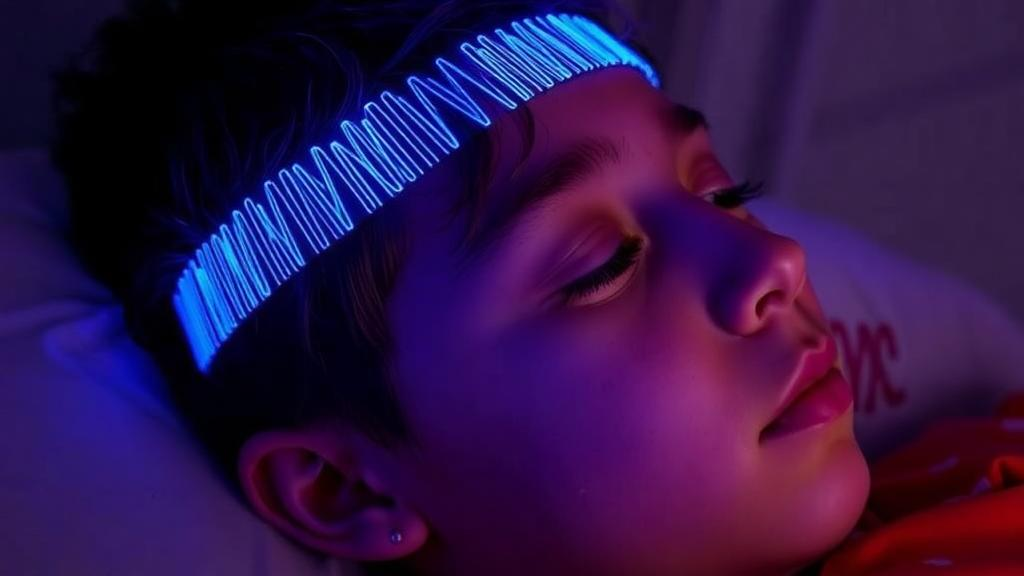
The study, led by Jamie L. Flannery and Jessica R. Lunsford-Avery, enrolled eighty-five adolescents between the ages of eleven and seventeen, with roughly half female, drawn from the community rather than from sleep clinics. Each participant wore a single-channel EEG device for seven consecutive nights while sleeping at home. Unlike conventional polysomnography, the gold-standard sleep test that requires an overnight stay in a laboratory wired with electrodes across the scalp, a single-channel device records brain activity from one electrode location and relies on automated algorithms to stage sleep. The researchers paired this physiological data with physical health measurements, including body mass index and blood pressure, subjective sleep questionnaires, adolescent-reported behavioral health measures, and parent-reported histories of psychiatric diagnoses.
The technical appeal of the approach lies in what it can see that questionnaires cannot. Adolescents are notoriously poor at estimating their own sleep, and parents often cannot observe what happens after lights go out. Single-channel EEG, by contrast, captures the architecture of sleep: how long teenagers spend in rapid eye movement (REM) sleep, the stage associated with emotional processing and memory consolidation; how much stage 3 non-REM sleep, or N3, they obtain, the deep slow-wave sleep linked to physical restoration; how efficiently they sleep once asleep; and how long it takes them to fall asleep. The device also allowed the team to compute the overnight decline in delta power, the slowing of brain waves across the night that is considered a marker of sleep pressure dissipation.
The physical health results were striking. The odds of being overweight or obese decreased by about 2.72 percent for every additional minute of REM sleep, and dropped by a full 100 percent per one-percentage-point increase in the proportion of time spent in REM. In other words, adolescents whose sleep contained more REM tended to weigh less relative to their height. Blood pressure told a different story: the odds of hypertension decreased by 4.78 percent for each additional minute spent in N3, the deepest stage of sleep. These associations align with a growing body of evidence that REM sleep plays a role in metabolic regulation, while slow-wave sleep is tied to cardiovascular health, and they suggest that wearable EEG can detect these relationships outside the artificial environment of a sleep laboratory.
The behavioral health findings were equally detailed. In multivariate analyses, reduced N3 sleep was associated with parent-reported ADHD symptoms, hinting that the deepest, most restorative stage of sleep may be diminished in youth showing attention problems. Meanwhile, shorter total sleep time, lower sleep efficiency, and longer sleep onset latency were each linked to higher adolescent-reported ADHD symptoms and conduct problems. When the researchers looked at formal diagnoses, the odds of having an ADHD diagnosis rose by 1.92 percent for every additional minute it took to fall asleep and were dramatically higher, by 89.4 percent, for each 0.01-unit slowing in the overnight decline of delta power, but fell by 7.78 percent for each one-percentage-point increase in sleep efficiency. A sluggish dissipation of sleep pressure across the night, detectable only through EEG, emerged as a particularly intriguing correlate of ADHD.
Internalizing disorders, which include anxiety and depression, showed their own distinct sleep signature. The odds of an internalizing diagnosis increased by 12.4 percent for each percentage point of higher sleep efficiency and by 3.18 percent for each additional minute of wake after sleep onset, but decreased by 9.62 percent for every extra minute of REM sleep. That seemingly paradoxical combination, more fragmented sleep with higher measured efficiency and less REM, illustrates why the researchers argue that physiological sleep data adds information beyond what teenagers or their parents can report. Two adolescents may describe their sleep identically on a questionnaire while their brains are doing very different things across the night.
Adolescence is a developmental window in which sleep is uniquely vulnerable. Biological shifts push circadian rhythms later, making it harder for teens to fall asleep at a clock-appropriate hour, while early school start times, homework loads, and evening screen use compress the opportunity for sleep. Researchers have described this convergence as a perfect storm. At the same time, sleep disturbances during these years heighten the risk of obesity, hypertension, and emerging psychiatric illness, conditions whose trajectories often harden into adulthood. Despite this, sleep physiology is rarely assessed in pediatric care, where screening typically relies on brief conversations or, at best, wrist-worn activity trackers that estimate sleep from movement rather than measuring brain activity directly.
This is the gap the Duke team hopes wearable EEG can close. Because the devices are inexpensive, comfortable, and usable without technician supervision, they can collect multiple consecutive nights of data in the environment where sleep actually happens, an approach known as ecologically valid assessment. Multi-night home monitoring also captures night-to-night variability that a single laboratory night cannot, improving the reliability of sleep estimates. Earlier work by the same group demonstrated that adolescents find the devices feasible and acceptable to wear, a critical prerequisite for any tool intended for routine pediatric use. The new study extends that feasibility work by showing that the data these devices produce correlates meaningfully with real health outcomes in a general community sample, not just in clinical populations.
The authors are careful about interpretation. These are cross-sectional associations in a modestly sized sample, so the data cannot establish whether altered sleep causes obesity, hypertension, or psychiatric conditions, whether poor health disrupts sleep, or whether shared underlying mechanisms drive both. Some findings, such as the link between higher sleep efficiency and internalizing diagnoses, will require replication and deeper investigation before they can guide clinical decisions. The researchers also note that single-channel EEG, while validated against polysomnography for sleep staging, provides a coarser view of brain activity than full laboratory recordings. Still, the pattern of results is consistent with mechanistic literature linking REM sleep to metabolic and emotional regulation and slow-wave sleep to cardiovascular recovery, lending biological plausibility to the observed associations.
The practical vision emerging from this research is one of precision prevention. If a pediatrician could review a week of home EEG data during a routine visit and see that a twelve-year-old has chronically short REM sleep, prolonged sleep onset, and an abnormally slow decline in delta power, that child might be flagged for sleep-focused intervention years before obesity, hypertension, or a psychiatric diagnosis takes hold. Sleep interventions, from behavioral therapy to adjustments in school schedules and evening routines, are comparatively low-risk and well understood. By capturing physiological features invisible to self-report, wearable sleep EEG could complement routine care, identify youth who would benefit from targeted sleep treatment, and support developmentally informed approaches to protecting adolescent health. What was once confined to a hospital sleep lab for a single artificial night may soon become a quiet, nightly conversation between a teenager’s brain and their doctor.
Subject of Research: Wearable single-channel sleep EEG correlates of physical and behavioral health in adolescents
Article Title: Leveraging convenient wearable technology to assess adolescent sleep: physical and behavioral health correlates of single-channel sleep electroencephalogram in a community sample of youth
Article References: Flannery, J. L., Engelhard, M. M., Kansagra, S., Kollins, S. H., Krystal, A., & Lunsford-Avery, J. R. (2026). Leveraging convenient wearable technology to assess adolescent sleep: physical and behavioral health correlates of single-channel sleep electroencephalogram in a community sample of youth. Journal of Clinical Sleep Medicine, 22(1), Article 113. https://doi.org/10.1007/s44470-026-00118-3
Image Credits: AI Generated
DOI: 10.1007/s44470-026-00118-3
Keywords: adolescent sleep, wearable EEG, REM sleep, N3 sleep, obesity, hypertension, ADHD, internalizing disorders, sleep efficiency, pediatric health, sleep medicine, home sleep monitoring
News Source: Daisy Hatcher. (October 6, 2026). Wearable EEG Reveals How Teen Sleep Patterns Track With Obesity, Blood Pressure and ADHD. Scienmag.