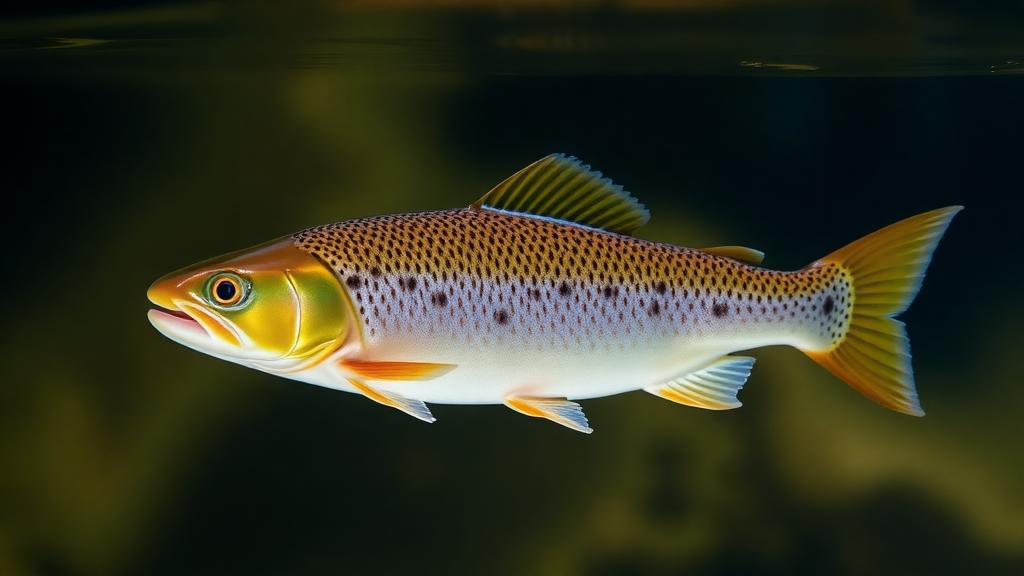
For more than half a century, fisheries managers across the Great Lakes region have poured resources into restoring lake trout, only to watch wild recruitment stall again and again. Overfishing, sea lamprey predation, invasive species, and habitat alteration have all been implicated in the species’ failure to reclaim its former abundance. Now a new study adds an unexpected and cautiously hopeful piece to the puzzle: developing lake trout embryos may be able to pull vitamin B1 directly from the water around them, a pathway that could mean thiamine deficiency plays out very differently in nature than it does in hatcheries.
The research, published in Scientific Reports and funded by the Great Lakes Fishery Commission, was conducted by scientists from SUNY Brockport, the University of Vermont, and Oregon State University. It is the first study to examine whether fish embryos can acquire thiamine naturally in their wild incubation environment. Led by Matthew Futia of the University of Vermont’s Rubenstein Ecosystem Science Laboratory, in collaboration with the Rinchard Lab at SUNY Brockport, the team chose Lake Champlain as its experimental arena because thiamine deficiency has already been documented in stocked populations of lake trout and Atlantic salmon there, and the lake’s spawning sites are well studied.
The disorder at the center of the work is Thiamine Deficiency Complex, or TDC, a syndrome caused by insufficient vitamin B1. Thiamine is an essential cofactor in carbohydrate metabolism and neural function, and fish cannot synthesize it in useful amounts; it must be obtained from diet or the surrounding environment. In salmonines, TDC is typically observed in hatcheries that rear eggs collected from wild adults, where it produces severe behavioral and neurological abnormalities and extremely high mortality in newly hatched fish. Hatchery staff can mitigate the effects with thiamine baths or injections, but until now, essentially everything scientists knew about TDC-related mortality came from those controlled settings.
That hatchery-centric knowledge base left a glaring gap. Eggs of lake trout incubate in the wild for more than five months before haking, resting in the interstices of rocky spawning reefs where water flows continuously around them. Because thiamine is potentially highly available dissolved in water, the researchers reasoned that embryos might be absorbing the vitamin from their environment throughout that long incubation period, something no laboratory rearing protocol had ever replicated or measured.
To test the idea, the team fertilized lake trout eggs from Lake Champlain and split them between two very different fates. One portion was deployed in the lake itself, placed in egg incubation bags on natural spawning substrate, while the paired portion was reared under controlled laboratory conditions. The researchers then measured thiamine concentrations at four developmental stages in both groups, and separately analyzed the lake water to determine how much thiamine was actually available in the embryos’ surroundings.
The results were striking. Lake-reared embryos accumulated substantial amounts of thiamine as development proceeded, showing significant increases in thiamine concentrations at the time of hatching and in the weeks that followed. Their lab-reared siblings, incubated in the same water source but under controlled conditions, showed no increase at all. The contrast between the two groups demonstrates that something about the natural environment, likely the continuous exchange of lake water across the egg membranes, allows embryos to take up the vitamin in quantities that artificial rearing does not provide.
The team also detected thiamine precursors and byproducts in Lake Champlain, adding a biochemical dimension to the findings. Together, the measurements indicate that developing embryos may be able to take up sufficient concentrations of thiamine during their months in the substrate to offset problems that would otherwise arise from thiamine deficiency. In other words, the wild may be quietly doing for lake trout embryos what hatcheries must accomplish with vitamin treatments.
Futia emphasized how much this changes the interpretive frame. Prior to this study, practically everything known about the effects of TDC on newly hatched fish was based on laboratory and hatchery work, he noted, and the findings suggest that what occurs in natural environments may actually be quite different, and thankfully in a good way for the fish. That distinction matters enormously for conservation planning, because assessments of TDC risk have so far been extrapolated from hatchery observations that may not reflect what wild embryos actually experience on a spawning reef.
The implications extend well beyond Lake Champlain. Thiamine Deficiency Complex is considered a major threat to conservation and restoration efforts for salmonines across a wide geographic range, and it has complicated recovery programs for Atlantic salmon, steelhead, and other species wherever thiamine-poor forage fish dominate adult diets. By revealing a previously unknown pathway for thiamine acquisition in the wild, the study opens the door to improved restoration strategies, more accurate field assessment of TDC, and better-informed management decisions for lake trout and related species across the Great Lakes and beyond.
For a species whose wild reproduction has frustrated managers for decades, the message is one of cautious optimism. The barriers to lake trout recovery remain real, from lamprey predation to habitat loss, but the new evidence suggests that one suspected obstacle, embryonic thiamine starvation in nature, may be less severe than hatchery data implied. Future work building on this experimental design could help managers distinguish which populations genuinely face thiamine-limited recruitment in the wild and which have been quietly rescuing themselves from the lake water all along.
Subject of Research: Thiamine uptake by lake trout embryos in natural versus laboratory incubation environments
Article Title: UVM study reveals how lake trout embryos acquire thiamine in the wild
Article References: UVM study reveals how lake trout embryos acquire thiamine in the wild. (n.d.). Original publication
Image Credits: AI Generated
DOI: Not provided
Keywords: lake trout, thiamine, Thiamine Deficiency Complex, vitamin B1, Lake Champlain, Great Lakes, fish embryos, fisheries restoration, salmonines, aquatic ecology, Scientific Reports, conservation
News Source: Denise Maddox. (October 6, 2026). Lake Trout Embryos Absorb Vitamin B1 Directly From Lake Water, Study Finds. Scienmag.