Italy has just completed one of the most ambitious audits of botanical knowledge ever attempted for a single country. A team of more than forty botanists, coordinated through the Working Group for Floristics, Systematics and Evolution of the Italian Botanical Society, has evaluated 3,902 local floristic references published between 2005 and 2025 to produce a completely updated map of how well the country’s vascular flora is actually known. The results, published in the journal Plant Biosystems, are both encouraging and unsettling: knowledge of Italy’s plants has advanced dramatically in the north and center of the peninsula, while large swaths of the south remain botanically terra incognita. The study also documents a remarkable wave of species discovery, with 453 new plant taxa described from Italian territory in just two decades, nearly all of them found nowhere else on Earth.
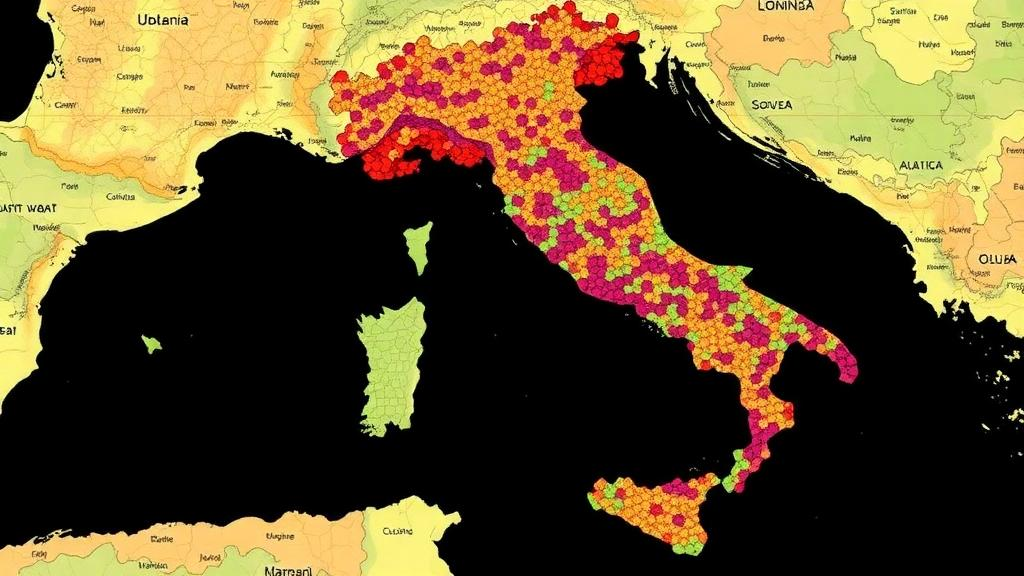
The effort builds on a cartographic tradition that stretches back almost half a century. The first map of Italian floristic knowledge was released in 1978, and a second edition followed in 2005. To create the new version, the researchers compiled a bibliographic catalogue of 3,423 scientific articles and 479 books or book chapters, organized by administrative region. Each reference was manually georeferenced to a polygon delimiting the spatial extent of the area it covered, using vector cartography from the Italian National Geoportal and toponyms drawn from the 1:25,000 topographic map series of the Italian Military Geographic Institute. The team adopted the same five-level classification system used in 2005, ranging from virtually unknown areas to well-known areas, allowing a direct comparison of knowledge across three benchmark years: 1978, 2005 and 2025.
To quantify progress objectively rather than relying on anecdotal impressions, the researchers introduced a new metric: the Index of Floristic Knowledge Advancement, or IFA. This index measures the proportion of maximum potential progress that each region has actually achieved between 2005 and the ideal state of complete knowledge, expressed as a normalized value between 0 and 1. Values are categorized as limited, moderate, high or very high. Crucially, all analyses were based on regional percentage distributions rather than absolute areas, ensuring that small regions could be compared fairly with large ones. At the national scale, the IFA was just 0.22 when comparing 1978 with 2005, but rose to 0.30 when comparing 2005 with 2025, a signal that the pace of discovery has accelerated even as the easiest gains have already been made.
The regional rankings tell a striking story. Emilia-Romagna emerged as the most comprehensively documented region in Italy, with an IFA of 0.81, the only region to reach the very high category. Its area classified as well-known soared from 26.52 percent to 82.01 percent over the two decades. Lombardia followed with 0.60, then Friuli-Venezia Giulia at 0.54, and Trentino-Alto Adige and Veneto tied at 0.53. In central Italy and the islands, Lazio scored 0.50, Sardegna 0.45 and Toscana 0.36. Trentino-Alto Adige deserves special mention for sheer data volume: the number of floristic records there jumped from 897,000 in 2005 to 2,191,000 in 2025, driven by two ongoing mapping projects, one for the province of Bolzano and one for the province of Trento.
The drivers of this acceleration are diverse. Coordinated scientific projects, citizen science programs, the development of digital databases such as the Wikiplantbase platforms, and a renewed focus on taxonomic research all played a role. In Piemonte, a collaborative mapping programme gathered more than 790,000 georeferenced records by 2021, most of them collected in the last two decades, while the annual series Note floristiche piemontesi has published over 1,350 records since 2005. In Toscana, the companion series Contributi per una flora vascolare di Toscana has added more than 1,200 records since 2009, and the monumental Flora Analitica della Toscana, published between 2016 and 2021, synthesized the region’s vascular flora in eight volumes. In Emilia-Romagna, a decade-long mapping project launched in 2016 has compiled over 200,000 bibliographic and original field records for the Romagna biogeographical region.
The discovery of new species has been equally impressive. Between 2005 and 2025, a total of 579 new names were published based on material collected in Italy, of which 126, roughly 22 percent, were later synonymized with previously described taxa. The remaining 453 accepted taxa include 291 species and 162 subspecies, and 443 of them are Italian endemics. Abruzzo leads the regional count with 74 newly described taxa, followed by Sicilia with 69, Toscana with 53 and Sardegna with 51. The genus Hieracium, the hawkweeds, dominates the list with 147 taxa, followed by the orchid genera Ophrys with 33 and Epipactis with 29, and the dandelion genus Taraxacum with 26. By family, Asteraceae accounts for 195 of the new taxa, with Orchidaceae contributing 44.
Yet the numbers also expose a structural weakness in Italian botany. The vast majority of publications, 2,931 of them, focus on small areas within a single region, while only 95 works cover at least 18 regions and a mere 2.43 percent address the national scale. Research effort is also geographically skewed: Sardegna, with 916 references, and Piemonte, with 784, together account for nearly a third of the total, while Basilicata, Friuli-Venezia Giulia, Molise, Umbria and Valle d’Aosta each attracted about 300 references or fewer. The Orchidaceae family, beloved of amateur botanists, generated the most studies of any plant family, with 425 references representing 10.8 percent of the total output.
The north-south divide is the study’s most sobering finding. While northern regions surged ahead, progress in the south and on the islands was markedly slower. Calabria and Sicilia exhibited near-stagnation, with minimal advancement into the highest knowledge categories, and Basilicata, Molise and Umbria remained largely at intermediate levels with little change over two decades. Virtually unknown areas still persist in central-western Abruzzo, Campania, Puglia, Basilicata and Calabria, and large areas with only generic knowledge are concentrated in Liguria, Umbria, southern Abruzzo, northern Campania, northern Puglia, central Basilicata, central Calabria and central Sicilia. This is paradoxical given that much of the fieldwork organized by the Italian Botanical Society’s floristic working group was deliberately concentrated in southern Italy, yet these regions showed only modest improvements in documentation.
The analysis of newly published names also reveals instructive patterns about how taxonomy gets done. The 147 Hieracium names are almost exclusively the work of a single researcher, Günther Gottschlich, collaborating with local collectors. Among orchids, a group heavily studied by amateurs, the rate of synonymy is strikingly high: more than 45 percent of the 81 described names, 37 in total, are now considered synonyms. The authors argue that this contrast demonstrates a key lesson, namely that synergistic collaboration between professional and amateur taxonomists is essential for producing reliable and durable taxonomic hypotheses. In Sicilia, most of the 69 new species and subspecies described resulted from critical re-evaluation of previously known plants rather than genuine discoveries in under-explored areas, a reminder that naming is not the same as knowing.
Why does all this matter beyond the herbarium? Floristic knowledge, the authors contend, is a foundational, long-term investment and a cumulative record built through generations of fieldwork, and even a small floristic contribution is an essential component of global biodiversity knowledge, supporting taxonomic, biogeographic, evolutionary and conservation research. It is also a legal necessity: protected area managers rely on these baseline data to comply with monitoring obligations under Article 11 and reporting duties under Article 17 of the European Habitats Directive. Without a rigorous knowledge baseline, the researchers warn, advanced studies risk being erected on unstable ground, compromising the integrity, reproducibility and long-term value of the entire scientific enterprise. The message of the new map is clear: Italy knows its northern flora better than ever, but achieving a truly comprehensive picture of the country’s extraordinary plant diversity will require targeted fieldwork, sustained investment and far greater collaboration in the regions that time and funding have left behind.
Subject of Research: Twenty-year mapping of floristic knowledge advancement across the administrative regions of Italy
Article Title: Mapping the advancements in floristic knowledge of Italy (2005–2025)
Article References: Domina, G., Bacchetta, G., Bartolucci, F., D’Antraccoli, M., Peruzzi, L., Stinca, A., Alessandrini, A., Bernardo, L., Boscutti, F., Bouvet, D., Bovio, M., Calvia, G., Cambria, S., Conti, F., Dagnino, D., Del Guacchio, E., Galasso, G., Gigante, D., Di Gristina, E., … Barone, G. (2026). Mapping the advancements in floristic knowledge of Italy (2005–2025). Plant Biosystems, 160(4), Article 213. https://doi.org/10.1007/s44473-026-00207-4
Image Credits: AI Generated
DOI: 10.1007/s44473-026-00207-4
Keywords: floristics, Italy, vascular flora, biodiversity, endemism, plant taxonomy, biogeography, citizen science, Hieracium, Orchidaceae, conservation, floristic mapping
News Source: Margaret Porter. (October 5, 2026). Italy’s Plant Map Reveals a Stark North-South Knowledge Divide. Scienmag.