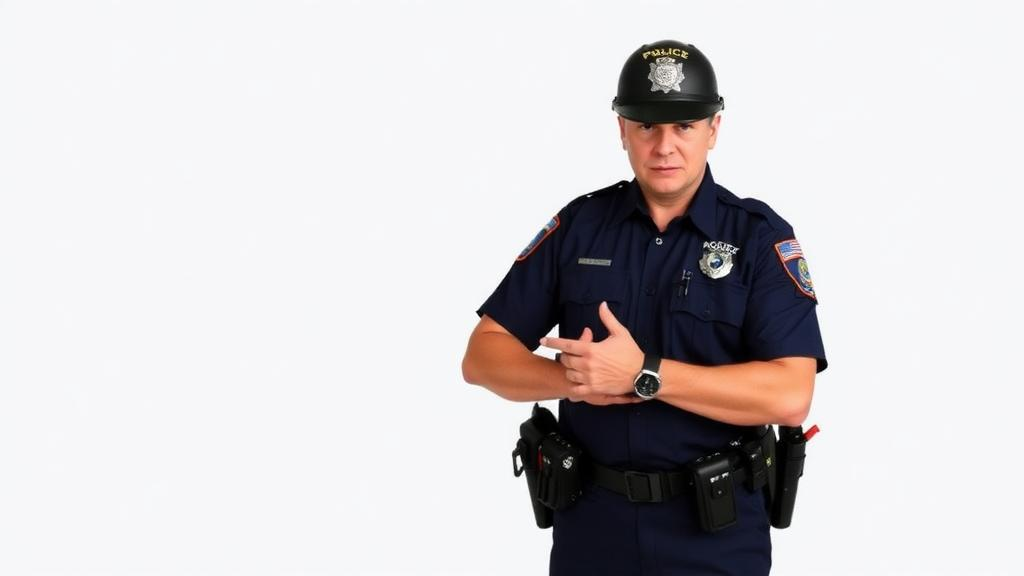
When a police officer pulls someone over, questions a witness, or responds to a call about a person behaving unusually, there is a reasonable chance that the person involved is autistic. Autistic individuals encounter law enforcement at every stage of the criminal justice system, from street-level interactions to incarceration, and research has repeatedly shown that many officers receive little or no autism-specific preparation for these encounters. A new study published in the Journal of Autism and Developmental Disorders offers one of the largest examinations to date of how autism training changes the attitudes of serving officers, and its findings are both encouraging and unexpectedly complicated.
The research, led by Lauren Gardner of Johns Hopkins All Children’s Hospital together with colleagues at Directions for Living in Florida and Marcus Autism Center in Atlanta, followed 438 law enforcement officers who attended autism training in California or Florida. The team used a nonrandomized pre-post intervention design, meaning they measured officers’ attitudes toward autistic people immediately before and after training rather than comparing them against an untreated control group. Officers completed either a two-hour or a four-hour program, and the California cohort received an additional component delivered through virtual reality, a technology increasingly used to simulate high-stakes encounters in a controlled environment.
The central question was stigma. Stigma toward autistic people is not an abstract concern for the autism community; it shapes how officers interpret behavior, how they assess risk, and ultimately whether an encounter escalates or de-escalates. Prior work by the same research group and others has documented that officers commonly report incidents involving autistic individuals and that use of force can occur when communication differences are misread as defiance, intoxication, or suspiciousness. Autistic adults themselves, along with their families, consistently describe fear of police contact and report that officers often fail to recognize autism or adapt their communication style accordingly.
To quantify stigma, the researchers used a validated measure of autism-related attitudes, capturing both stigmatizing views and what the field calls neurodiversity-affirming attitudes, meaning beliefs that recognize autism as a form of natural human variation deserving of acceptance and accommodation rather than purely as a deficit to be corrected. This distinction matters methodologically. Older training evaluations often measured only knowledge gains or self-reported confidence, which can improve after any structured course without touching the deeper attitudes that guide behavior under pressure. By tracking a validated stigma measure across two large, geographically distinct samples, the study moves the field toward outcomes that are more plausibly connected to real-world conduct.
The headline result was clear: overall autism stigma decreased significantly following training across the combined samples. That finding alone is notable given the scale of the cohort and the brevity of the interventions. Even relatively short training, measured in hours rather than days, appeared capable of nudging attitudes in a more affirming direction among a professional group whose members often enter service with limited exposure to autism and whose prior experiences on the job may reinforce stereotyped assumptions about unusual behavior.
Beneath the aggregate result, the demographic patterns were revealing. In both the California and Florida samples, female officers reported higher neurodiversity-affirming attitudes than male officers before any training took place, a baseline difference consistent with broader literature on gender and attitudes toward disability and neurodivergence. More interesting was what happened afterward: male officers in the California sample showed significant increases in neurodiversity-affirming attitudes, suggesting that training may be particularly valuable for closing the attitudinal gap between groups that starts out uneven. In the Florida sample, officers who had a personal relationship with an autistic person began with more affirming attitudes, but it was the officers without such a relationship who showed the greater gains, implying that structured training can partially substitute for the perspective that personal connection otherwise provides.
Then comes the part of the study that resists a tidy narrative. Item-level analyses, which examine responses to individual questionnaire statements rather than only composite scores, revealed a mixture of positive and unexpected changes. Alongside increased neurodiversity-affirming attitudes, officers showed greater endorsement of normative behavioral expectations, the assumption that people should behave in conventionally expected ways, and reduced trust in information provided by autistic individuals themselves. In other words, some officers appear to have absorbed affirming language about autism while simultaneously becoming more likely to expect neurotypical conduct and less likely to credit autistic people as reliable narrators of their own experience.
This pattern is scientifically important because it illustrates a known hazard of stigma-reduction interventions: attitudes are multidimensional, and training can shift some dimensions while leaving others untouched or even moving them in the wrong direction. Researchers studying stigma have argued that interventions emphasizing deficit-based framings, even unintentionally, can reinforce the idea that autistic people are less credible or less capable of self-report. The new findings give that theoretical concern an empirical foothold in a population, law enforcement, where the stakes of discounted testimony and rigid behavioral expectations are unusually high. An officer who believes autistic people deserve acceptance but trusts their statements less may still make consequential errors during an interview or a crisis call.
The authors are appropriately cautious about causation. Because there were no randomized control groups, it is impossible to rule out alternative explanations for the observed changes, such as demand characteristics, where participants report what they believe the training intends them to feel, or simple regression artifacts. The two samples also differed in program length and in the inclusion of virtual reality components, so the study cannot isolate which specific ingredient drove the improvements. What the design does support is a preliminary conclusion that autism-specific training is associated with measurable increases in neurodiversity-affirming attitudes among officers, and that these changes are detectable with validated instruments rather than satisfaction surveys.
The practical implications reach well beyond academic debate. Policing agencies across the United States and elsewhere are under growing pressure to adopt autism training, driven by high-profile incidents, advocacy from autistic people and their families, and systematic reviews documenting gaps in policy and practice at the intersection of autism and criminal justice. This study suggests that such training is worth investing in, particularly for officers without personal connections to autism and potentially for male officers who start with less affirming baseline attitudes. At the same time, the item-level findings argue for scrutinizing training content itself: curricula should be designed and evaluated not just to reduce global stigma but to specifically strengthen trust in autistic self-report and to loosen normative behavioral expectations that can make ordinary autistic communication look like noncompliance. The authors call for randomized controlled trials and longitudinal research to determine whether attitudinal gains persist over time and, crucially, whether they translate into safer, more affirming behavior during real encounters. Until that evidence arrives, the study stands as a rigorous first step: a demonstration that the attitudes of hundreds of serving officers can move in a matter of hours, along with a candid warning that the direction of movement is not uniformly what advocates might hope for.
Subject of Research: Changes in law enforcement officers' autism stigma following autism-specific training
Article Title: Law Enforcement Officers and Autism Stigma: Changes Associated With Autism Training
Article References: Gardner, L., Powell, L., Montoya, K., Ku, T., Lott, A., & Campbell, J. (2026). Law Enforcement Officers and Autism Stigma: Changes Associated With Autism Training. Journal of Autism and Developmental Disorders. https://doi.org/10.1007/s10803-026-07544-5
Image Credits: AI Generated
DOI: 10.1007/s10803-026-07544-5
Keywords: autism, law enforcement, stigma, police training, neurodiversity, attitudes, virtual reality training, pre-post intervention, autistic individuals, criminal justice, Journal of Autism and Developmental Disorders, Enforcement
News Source: Ophelia Keating. (October 5, 2026). Autism Training Shifts Police Officers’ Attitudes, But Not Always in Expected Ways. Scienmag.