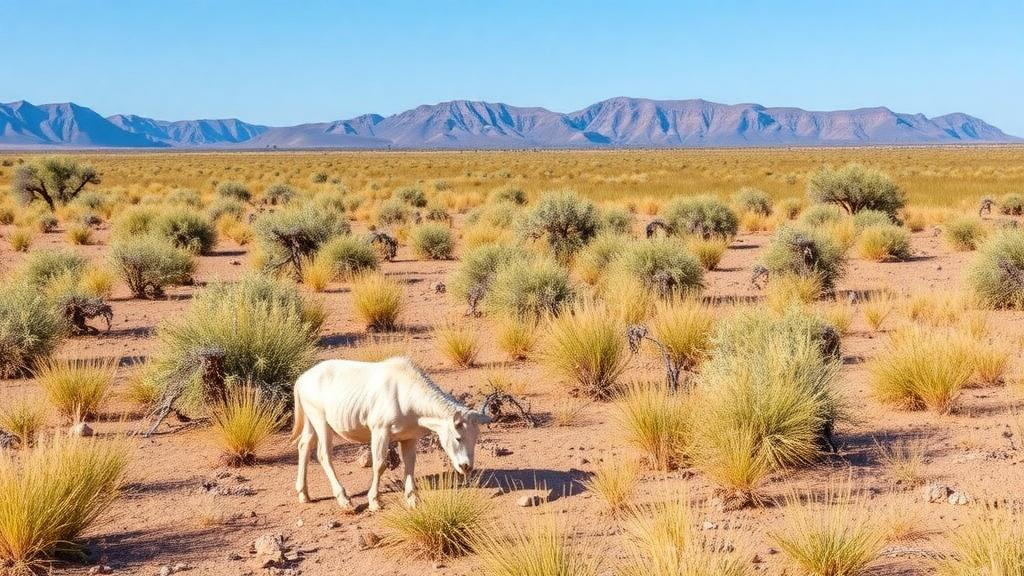
Beneath the windswept desert grasslands of Inner Mongolia, an invisible economy hums along regardless of what happens above ground. Bacteria and fungi trade nutrients, decompose organic matter, and anchor the thin soils that hold this fragile ecosystem together. A new study published in Plant and Soil now shows that the relentless pressure of overgrazing does not merely thin the vegetation and compact the soil; it quietly dismantles the diversity and the intricate web of relationships among the microbes that make these arid lands function at all. The findings carry an uncomfortable warning for one of the world’s largest pastoral landscapes.
The research team, led by Shaokun Wang and Salman Zare of the Northwest Institute of Eco-Environment and Resources at the Chinese Academy of Sciences, working from the Urat Desert-grassland Research Station, set out to answer a deceptively simple question: how do different grazing intensities reshape the soil microbial communities of desert grasslands, and does the dominant vegetation type, shrubs versus grasses, change that answer? To find out, they sampled soils across six treatment combinations, pairing three grazing regimes, non-grazing, light grazing, and heavy grazing, with two vegetation types, shrub-dominated and grass-dominated plots, in the Inner Mongolian desert steppe.
The methodological backbone of the study was high-throughput sequencing of the 16S rRNA gene for bacteria and the internal transcribed spacer region for fungi, the standard molecular barcodes that allow ecologists to inventory entire microbial communities from a pinch of soil. Rather than stopping at a simple species list, the researchers also constructed co-occurrence networks, statistical maps in which microbial taxa are nodes and significant correlations between their abundances are edges. These networks offer a window into the potential ecological interactions, cooperation, competition, and shared habitat preferences, that structure life below ground, and their architecture is increasingly used as a proxy for ecosystem stability.
What the sequencing revealed first was a familiar cast of characters. The bacterial communities were dominated by the phyla Proteobacteria, Actinobacteria, Acidobacteria, Bacteroidetes, and Chloroflexi, a lineup typical of arid-land soils where rapid-growing copiotrophs and slow, resilient oligotrophs jostle for scarce carbon. On the fungal side, a single phylum, Ascomycota, overwhelmingly dominated, reflecting the capacity of many ascomycete lineages to tolerate drought, exploit plant litter, and persist in harsh, resource-poor conditions. But the real story emerged not from who was present, but from how many were present and how they were connected.
Across the board, heavy grazing eroded microbial diversity. Plots that had never been grazed supported the highest richness, the highest Shannon diversity, and the greatest phylogenetic diversity of soil microbes, meaning they harbored not just more species but a broader evolutionary spread of lineages. Light grazing occupied an intermediate position, while heavy grazing consistently produced the poorest communities. This pattern matters because diversity is widely treated as insurance: communities rich in species and evolutionary history are expected to buffer ecosystems against disturbance, maintain nutrient cycling under stress, and recover more readily after shocks. Stripping away that insurance in already marginal desert soils is a gamble with thin margins.
The network analysis delivered the study’s most striking and counterintuitive result. The most complex bacterial network appeared not in the untouched plots but under heavy grazing in the grass-dominated sites, where the network boasted 62,255 edges, a density of 0.0530, and a complexity index of 43.65. At first glance, that might sound like good news, as if heavy grazing somehow stimulated a richer web of microbial interactions. But the researchers found that this apparent complexity came bundled with reduced stability indicators. In other words, the network had become tangled and densely connected in a way that signals fragility rather than robustness, a crowded switchboard in which the failure of a few key nodes could cascade through the whole system.
This distinction between complexity and stability is the conceptual heart of the paper. Ecologists have long debated whether bigger, denser ecological networks are inherently more stable, and the evidence from Inner Mongolia argues emphatically that they are not. A network can be large and interconnected yet brittle, particularly when that structure arises as a stress response rather than as the product of a mature, well-buffered community. Under heavy grazing pressure, the loss of plant cover, the trampling and compaction of soil, and the depletion of carbon and nitrogen inputs appear to force microbes into a reorganized, densely correlated state, one that may reflect shared stress responses or disrupted niche partitioning rather than healthy mutualism. Complexity, the authors conclude, is not synonymous with stability.
Vegetation type turned out to be a critical modifier of these grazing effects. Shrub-dominated plots partially mitigated the damage that heavy grazing inflicted on the microbial communities. Shrubs, with their deeper roots, woody litter, and ability to trap windblown organic material, create fertile islands beneath their canopies that can sustain microbial populations even when livestock pressure is intense. Grass-dominated communities, by contrast, offered less protection, and it was precisely in the heavily grazed grass sites that the most complex yet least stable bacterial networks appeared. For land managers, this suggests that the composition of the plant community is not a backdrop to soil health but an active participant in it, capable of either cushioning or amplifying the impacts of grazing.
The statistical analyses reinforced how tightly the underground world is coupled to what happens above it. Mantel tests, which measure the correspondence between two distance matrices, revealed strong positive associations between microbial community composition and plant diversity, plant biomass, soil carbon, and soil nitrogen, with Mantel’s r exceeding 0.4 and p-values below 0.001. Pearson correlations painted a consistent picture at the level of individual variables. The message is that microbes are not passive residents of these soils; their diversity and their interaction networks track the plant community and the soil’s chemical fertility almost in lockstep. When grazing degrades plants and depletes carbon and nitrogen, the microbial world degrades with them, and the ecosystem services those microbes provide, decomposition, nutrient mineralization, soil aggregation, are likely to follow.
The practical implications stretch well beyond Inner Mongolia. Desert grasslands cover vast swaths of Central Asia and similar arid regions worldwide, and they support pastoral livelihoods that have persisted for millennia. Yet they are also among the ecosystems most vulnerable to degradation, and the soil microbes that underpin their functioning recover slowly, if at all, once lost. The study’s authors argue that their findings underscore the necessity of sustainable grazing management to preserve soil microbial resilience and ecosystem functioning. Concretely, that means keeping stocking rates within the carrying capacity of the land, rotating livestock to allow recovery periods, and paying particular attention to shrub-dominated patches, which appear to act as refugia for below-ground biodiversity. The invisible economy beneath the steppe, the new research makes clear, can only absorb so much before its tangled connections begin to fray, and once they do, the productivity and stability of the entire grassland hang in the balance.
Subject of Research: Effects of grazing intensity on soil microbial diversity and co-occurrence networks in Inner Mongolian desert grasslands
Article Title: Responses of soil microbial diversity and network complexity to the grazing intensities in grass and shrub dominated desert-grasslands of Inner Mongolia
Article References: Wang, S., Zhao, S., Zhao, X., Liu, L., Zare, S., Qu, H., Ma, X., & Yue, P. (2026). Responses of soil microbial diversity and network complexity to the grazing intensities in grass and shrub dominated desert-grasslands of Inner Mongolia. Plant and Soil. https://doi.org/10.1007/s11104-026-09069-3
Image Credits: AI Generated
DOI: 10.1007/s11104-026-09069-3
Keywords: soil microbiome, grazing intensity, desert grasslands, Inner Mongolia, co-occurrence networks, microbial diversity, 16S rRNA sequencing, ITS sequencing, network stability, shrub encroachment, soil carbon, ecosystem functioning
News Source: Morgan Morrow. (October 5, 2026). Heavy Grazing Unravels the Hidden Microbial Networks Beneath Desert Grasslands. Scienmag.