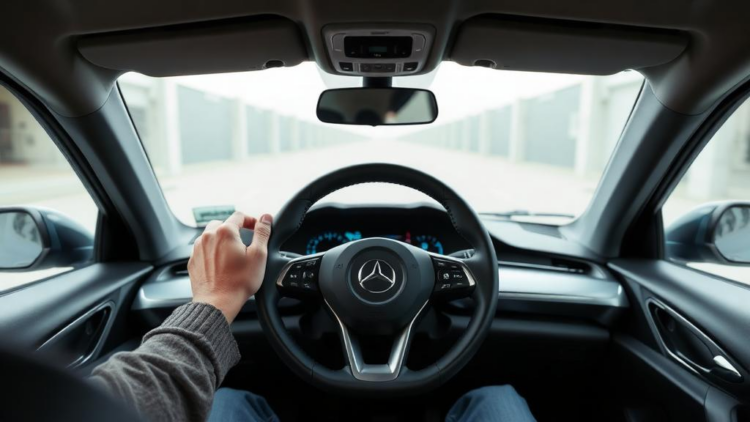
For years, the relationship between human drivers and semi-autonomous vehicle systems has been defined by a frustrating one-way conversation. The car beeps, flashes warnings across dashboard screens, and occasionally wrestles the steering wheel out of the driver’s hands when the two disagree about what should happen next. That experience, researchers say, leaves many drivers feeling like they are fighting their own vehicle, and a surprising number simply switch the helpful automation off. A team at the University of Michigan, working with funding from the Toyota Research Institute, believes it has found a better way: a steering wheel that can talk back, listen, and even negotiate.
The new system, described in the journal Human Factors, adds two haptic zones to a steering wheel at the ten o’clock and two o’clock positions. These zones can expand or contract, inflating under the driver’s palms to express the intention of the automated driving system. Crucially, the communication is not just one-directional. Drivers can respond by squeezing the haptic zones, signaling agreement or disagreement with the computer’s proposed maneuver before it happens. According to Hannah Báez, a robotics Ph.D. student and first author of the study, this ability to negotiate before an action is taken allows driver and machine to resolve conflicts in advance rather than clashing over control mid-maneuver.
To test the concept, the research team placed drivers in a driving simulation centered on an upcoming turn. The scenario was deliberately designed to create friction. Sometimes the driver and the automation would agree on which direction to turn; sometimes they would disagree. To raise the stakes further, the simulation could introduce sudden obstacles into the driver’s planned path in either situation. As the driver approached the turn, the semi-autonomous system inflated the left or right haptic portion of the steering wheel to indicate the direction it intended to go. A driver who disagreed could squeeze that portion of the wheel to register the objection and negotiate a new plan. If an obstacle appeared in the driver’s chosen path, the wheel pulsed on the corresponding side to deliver a tactile alert.
The results were striking when compared against two baselines: conditions in which drivers received no information at all, and conditions in which the automation displayed its intentions one-way, without any channel for the driver to respond. With the two-way haptic negotiation interface, driving performance improved measurably. Brent Gillespie, professor of robotics at the University of Michigan and senior author of the study, reported that drivers displayed smoother and more accurate driving paths, fought less with the automation, and used less braking while maneuvering with greater confidence. In other words, when the car and the driver could hash out a shared plan through touch, the resulting driving was simply better.
The benefits extended beyond the trajectory of the vehicle itself. Participants in the negotiation condition reported significantly lower workload, including reduced effort, frustration, and physical demand. This finding matters because mental workload is a well-documented problem in modern driver-assistance systems. When a car communicates through a barrage of auditory beeps and flashing visual alerts while simultaneously tugging at the wheel, the driver is forced to parse multiple competing channels of information under time pressure. A haptic channel embedded directly in the point of contact between driver and vehicle consolidates that communication into a single, intuitive medium, one that requires no glance away from the road and no interpretation of abstract warning symbols.
Perhaps the most consequential result concerned trust, the fragile currency on which the entire enterprise of semi-autonomous driving depends. After the automated system made a mistake, such as missing an obstacle or issuing a false warning, drivers using the negotiation interface recovered their trust in the system much faster than those relying on traditional one-way communication. The researchers attribute this resilience to the structure of the interaction itself. When driver and automation communicate intent, exchange feedback, and adjust to one another, they begin to operate as a team with transparency in decision-making, rather than as two agents taking turns behind the wheel and second-guessing each other in between.
The team is careful to note that the technology is not without risks. Some drivers became overly trusting after experiencing successful negotiations with the system, a phenomenon that raises familiar concerns about automation complacency. If a steering wheel negotiates well a dozen times in a row, a driver may come to assume it will always negotiate well, potentially disengaging their own vigilance at precisely the moments it matters most. The researchers emphasize that further study of trust dynamics is needed before such a system reaches the road, particularly around how drivers calibrate their reliance on the automation over longer exposure and across more varied driving conditions.
The technical elegance of the approach lies in its use of shared haptic channels for what human-factors researchers call shared planning and control. Conventional driver-assist systems tend to intervene silently, correcting steering without warning and leaving the driver to discover the machine’s decision through the physical sensation of resistance. That sensation of fighting for control, combined with overwhelming visual and auditory warnings, is precisely what drives some users to disable semi-autonomous features altogether. By contrast, the haptic negotiation interface makes the automation’s intentions legible before they become actions, and gives the driver a low-effort, high-bandwidth means of dissent. The wheel becomes a medium of dialogue rather than a battleground.
The implications reach well beyond the laboratory simulation. As automakers race to deploy increasingly capable driver-assistance features, the question of how humans and machines share authority has become one of the central challenges of the field. Regulatory frameworks and safety standards increasingly recognize that the interface between driver and automation is as important as the underlying algorithms. A steering wheel that can express intent, receive feedback, and support genuine negotiation offers a template for that interface, one grounded in the oldest and most trusted sensory channel a driver has: the sense of touch. The technology is covered by U.S. patent US12227190B2, applied for with the assistance of U-M Innovation Partnerships, and the team is actively seeking partners to bring it to market.
The study, titled Haptic shared planning and control: enabling coordination of future actions in human-autonomous vehicle teams through a haptic negotiation interface, was authored by Hannah Báez along with Haochi Pan, Nadine Sarter, and Brent Gillespie of the University of Michigan, and Jean Costa and John Gideon of the Toyota Research Institute. While one-way information remains the current norm for communication between autonomous vehicles and their human occupants, this research demonstrates the tangible benefits of a fuller two-way dialogue, one in which driver and automation exchange intent, agreement, and action. If the steering wheel of the future can negotiate, the drivers of the future may finally stop fighting their cars and start working with them, arriving safer, calmer, and considerably more willing to let the automation help.
Subject of Research: Haptic negotiation interfaces for communication between drivers and semi-autonomous vehicle systems
Article Title: Steering wheel communicates for better semi-autonomous driving performance
Article References: Steering wheel communicates for better semi-autonomous driving performance. (n.d.). Original publication
Image Credits: AI Generated
DOI: Not provided
Keywords: haptic feedback, semi-autonomous driving, human-machine interaction, steering wheel interface, driver trust, automation, University of Michigan, Toyota Research Institute, Human Factors, driver-assistance systems, shared control, automotive robotics
Cite Scienmag News
APA MLA Chicago
Denise Maddox. (October 4, 2026). Haptic steering wheel lets drivers negotiate with autonomous systems. Scienmag. https://scienmag.com/haptic-steering-wheel-lets-drivers-negotiate-with-autonomous-systems/
Denise Maddox. “Haptic steering wheel lets drivers negotiate with autonomous systems.” Scienmag, 4 October 2026, https://scienmag.com/haptic-steering-wheel-lets-drivers-negotiate-with-autonomous-systems/. Accessed 4 October 2026.
Denise Maddox. “Haptic steering wheel lets drivers negotiate with autonomous systems.” Scienmag. October 4, 2026. https://scienmag.com/haptic-steering-wheel-lets-drivers-negotiate-with-autonomous-systems/
Copy citation Download RIS
Tags: adaptive haptic zones in vehicle controlsadvanced steering wheel designs for autonomous carsautomationautomotive roboticsdriver trustdriver-assistance systemsdriver-vehicle interaction in semi-autonomous carshaptic feedbackhaptic feedback technology in steering wheelsHaptic steering wheel for autonomous vehicle communicationHuman Factorshuman factors in driver-assistance systemshuman-machine interactionimproving driver trust in autonomous vehiclesnegotiation interface between drivers and automated driving systemsreal-time driver input in automated drivingsemi-autonomous drivingshared controlsteering wheel interfaceToyota Research InstituteToyota-funded automotive innovationtwo-way communication in autonomous drivingUniversity of MichiganUniversity of Michigan vehicle research