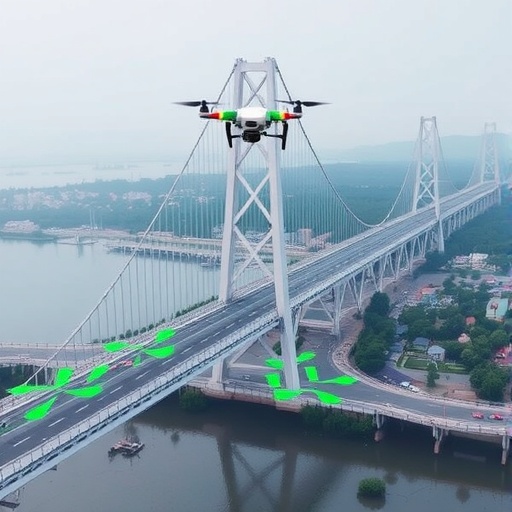
A new study is turning ordinary drone flights into a high-tech early-warning system for aging bridges, combining aerial imagery with artificial intelligence to identify defects and estimate the condition of structures that are often difficult, dangerous, and expensive to inspect by hand. Published in Communications Engineering, the research by N.T. Tsegaye, Q. Cui, and Y. Zhang presents an AI-powered approach for detecting bridge damage from visual data collected by drones. The work arrives as transportation agencies around the world face a growing challenge: thousands of bridges are aging at the same time that inspection budgets, skilled personnel, and access to hard-to-reach structural components remain limited.
Bridge inspections have traditionally depended on teams of engineers who examine concrete, steel, joints, decks, supports, and other components from the ground, using ladders, elevated platforms, traffic closures, or specialized vehicles. These inspections remain essential, particularly when subtle damage must be confirmed by experts, but they can be slow and disruptive. Inspectors may also struggle to obtain a complete view of surfaces located above traffic, over water, or beneath a bridge deck. A drone can approach these areas without placing workers directly in harm’s way, capturing hundreds or thousands of overlapping photographs in a single flight. The central idea of the new research is to transform that visual flood into useful engineering information through machine learning.
At the heart of the system is computer vision, a branch of artificial intelligence designed to interpret images. Instead of treating drone photographs as simple pictures, an AI model can analyze patterns of color, texture, shape, and geometry that may indicate deterioration. Cracks can appear as narrow, irregular lines across concrete. Spalling may create areas where the surface has broken away, exposing coarse aggregate or reinforcement. Rust stains, corrosion, water leakage, delamination, missing components, and damaged expansion joints can each produce distinctive visual signals. The challenge is that these signals are often faint, partially hidden, distorted by shadows, or confused with harmless features such as construction marks, dirt, seams, and changes in lighting.
To address that challenge, an AI-based inspection workflow generally begins by preparing and organizing drone-collected images. Photographs must be linked to specific locations on the bridge and assessed for quality before an algorithm can interpret them. Images may vary in brightness, scale, viewing angle, focus, and distance from the structure. A successful model therefore needs to recognize the same type of defect under changing conditions rather than memorizing a single visual appearance. In technical terms, the process can involve image enhancement, feature extraction, object detection, and semantic or instance segmentation. Detection identifies where a suspected defect is located, while segmentation traces its boundaries, making it possible to estimate dimensions such as length, width, or affected surface area.
That distinction matters because bridge management is not based solely on whether a defect exists. Engineers also need to understand its extent, location, severity, and possible consequences. A short surface crack in one area may require monitoring, while a pattern of extensive cracking, corrosion, or concrete loss near a critical structural component could demand urgent intervention. By mapping defects across a bridge, an AI system can help organize inspection findings into a broader condition assessment. Rather than producing a photograph marked with an alarming red box, the technology aims to create a structured picture of where damage is concentrated and which elements may deserve closer examination.
The research is especially significant because visual data from drones can provide a bridge-wide perspective that is difficult to achieve through isolated manual observations. A drone can follow repeatable flight paths, record images from multiple angles, and revisit the same structure over time. When new imagery is compared with older surveys, changes in crack patterns, corrosion, surface loss, or other visible features may become easier to track. This opens the door to more frequent monitoring and to maintenance strategies based on observed deterioration rather than fixed schedules alone. In principle, infrastructure owners could use such information to identify emerging problems before they develop into expensive repairs or safety emergencies.
The approach also highlights the difference between automation and replacement. AI can rapidly screen large image collections, flag suspicious regions, and prioritize areas for review, but it does not eliminate the need for structural engineers. A visual model may detect the appearance of a crack without knowing whether it extends deep into a load-bearing element. It may recognize corrosion staining without being able to determine the remaining strength of embedded steel. Engineering judgment, targeted physical testing, and knowledge of design history and environmental exposure remain essential for interpreting what an image means. The most valuable role for AI is therefore as a force multiplier: it can help experts focus their time on the locations most likely to require detailed assessment.
Reliability is one of the hardest technical problems in automated bridge inspection. Algorithms trained on limited or highly uniform image collections can perform well in controlled tests but struggle when confronted with unfamiliar bridges, unusual materials, poor weather, low light, water reflections, or heavy dirt and vegetation. A crack that is obvious in a close-up photograph may disappear in a wide aerial image. Conversely, shadows and stains can resemble structural damage. For that reason, trustworthy deployment requires carefully labeled training data, independent testing, transparent performance measures, and human verification. It also requires attention to false negatives, because a missed defect may be more consequential than an unnecessary alert.
The drone itself introduces another layer of engineering complexity. Flight planning must account for wind, battery life, obstacles, electromagnetic interference, regulations, and the need to maintain safe distances from people, vehicles, and the bridge. Image overlap and camera angle influence whether the collected data can be assembled into a consistent three-dimensional representation. Photogrammetric techniques can use common points across multiple images to reconstruct surfaces and estimate geometry, although the accuracy of such reconstructions depends on image quality and the bridge environment. When combined with AI-based defect mapping, these methods could allow inspection teams to view damage in relation to the structure’s actual geometry rather than as disconnected photographs.
The broader implications extend beyond bridges. Roads, tunnels, dams, towers, rail infrastructure, and industrial facilities all present inspection challenges that could benefit from autonomous or semi-autonomous visual surveys. As infrastructure ages and extreme weather places additional stress on built environments, rapid assessment after floods, storms, earthquakes, or collisions may become increasingly important. A drone can quickly collect evidence from areas that are unsafe for people, while an AI system can help sort the results when thousands of images arrive at once. The study by Tsegaye, Cui, and Zhang captures a moment when robotics, machine learning, and civil engineering are converging around a practical question with enormous public consequences: how can societies see structural deterioration early enough to act?
The promise of AI-powered bridge inspection is not that machines will make every engineering decision, but that they may make vital information arrive sooner, cover more of a structure, and become easier to compare over time. If validated across diverse bridge types and operating conditions, systems based on drone-collected visual data could help shift infrastructure management from occasional, labor-intensive checks toward continuous, data-informed surveillance. The result could be a safer and more efficient way to protect some of the most heavily used structures in modern life—by giving engineers a clearer view of what is happening above the traffic, beneath the deck, and inside the images that drones capture from the sky.
Subject of Research: AI-powered bridge defect detection and condition assessment using drone-collected visual data
Article Title: AI-powered bridge defect detection and condition assessment using drone-collected visual data
Article References: Tsegaye, N.T., Cui, Q. & Zhang, Y. “AI-powered bridge defect detection and condition assessment using drone-collected visual data.” Communications Engineering (2026). https://doi.org/10.1038/s44172-026-00749-7
Image Credits: AI Generated
DOI: 10.1038/s44172-026-00749-7
Keywords: Artificial intelligence, bridge inspection, defect detection, condition assessment, drones, computer vision, infrastructure monitoring, machine learning, structural health monitoring
Tags: advanced drone inspection methodsaerial imagery for infrastructure healthAI-enhanced bridge safety inspectionsAI-powered structural assessmentautomated damage identification in bridgesBridge defect detection using drone imagerychallenges in traditional bridge inspectionscost-effective bridge maintenance solutionsdrone-based structural condition monitoringhigh-resolution drone surveys for aging infrastructureremote bridge inspection technologyvisual data analysis for bridge integrity