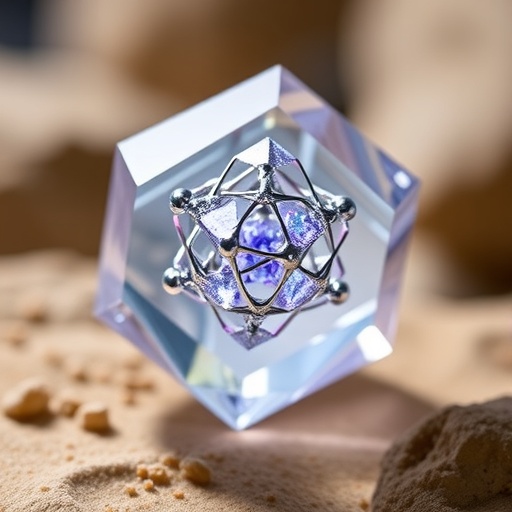
Scientists have observed a form of organization in matter that looks less like a conventional crystal and more like an intricate woven textile. In a study published in Light: Science & Applications, an international research team reports the first observation of a three-dimensional woven structure forming spontaneously inside a ferroelectric crystal. The discovery reveals that electric dipoles—the tiny regions of positive and negative charge responsible for ferroelectric behavior—can arrange themselves into an interlaced network in which some strands pass over and under others.
The structure emerged in a specially engineered potassium-tantalate-niobate crystal containing lithium, known as KTN:Li or KLTN. Ferroelectric materials are usually described in terms of domains: regions in which electric dipoles point predominantly in the same direction. These domains can switch orientation in response to electric fields, making ferroelectrics useful in sensors, memory devices, optical modulators and other technologies. The new observations suggest that, under particular conditions, the dipoles do not simply form parallel regions or conventional domain walls. Instead, they can create a complex, interconnected fabric throughout the crystal.
The woven arrangement develops as the material cools through a phase transition. At higher temperatures, the crystal exists in a more symmetric state, but cooling changes the balance of its internal forces and allows local electric polarization to emerge. This process is an example of spontaneous symmetry breaking, in which a system adopts one of many possible organized states even though the underlying physical laws remain symmetric. In the KTN:Li crystal, the result is not a simple pattern of uniformly aligned polarization. The dipoles organize into nanoscale ensembles that twist and interlace in three dimensions, producing a topology that resembles threads woven into fabric.
The researchers say the effect is linked to the crystal’s unusual internal structure. During growth, the material was prepared with periodic variations in chemical composition, creating fine striation gratings inside the crystal. These variations influence the local electrical and optical properties of the material and appear to provide the conditions needed for the woven domain fabric to form. The crystals were originally developed by Aharon J. Agranat of the Hebrew University of Jerusalem for electroholographic photonic switching, a technology in which light patterns are used to control optical signals. Their unexpected behavior now offers a platform for exploring a new state of organization in solid matter.
Capturing the phenomenon required the combined efforts of three research groups using advanced imaging methods. The project brought together teams led by Eugenio Del Re of Sapienza University of Rome, Feifei Xin of Nankai University and Agranat of the Hebrew University of Jerusalem, with contributions from researchers at the University of Groningen. Phase-contrast microscopy revealed the fabric-like arrangement, allowing the scientists to visualize the domain structure inside the crystal rather than merely infer it from surface effects. The observations indicated that the pattern was genuinely three-dimensional, with the polarized regions crossing and interlocking through the volume of the material.
The most striking aspect of the discovery is that the structure is not permanently fixed. The scientists found that a tightly focused green laser could locally alter the woven network. When the beam was directed at a small region, it could untangle or disrupt part of the pattern while leaving the surrounding structure largely undisturbed. This localized optical control is possible because the crystal interacts strongly with light: the focused beam changes the material’s local electrical and thermal conditions, modifying the stability of the dipole arrangement. The ability to rewrite a small portion of the fabric without erasing the entire pattern could be important for future optical information technologies.
The network can also regenerate. When the crystal is heated and then cooled again, the woven structure returns, but not necessarily in its original configuration. This behavior shows that the pattern is a self-organized state rather than a permanent defect embedded during crystal growth. Each cooling cycle allows the system to select a new arrangement from many possible configurations. In physical terms, the material appears to retain the conditions that favor the woven topology while remaining free to reorganize its individual domains.
The finding may have implications well beyond ferroelectric crystals. Interlaced or knotted structures are examples of topological organization, in which the essential properties of a pattern depend on how its elements are connected rather than only on their precise positions. Similar ideas have become important in the study of magnetic skyrmions, quantum materials, superconductors and liquid crystals. If the mechanism identified in KTN:Li reflects a broader principle, comparable woven or linked structures could be found in other systems undergoing symmetry-breaking transitions. Some may already exist but have gone unnoticed because conventional imaging methods tend to reduce three-dimensional patterns to two-dimensional projections.
For now, the discovery presents both a fundamental scientific question and a technological opportunity. The question is how competing interactions between polarization, composition, temperature and light produce such an elaborate structure from an initially more symmetric state. The opportunity lies in the material’s responsiveness: a laser can modify the network locally, while thermal cycling can restore its self-organized character. A crystal that naturally creates and repeatedly rewrites a three-dimensional domain fabric could eventually inspire new approaches to photonic switching, reconfigurable optical devices and information storage. More broadly, the work is a reminder that matter can generate forms of order far more intricate than the simple aligned domains traditionally used to describe crystals.
Subject of Research: Not applicable
Article Title: Spontaneous formation and optical manipulation of a woven domain fabric in a ferroelectric crystal
News Publication Date: 14-Jul-2026
Web References: https://doi.org/10.1038/s41377-026-02374-7
References: Light: Science & Applications, DOI: 10.1038/s41377-026-02374-7
Image Credits: J. Gelkop
Keywords
Ferroelectric crystals, woven domain fabric, dipoles, symmetry breaking, KTN:Li, KLTN, materials science, condensed matter physics, optical manipulation, photonics, nanotechnology, crystallography, laser control, topological structures
Tags: advanced ferroelectric materials with intricate internal structurescomplex interconnected dipole networks in crystalsdiscovery of natural woven microstructures in crystalline solidselectric dipole arrangements in ferroelectricsferroelectric crystal woven structureimplications of woven dipole structures for memory and sensor technologiesnovel woven textile-like structures inside ferroelectric crystalsphase transition-induced woven patterns in potassium-tantalate-niobatespontaneous formation of woven structures in crystalsthree-dimensional woven organization in ferroelectric materials