• HOME
  • NEWS
  • EXPLORE
    • CAREER
      • Companies
      • Jobs
    • EVENTS
    • iGEM
      • News
      • Team
    • PHOTOS
    • VIDEO
    • WIKI
  • BLOG
  • COMMUNITY
    • FACEBOOK
    • INSTAGRAM
    • TWITTER
Wednesday, July 29, 2026
BIOENGINEER.ORG
No Result
View All Result
  • Login
  • HOME
  • NEWS
  • EXPLORE
    • CAREER
      • Companies
      • Jobs
        • Lecturer
        • PhD Studentship
        • Postdoc
        • Research Assistant
    • EVENTS
    • iGEM
      • News
      • Team
    • PHOTOS
    • VIDEO
    • WIKI
  • BLOG
  • COMMUNITY
    • FACEBOOK
    • INSTAGRAM
    • TWITTER
  • HOME
  • NEWS
  • EXPLORE
    • CAREER
      • Companies
      • Jobs
        • Lecturer
        • PhD Studentship
        • Postdoc
        • Research Assistant
    • EVENTS
    • iGEM
      • News
      • Team
    • PHOTOS
    • VIDEO
    • WIKI
  • BLOG
  • COMMUNITY
    • FACEBOOK
    • INSTAGRAM
    • TWITTER
No Result
View All Result
Bioengineer.org
No Result
View All Result
Home NEWS Science News Technology

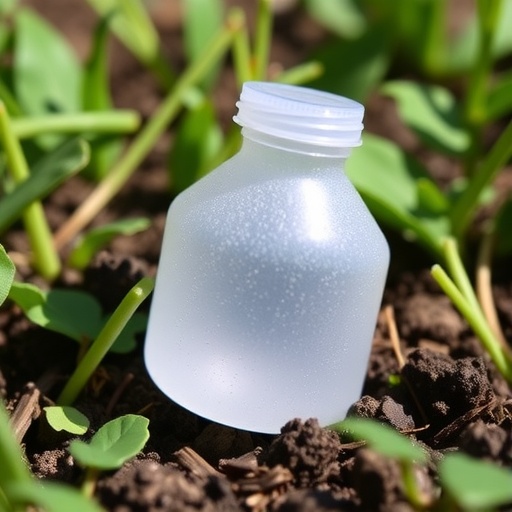
Trace Additive Could Help Compostable PLA Plastics Degrade in Backyards

Bioengineer by Bioengineer
July 29, 2026
in Technology
Reading Time: 2 mins read
0
Share on FacebookShare on TwitterShare on LinkedinShare on RedditShare on Telegram

MINNEAPOLIS / ST. PAUL (07/29/2026) — A team at the University of Minnesota Twin Cities reports a chemical tweak that could make polylactide (PLA), a widely used “compostable” plastic, break down far faster in ordinary composting conditions. The advance targets a practical bottleneck: even when products are labeled compostable, most households lack access to industrial composting facilities where PLA degrades reliably.

PLA is popular because it is derived from renewable resources and is intended to degrade after disposal. Yet the reality is sobering. In the United States, only a minority of people can reach the controlled heat, moisture, and time profiles used in industrial composting, so PLA frequently ends up in landfills instead.

The researchers’ strategy adds a trace amount of 2-sulfobenzoic acid cyclic anhydride (SAn) into PLA. Under prolonged exposure to moisture and elevated temperatures, SAn transforms and releases acidic compounds. These acids promote hydrolytic attack inside the polymer network, disrupting the molecular bonds that hold PLA together.

Crucially, the additive is described as a “masked acid.” It stays relatively inactive during normal use, then becomes chemically engaged only when the combined environmental triggers of water, composting temperature, and time are present. This design aims to preserve the mechanical strength and durability of the plastic during everyday handling.

According to the study, only about 0.01% of the additive is sufficient to drive a dramatic acceleration in PLA hydrolysis. With that low loading, the material maintains its functional properties while still becoming substantially more susceptible to breakdown under compost-like conditions.

The work also suggests a pathway to milder degradation requirements, potentially reducing dependence on the hotter industrial settings traditionally used to process PLA. If scalable, this could shift compostable packaging from “special facility dependent” to “household feasible.”

Beyond performance, the team is proceeding with rigorous ecotoxicity evaluations. Their goal is to confirm that the resulting breakdown products and regenerated soil chemistry do not introduce harmful effects to ecosystems.

The findings appear in ACS Central Science, in the peer-reviewed article titled “Dramatic Enhancement in Polylactide Hydrolysis and Biodegradability Utilizing Low Levels of Organic Anhydrides As Masked Acids.” The authors expect follow-up studies testing the approach across a broader set of commercial plastics.

Image Credits: Credit: Daun Jeong, University of Minnesota Twin Cities

Keywords

Biodegradable plastics, Plastics, Synthetic polymers

Share12Tweet7Share2ShareShareShare1

Related Posts

Gene base editing reverses Huntington’s disease in mice

Gene base editing reverses Huntington’s disease in mice

July 29, 2026
Optical methods tackle complex optimization problems faster and more efficiently

Optical methods tackle complex optimization problems faster and more efficiently

July 29, 2026

KAIST AI Uncovers Its Hidden Weaknesses, Making Generative Models Safer

July 29, 2026

Tire Microplastics Could Speed Up Antibiotic Resistance Spread in Cities

July 29, 2026

POPULAR NEWS

  • Bioengineered Approaches to Probe and Modulate the Aging Immune System

    29 shares
    Share 12 Tweet 7
  • Pusan National and Chung-Ang Develop Next-Gen Self-Renewing Air Filter Coating

    29 shares
    Share 12 Tweet 7
  • CHEST Critical Care Achieves First Ever Impact Factor

    29 shares
    Share 12 Tweet 7
  • New Strategy Enables Oxidation-Free, Efficient Oligonucleotide Synthesis

    29 shares
    Share 12 Tweet 7

About

We bring you the latest biotechnology news from best research centers and universities around the world. Check our website.

Follow us

Recent News

Bioengineered Approaches to Probe and Modulate the Aging Immune System

Pusan National and Chung-Ang Develop Next-Gen Self-Renewing Air Filter Coating

CHEST Critical Care Achieves First Ever Impact Factor

Subscribe to Blog via Email

Enter your email address to subscribe to this blog and receive notifications of new posts by email.

Join 85 other subscribers
  • Contact Us

Bioengineer.org © Copyright 2023 All Rights Reserved.

Welcome Back!

Login to your account below

Forgotten Password?

Retrieve your password

Please enter your username or email address to reset your password.

Log In
No Result
View All Result
  • Homepages
    • Home Page 1
    • Home Page 2
  • News
  • National
  • Business
  • Health
  • Lifestyle
  • Science

Bioengineer.org © Copyright 2023 All Rights Reserved.