Under prolonged stretch, epithelial tissues can’t simply “hold on”—they remodel. A new Nature Physics study from IBEC reveals how cells respond to mechanical stress lasting hours or days by reorganizing their keratin cytoskeleton into large multicellular networks, ultimately changing the physical relationship between the cytoskeleton and the nucleus.
Keratin filaments are a key load-bearing component of the cytoskeleton, known for buffering cells against deformation. Yet the time-dependent pathway of how keratin adapts to sustained stretching—and how this influences intracellular mechanics—has remained unclear.
To address this, the researchers combined engineered epithelial tissue models with a custom microfluidic stretching system and advanced live imaging. They tracked, in real time, how keratin architecture evolves under constant tension, then linked these observations to multiscale computational simulations.
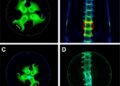
The striking result is that keratin does not reorganize instantaneously. Over several hours, individual filaments progressively gather into thick, star-shaped bundles. These bundles spread beyond single cells, connecting neighboring cells through supracellular networks that span substantial regions of the tissue.
Computational modeling provided the missing causal bridge: the same processes that build keratin bundles also generate internal mechanical forces capable of displacing the nucleus from its surrounding keratin “cage.” As bundles thicken and the local cytoskeletal geometry changes, nucleus-keratin coupling weakens.
Live imaging confirmed the prediction. With bundle growth, the nucleus gradually detaches from the keratin mesh until separation is complete, leaving the nucleus connected only to a residual filament fraction. The study describes this as “nuclear uncaging,” a mechanobiological event tightly coupled to cytoskeletal bundling.
An additional layer of regulation emerges through actin. When molecular linkages between actin and keratin are weakened, bundling accelerates nearly threefold, indicating that cross-talk between filament systems controls the pace and structure of tissue adaptation.
The authors propose a mechanistic trade-off for the nucleus. Detaching from a stressed keratin network could expose the nucleus to new forces, or alternatively protect it by preventing direct force transmission. Determining which outcome dominates will require experiments probing nuclear mechanics under sustained stress.
Because similar stretching conditions occur during embryonic development and in organs that repeatedly expand and contract, the findings may inform how tissue mechanics are preserved over time. They could also help clarify disease pathways in which keratin organization is defective.
Subject of Research: Tissue mechanobiology; keratin cytoskeleton remodeling; nuclear uncaging under sustained mechanical stress.
Article Title: Under pressure: when tension builds up, the nucleus escapes
News Publication Date: 27-Jul-2026
Web References: https://doi.org/10.1038/s41567-026-03371-8
References: Nature Physics (DOI: 10.1038/s41567-026-03371-8)
Image Credits: Queen Mary University of London
Keywords: keratin, epithelial tissues, cytoskeleton, mechanobiology, nuclear uncaging, actin-keratin coupling, live imaging, microfluidic stretching, computational modeling, Nature Physics
Tags: cell nucleus-cytoskeleton interactionscomputational modeling of cell mechanicsepithelial tissue response to mechanical stressintracellular force transmissionkeratin cytoskeleton remodelinglive cell imaging of cytoskeletonlong-term cytoskeletal reorganizationmicrofluidic stretching systemsmulticellular keratin networksnuclear displacement under stressNuclear mechanicsstress-induced cellular architecture changes