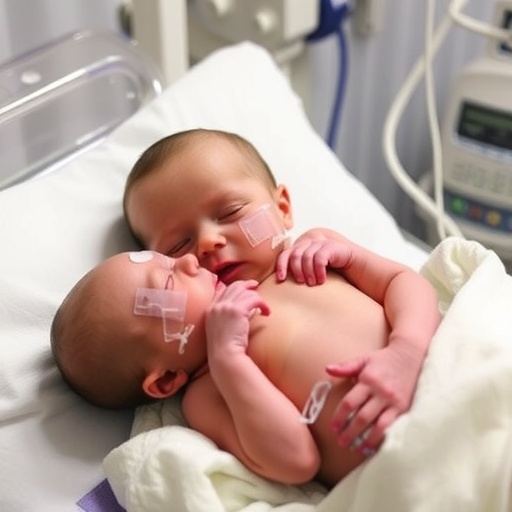
A new randomized controlled trial is challenging a quiet assumption in neonatal care: that “more humidification” automatically means “better humidification” during non-invasive ventilation. Researchers focused on late preterm and term newborns who require respiratory support without an endotracheal tube—an approach widely used to reduce the risks associated with invasive procedures.
Non-invasive ventilation delivers airflow through masks or nasal interfaces, but dry or insufficiently conditioned gas can worsen airway dehydration. That, in turn, may increase mucus viscosity, contribute to mucosal injury, and potentially impair effective breathing. Humidification is therefore considered essential, yet the precise temperature settings that best balance safety and physiologic performance have remained uncertain.
In the study, infants receiving non-invasive ventilation were assigned to receive gas humidified at a lower temperature, testing whether this adjustment could maintain adequate airway conditioning while avoiding drawbacks linked to overly warm systems. The trial’s design sought to establish not just feasibility, but clinically relevant outcomes tied to respiratory stability and tolerability.
Researchers monitored respiratory parameters and the course of support, comparing how infants responded under differing humidification conditions. The key question was whether lowering humidification temperature would compromise airway comfort and gas exchange—or whether it could still support effective ventilation while minimizing potential harms from excess heat.
The findings indicate that humidification temperature can meaningfully affect how safely and comfortably infants tolerate non-invasive respiratory support. By systematically comparing temperature strategies rather than relying on generalized equipment defaults, the trial helps narrow a practical gap between device engineering and bedside physiology.
Beyond immediate clinical implications, the work raises broader mechanistic questions. Heat and moisture interact with airway epithelial function, mucus behavior, and the propensity for inflammatory stress. Even modest changes in conditioning may shift the balance between maintaining hydration and preventing temperature-driven stress in delicate neonatal airways.
If validated by further studies and incorporated into neonatal ventilator protocols, the results could influence how hospitals calibrate humidifiers, especially where equipment capabilities differ across regions. For clinicians, the message is clear: humidification is not a one-size-fits-all setting, and temperature may be a controllable variable in outcomes.
The trial also underscores a recurring theme in neonatal science: optimizing supportive technologies requires rigorous comparison under real clinical conditions. As non-invasive ventilation expands, fine-tuning parameters such as humidification temperature may become an evidence-driven standard rather than an institutional habit.
Taken together, the study turns a technical detail into a measurable intervention. The next step is replication across larger cohorts and diverse ventilation platforms, to ensure that “low-temperature humidification” consistently delivers benefit or at least preserves safety for this vulnerable population.
Subject of Research: Non-invasive ventilation humidification settings in late preterm and term neonates.
Article Title: Low humidification temperature during non-invasive ventilation in late preterm and term neonates: a randomized controlled trial.
Article References: Madaan, A., Murki, S., Subramanian, S. et al. Low humidification temperature during non-invasive ventilation in late preterm and term neonates: a randomized controlled trial. J Perinatol (2026). https://doi.org/10.1038/s41372-026-02840-5
Image Credits: AI Generated
DOI: 10.1038/s41372-026-02840-5
Keywords:
Tags: airway dehydration prevention in neonatesbalancing humidification efficacy and safetyeffects of humidification temperature on mucus viscosityhumidification temperature in preterm and term infantsnasal interface ventilation safetyneonatal mucosal injury preventionNeonatal non-invasive ventilationnon-invasive ventilation gas conditioningoptimal humidification settings for neonatesrandomized controlled trial in neonatal respiratory carerespiratory stability in newbornsrespiratory support in newborns